With an average elevation of 5,312 feet and a semi-arid climate that cycles between dry crusts and monsoon events, Albuquerque sits on a deep alluvial basin. The Rio Grande has been depositing loose, clean sands and silty sands here for millennia. When we design a vibrocompaction treatment in this valley, we are not dealing with a theoretical soil profile. The challenge is real: layers that reach 30 to 60 feet of loose sand with relative densities as low as 30 percent. A proper vibrocompaction design targets a post-treatment relative density of 70 to 85 percent to meet IBC seismic site class C or D requirements. Before deploying the vibratory probe, we always run a site-specific granulometry curve to confirm the fines content stays below 15 percent, otherwise the method loses efficiency.
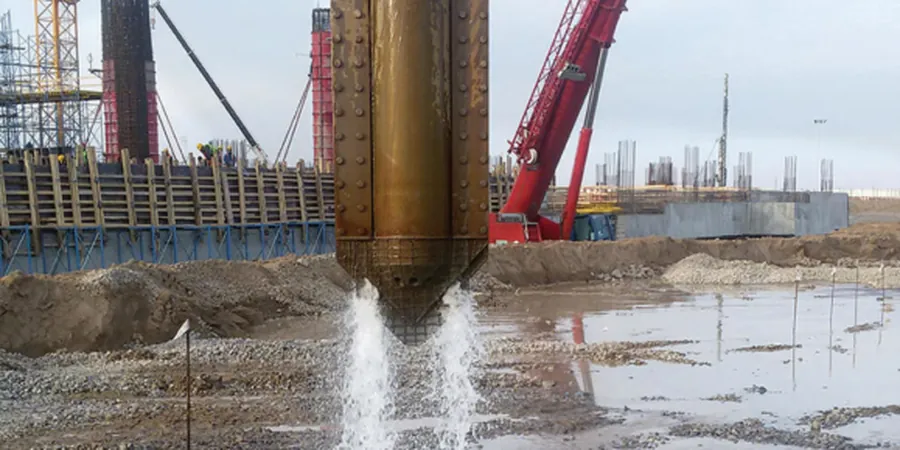
A vibrocompaction design without site-specific gradation curves is just guesswork. Fines content above 15 percent changes everything.
Scope of work
- Field CPT or SPT soundings before treatment every 25 to 30 meters
- Relative density target based on liquefaction potential (Youd-Idriss 2001 criteria)
- Spacing grid calculation: typically 2.5 to 3.5 meters depending on soil gradation
- Post-treatment verification with SPT or CPT at intermediate points
Area-specific notes
Albuquerque sits within the Rio Grande Rift, a seismically active extensional zone. The loose alluvial sands that underlie much of the city are prone to liquefaction under the design earthquake (M 6.5 to 6.8 on the Sandia fault). More than 60 percent of the urban area falls into NEHRP site class D or even E, where vs30/" data-interlink="1">shear wave velocities are below 360 m/s. If a foundation is built on untreated loose sand and a moderate earthquake hits, the consequences are not hypothetical. Differential settlements of 15 to 30 centimeters have been documented in similar basins during events like the 2011 Christchurch sequence. A properly designed vibrocompaction treatment reduces that risk by increasing lateral confinement and shear modulus.
Standards used
IBC 2021 – Chapter 18: Soil Investigation and Foundation Design, ASCE 7-22 – Seismic Site Classification and Liquefaction Hazard, ASTM D1586-18 – Standard Test Method for SPT, Youd & Idriss (2001) – Liquefaction Resistance Criteria
Linked services
Full-Scale Vibrocompaction Design Package
Includes pre-treatment field investigation (CPT or SPT), gradation analysis, grid layout optimization, liquefaction assessment per IBC criteria, and post-treatment verification report. Suitable for projects over 2,000 m² with moderate to high seismic risk.
Vibrocompaction Feasibility Study
A preliminary desktop evaluation using existing soil borings, USGS seismic hazard data, and local geotechnical records. We deliver a recommendation letter with expected densification range, cost estimate, and a go/no-go decision for the method. Ideal for early-stage due diligence.
Typical parameters
Common questions
What is the difference between vibrocompaction and dynamic compaction?
Vibrocompaction uses a deep vibratory probe that penetrates the soil and densifies it by rearranging sand particles through vibration and water jetting. Dynamic compaction relies on dropping a heavy weight from a crane to create impact waves. Vibrocompaction is better for deep loose sand layers (8 to 18 m) in saturated conditions, while dynamic compaction works on shallower profiles.
How much does a vibrocompaction design study cost in Albuquerque?
The cost for a complete vibrocompaction design including field testing and verification typically ranges between US$1,660 and US$4,920, depending on the site area, number of soundings, and depth of treatment required. This does not include the contractor's execution cost.
Can vibrocompaction work on the silty sands found near the Rio Grande?
It depends on the fines content. If the soil has less than 15% passing the No. 200 sieve, vibrocompaction is effective. Above that threshold, the fines absorb vibration energy and prevent particle rearrangement. In those cases, we recommend alternative methods such as stone columns or deep soil mixing.
How long does a vibrocompaction design take from start to finish?
For a standard project, the design phase takes 3 to 4 weeks: one week for field investigation, one week for lab gradation, and one to two weeks for analysis and reporting. If existing soil data is available, the timeline can be reduced to 10 working days.