Many construction crews in Albuquerque assume that the native sandy loam and caliche layers will provide adequate support for road subgrades without treatment. That assumption often leads to differential settlement, longitudinal cracking, and premature pavement failure within the first two years of service. The real problem is that the soil’s engineering behavior changes drastically when moisture hits it — especially in the Rio Grande valley where collapsible soils and expansive clays are common. Without a proper stabilization design that includes laboratory compaction curves and California Bearing Ratio values, you are essentially gambling with the long-term performance of the road. That is why we start every project with a thorough assessment of the subgrade's index properties before recommending any additive or mechanical treatment.
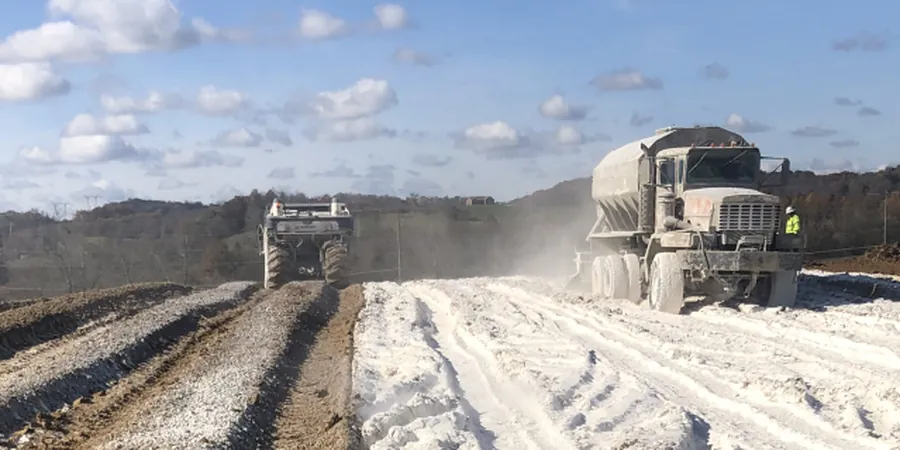
For high-plasticity subgrades in Albuquerque, cement or lime treatment can reduce swell potential by 50–70% when properly designed and cured.
Scope of work
Area-specific notes
A collector road we worked on near Eubank Boulevard had been placed directly on a low-plasticity clay without any stabilization. Within 18 months, longitudinal cracks up to 1 inch wide appeared along the wheel paths, and the pavement surface showed visible rutting during the monsoon season. The root cause was a subgrade that lost 70% of its strength when moisture infiltrated through the unsealed shoulder. We had to saw-cut and remove the failed sections, stabilize the exposed subgrade with 4% lime by dry weight, and re-compact in thin lifts before placing new asphalt. The owner paid nearly triple the original mobilization cost because the failure had already propagated into the base layer.
Watch how it works
Standards used
ASTM D1557 (Modified Proctor), ASTM D1883 (CBR in laboratory), AASHTO M 145 (classification of soils for highway subgrades), ASTM D4318 (Atterberg limits), ASTM D2487 (Unified Soil Classification System)
Linked services
Cement & Lime Stabilization Design
We determine the optimum binder content and water addition through laboratory mix designs, then verify the achieved unconfined compressive strength and durability through wet-dry cycling. Our reports include dosage curves, soaked CBR values, and a recommended curing protocol for the local climate.
Mechanical Stabilization & Subgrade Replacement
When chemical treatment is not feasible due to high sulfate content or environmental constraints, we design a mechanical stabilization solution using select granular borrow, geogrid reinforcement, and controlled compaction in lifts. We also supervise field density tests (ASTM D6938) to confirm lift quality.
Typical parameters
Common questions
What are the most common causes of road subgrade failure in Albuquerque?
The main culprits are expansive clays that swell when wet and collapsible alluvial soils that settle under load after saturation. Both conditions are common in the Rio Grande valley and the East Mesa areas. Without proper stabilization, the subgrade loses bearing capacity and the pavement cracks within one to three years.
How much does professional soil stabilization for roads cost in Albuquerque?
For a typical two-lane road project, laboratory stabilization design and field verification range from US$770 to US$3,060 depending on the number of samples, the binder type (lime vs. cement), and whether full-scale field trials are included. The final price is quoted after we review the project scope and soil conditions.
What tests do you run to determine if my road subgrade needs stabilization?
We start with Atterberg limits, natural moisture content, and grain-size analysis to classify the soil. Then we run a modified Proctor compaction test and a soaked CBR test on both untreated and treated specimens. If the untreated CBR is below 5% or the plasticity index exceeds 12, stabilization is usually required.
Can you stabilize a road subgrade that already shows signs of cracking?
Yes, but the approach is different from new construction. We first evaluate the extent of the damage with trenching and in-situ density tests. If the cracking is superficial, we can mill the pavement, treat the top 12 inches of subgrade with lime or cement, and repave. For deeper failures, partial removal and replacement are necessary.