Our field crew rolls into Albuquerque with a dynamic cone penetrometer mounted on the back of a pickup, ready to assess subgrade conditions along the proposed alignment. Before any asphalt goes down, we dig test pits or perform CPT soundings to map the variable alluvial sands and clays that dominate the Rio Grande valley. That data feeds directly into the flexible pavement design, letting us tailor layer thicknesses to the actual California Bearing Ratio values encountered. For projects near the West Mesa or the volcanic basalt zones east of the city, we supplement with evaluation of pavement sections to identify existing distress patterns. The goal is straightforward: build a pavement that handles Albuquerque's freeze-thaw cycles and heavy truck traffic without premature cracking.
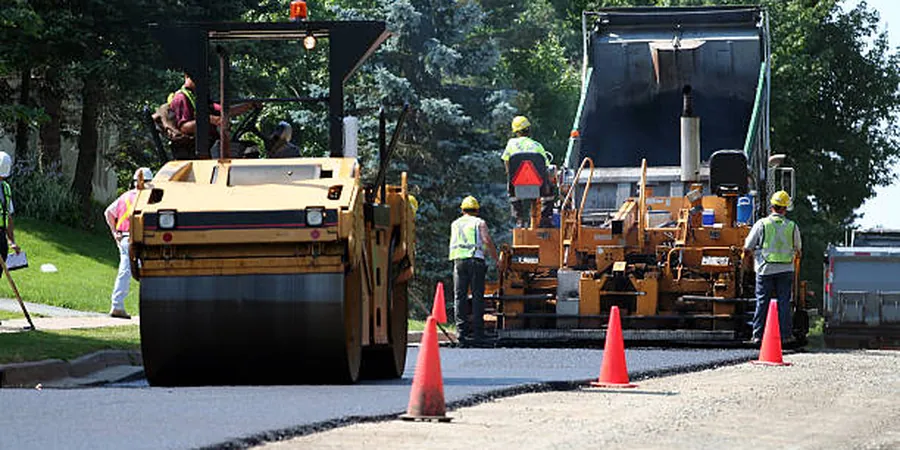
A flexible pavement designed for Albuquerque's arid climate still fails if the subgrade's swell potential isn't treated before the base course goes down.
Scope of work
Area-specific notes
A contractor working on a collector road near the South Valley ignored the high plasticity index of the native clay and placed the base directly on untreated subgrade. Within two winters the pavement developed longitudinal cracking along wheel paths, and water infiltration accelerated subgrade softening. The difference between that failure and a successful design in the Northeast Heights — where sandy soils prevail — comes down to sampling density. In Albuquerque, a single test pit every 500 feet rarely captures the lateral variability; we space boreholes at 300-foot intervals in urban settings to catch those hidden clay lenses before they become lawsuits.
Watch how it works
Standards used
AASHTO Guide for Design of Pavement Structures 1993, ASTM D1883-21 (CBR) / ASTM D1557-12 (Modified Proctor), AASHTO M 332 (Performance-Graded Asphalt Binder), New Mexico DOT Standard Specifications for Highway and Bridge Construction (2022)
Linked services
Subgrade Investigation & CBR Testing
Field and lab determination of California Bearing Ratio on undisturbed and remolded samples, plus Atterberg limits and grain size analysis to classify the soil. We correlate CBR with DCP readings for rapid screening along long corridors.
Structural Pavement Design (AASHTO 1993 / Mechanistic-Empirical)
Layer thickness calculations using traffic projections, climate data from Albuquerque's weather station, and reliability targets. We provide stamped design reports with an explicit construction quality control plan.
Drainage & Stabilization Recommendations
Design of edge drains, subdrains, and lime/cement treatment for swelling or frost-susceptible subgrades. We verify drainage performance with permeability tests and provide gradation specs for the drainage layer.
Typical parameters
Common questions
Why is flexible pavement design different in Albuquerque compared to coastal cities?
Albuquerque's semi-arid climate means low natural moisture below the pavement, but seasonal freeze-thaw cycles still damage untreated subgrades. The high silt content in many native soils also makes them frost-susceptible, so we often specify a granular base thicker than AASHTO minimums to protect the subgrade from ice lens formation.
What CBR value do you typically assume for Albuquerque subgrades?
In the Rio Grande floodplain (South Valley, Barelas) we see CBR values between 3 and 6 for the top 3 feet. On the mesa benches (Northeast Heights, Kirtland area) the sandy soils yield CBRs of 10 to 15. We never assume a single value — every design is based on site-specific boreholes and laboratory CBR tests.
How much does a flexible pavement design study cost in Albuquerque?
A typical study for a half-mile residential street, including 4 test pits, CBR and Proctor testing, and a stamped design report, ranges between US$1.460 and US$5.430 depending on traffic volume and number of pavement sections analyzed. Larger arterial projects with multiple borings fall at the upper end of that range.