Many construction teams in Albuquerque assume the shallow caliche crust is uniform across the valley. That assumption leads to footing designs that ignore interbedded sand lenses and old arroyo channels. An exploratory test pit exposes the actual stratigraphy before a single foundation trench is dug. We excavate pits up to 4 m deep using backhoes, log soil profiles in accordance with ASTM D2488, and collect bulk samples for index testing. The visual classification is paired with granulometría to confirm grain-size distribution when the soil looks transitional. For projects where perched water is suspected, we also run a permeabilidad de campo test directly inside the pit. Albuquerque's semi-arid climate creates desiccated crusts that mask deeper moisture regimes, so opening a pit is the only way to verify real conditions below the surface.
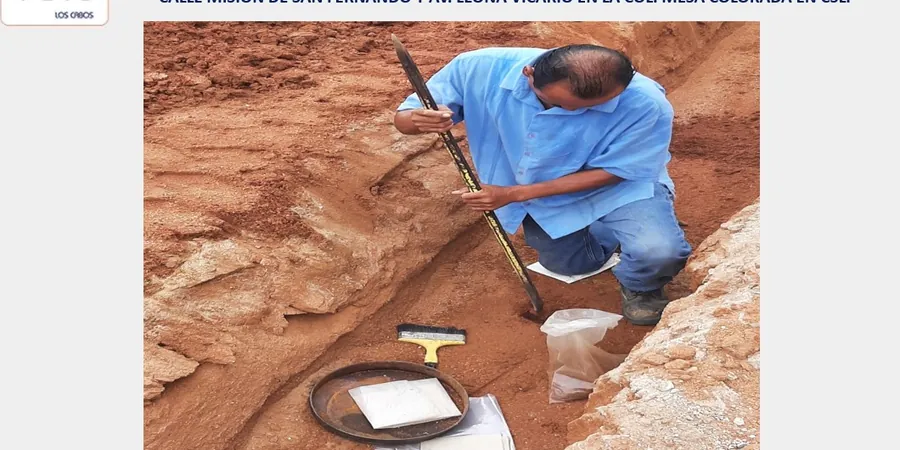
A test pit is the only method that lets you see the soil in place, not just infer it from blow counts or resistivity.
Scope of work
- Layer thickness and lateral continuity recording
- Bulk disturbed sampling for laboratory classification
- In-situ density estimates using a pocket penetrometer
- Field moisture content checks every 0.3 m
Area-specific notes
In Albuquerque, many geotechnical reports rely solely on SPT borings spaced 30 m apart. That spacing misses thin clay seams and old utility trenches that cause differential settlement. A test pit reveals these discontinuities directly. We have seen cases where a 0.15 m clay seam at 2.5 m depth was invisible to the driller but caused a 40 mm settlement crack in a residential slab. Opening a pit also detects undocumented fill from the 1950s construction boom, which is common near downtown. Ignoring that fill is a liability. The risk is not just structural — it is contractual. Without a test pit log, the owner cannot prove the contractor knew the actual soil conditions before pouring foundations.
Standards used
ASTM D2488 – Standard Practice for Description and Identification of Soils (Visual-Manual Procedure), ASTM D420 – Standard Guide for Site Characterization for Engineering Design and Construction Purposes, IBC 2021 Section 1803 – Geotechnical Investigation Requirements, ASCE 7-22 – Minimum Design Loads and Associated Criteria for Buildings (site class definition)
Linked services
Test Pit Excavation & Logging
Backhoe excavation to 4 m depth, full photographic wall record, ASTM D2488 log by a licensed geotechnical engineer. Includes backfill compaction to 95% Proctor density.
Bulk Sampling & Index Testing
Collection of 20–30 kg bag samples per stratum. Laboratory testing for natural moisture content, Atterberg limits, and grain-size distribution per ASTM D4318 and D6913.
In-Situ Permeability Testing
Falling-head or constant-head test conducted inside the open pit. Measures hydraulic conductivity of the native soil, critical for drainage design in Albuquerque's clay-rich layers.
Utility Clearance & Safety Coordination
Pre-excavation utility mark-out (811 service), site-specific safety plan, and confined-space protocol if depth exceeds 1.5 m. All work follows OSHA 1926 Subpart P.
Typical parameters
Common questions
What is the difference between a test pit and a borehole?
A test pit is an open excavation that allows direct visual inspection of soil layers, root zones, and voids. A borehole retrieves a narrow, disturbed sample; the driller cannot see lateral changes. Test pits are ideal for shallow foundations, utility trenches, and detecting undocumented fill. Boreholes are better for deep strata or when groundwater flow must be measured with piezometers.
How deep can a test pit go in Albuquerque?
Most backhoes reach 3.5 to 4.0 m. Deeper pits require shoring or benching per OSHA 1926 Subpart P. In Albuquerque's caliche layers, excavation below 4 m often becomes impractical due to cemented rock. For deeper investigation we recommend switching to a rotary drill with SPT sampling.
How much does an exploratory test pit cost in Albuquerque?
The typical range is US$490 to US$920 per pit, including backhoe time, engineer logging, and backfill compaction. Lab testing for index properties adds US$120–$250 per sample. Volume discounts apply for subdivisions with five or more pits. A formal quote is provided after reviewing site access and utility status.
Do I need a test pit if I already have an SPT boring?
Yes, if the project involves shallow foundations, retaining walls, or slab-on-grade construction. SPT borings give blow counts and disturbed samples, but they cannot show you a thin clay seam, a lens of loose sand, or a buried trash pit. A test pit provides visual confirmation of the conditions directly under the footing. We often recommend one test pit per 10 SPT borings for residential subdivisions.