In Albuquerque, many projects start with a surprise: the soil under that flat lot may be highly expansive clay from the Rio Grande valley or loose sand from the West Mesa. Proper soil classification using USCS and AASHTO systems prevents costly foundation redesigns. The team runs all samples through ASTM D2487 for USCS group symbols and AASHTO M 145 for pavement ratings. Before any earthwork begins, a granulometry test defines the grain-size distribution, while Atterberg limits confirm plasticity. This two-step classification tells engineers whether they face a CH clay, an SP sand, or a silty A-4 soil.
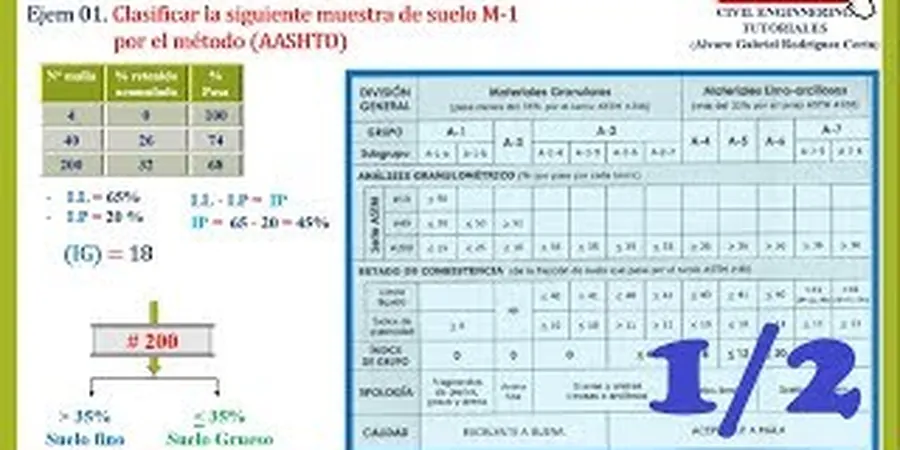
In Albuquerque, caliche-cemented sands often test as SP but behave like a low-plasticity clay under load — only a full USCS classification reveals the true behavior.
Scope of work
- Percent passing No. 200 sieve
- Liquid limit and plasticity index (Casagrande cup)
- Coefficient of uniformity (Cu) and curvature (Cc)
- Group index for AASHTO rating
Area-specific notes
Compare the North Valley and the South Valley: both floodplain areas, but the North Valley has deeper sands over clay, while the South Valley has fat clays (CH) near the surface. Misclassifying that CH clay as a CL clay leads to slab heave and cracked walls. In the West Mesa, loose silty sands (SM) can collapse when wetted during monsoon season. Without proper USCS/AASHTO classification, the contractor may spec the wrong compaction target or drainage layer. The risk is real: a single classification error can double the cost of foundation repairs within two years.
Standards used
ASTM D2487-17 (Standard Practice for Classification of Soils for Engineering Purposes – USCS), AASHTO M 145-91 (Standard Specification for Classification of Soils – AASHTO System), ASTM D2488-17 (Standard Practice for Description and Identification of Soils – Visual-Manual Procedure), ASTM D4318-17 (Standard Test Methods for Liquid Limit, Plastic Limit, and Plasticity Index of Soils)
Linked services
Full USCS Classification (ASTM D2487)
Complete sieve and hydrometer analysis plus Atterberg limits to determine group symbol and group name. Includes visual-manual description and report for foundation design or pavement subgrade rating.
AASHTO Classification for Pavement Design
Gradation and plasticity testing to assign AASHTO group and group index. Directly applicable to AASHTO 1993 pavement design method and New Mexico DOT specifications for road base and subbase.
Typical parameters
Common questions
How is soil classification different in Albuquerque compared to other regions?
The high desert climate produces dry, often cemented soils with caliche layers. USCS groups like SP, SM, CL, and ML dominate, but the caliche can cause a sand to test as SP while behaving like a low-plasticity silt under load. AASHTO ratings here are typically A-4, A-6, or A-2-4, reflecting the mixed sand-silt-clay composition of the Rio Grande valley.
Which ASTM standard is used for USCS classification in your lab?
We follow ASTM D2487-17 for assigning the group symbol and group name, and ASTM D2488-17 for the initial visual-manual identification. Atterberg limits follow ASTM D4318-17, and grain-size distribution follows ASTM D6913 (sieve) and ASTM D7928 (hydrometer).
What is the typical cost range for a soil classification test in Albuquerque?
A standard USCS/AASHTO classification (sieve, hydrometer, Atterberg limits) typically ranges from US$60 to US$100 per sample. The final price depends on the number of samples and whether additional tests like compaction or CBR are bundled. Contact us for a project-specific quote.
How long does a full USCS classification take?
Standard turnaround is 5 to 7 business days from sample receipt. Drying and hydrometer sedimentation require controlled time. Rush service (3 days) is available for an additional fee, provided the sample moisture content allows accelerated drying.