Albuquerque sits in the high desert at 5,312 feet, where annual rainfall barely reaches 9 inches. Yet the subsurface tells a different story. The Rio Grande valley fills with loose sands and soft silts, while the mesa edges harbor expansive clays that swell with every monsoon pulse. For deep soil mixing design in Albuquerque, this contrast demands a tailored approach. Wet mixing methods inject a cementitious binder directly into the ground, creating stiff columns that cut through the variability. Before specifying the mix design, we run a granulometría to map grain-size distribution across the site. That data governs binder dosage and column spacing. The result is a uniform treated mass where nature left heterogeneity.
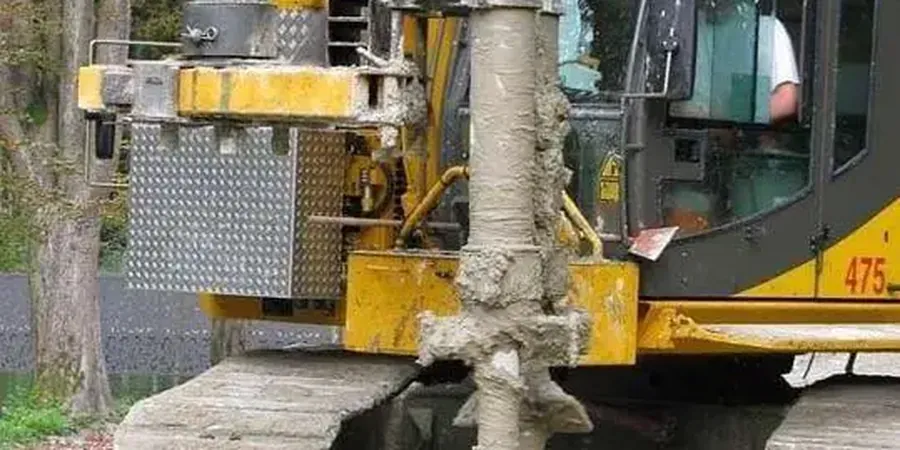
In Albuquerque, deep soil mixing design must bridge the gap between loose valley sands and expansive mesa clays — one binder formula cannot serve both.
Scope of work
Area-specific notes
One oversight we see repeatedly in Albuquerque is ignoring the change in soil moisture after monsoon storms. A deep soil mixing design in Albuquerque that works in May may fail in August if the binder hydration is disturbed by rising groundwater. The risk is incomplete curing — columns that never reach design strength. We mitigate this by installing piezometers before mixing and by adjusting the water-cement ratio on site. Another common pitfall is assuming a single binder recipe across the entire footprint. The Rio Grande silt at depth behaves chemically different from the caliche layers near the surface. Separate mix designs for each stratum are non-negotiable.
Standards used
ASTM D1586-18, ASCE 7-22, IBC 2021, FHWA-HRT-13-046 (Deep Mixing for Embankment and Foundation Support)
Linked services
Laboratory mix design
We formulate binder recipes using site soil samples, testing unconfined compressive strength and permeability at 7, 14, and 28 days.
Field installation supervision
On-site monitoring of auger penetration, binder injection rate, and column verticality to ensure design compliance.
QA/QC coring and testing
Core extraction from cured columns, followed by UCS testing and visual logging to verify homogeneity and strength.
Numerical modeling of DSM ground improvement
Finite element analysis to predict settlement, load transfer, and liquefaction potential in treated ground.
Typical parameters
Common questions
How does deep soil mixing design differ for the Rio Grande valley versus the East Mesa in Albuquerque?
The valley's loose sands require higher binder content to achieve cohesion, while the mesa's expansive clays need lime pre-treatment or low-heat cement to prevent uncontrolled swelling and thermal cracking. Separate mix designs are essential for each geological unit.
What is the typical cost range for deep soil mixing design in Albuquerque?
The cost for deep soil mixing design in Albuquerque typically ranges between US$1,530 and US$6,870, depending on the volume of soil treated, column depth, and binder type. For exact pricing, request a site-specific quote.
Which ASTM standard governs the quality control of DSM columns?
ASTM D1586-18 is the primary standard for penetration testing before and after treatment. For column integrity, we follow FHWA-HRT-13-046 guidelines, which recommend coring and UCS testing at a rate of 1 core per 500 m³ of treated soil.