In Albuquerque, the design of stone columns must follow the requirements of IBC Chapter 18 and ASCE 7-22, particularly given the city’s location within Seismic Design Category D. The Rio Grande alluvial deposits that underlie much of the urban area consist of loose sands and silty clays with moderate to high groundwater levels, conditions that can lead to unacceptable total and differential settlements under structural loads. Our team approaches each stone column design by correlating field data from ensayo SPT with laboratory classification to define column spacing, diameter, and replacement ratio. We also incorporate respuesta sísmica analyses when the project lies near the Sandia fault or within liquefaction-prone zones mapped by the New Mexico Bureau of Geology.
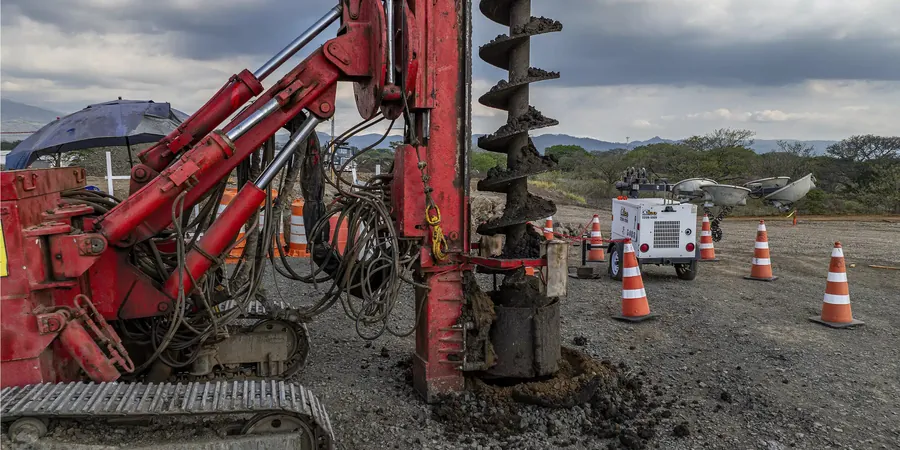
Stone columns transform loose alluvial sands into a composite ground with 2–3 times the original bearing capacity, cutting settlement risk in half.
Scope of work
Area-specific notes
The primary risk in stone column design for Albuquerque projects is underestimating the lateral confinement provided by the native soil. In very loose sands with SPT N-values below 5 blows per 300 mm, the columns can bulge laterally under load, reducing their effectiveness. We mitigate this by specifying a higher replacement ratio and using a vibratory probe that densifies the surrounding soil during installation. Another concern is the presence of cobbles and gravel lenses in the alluvial fan deposits near the foothills, which can obstruct the vibrator and lead to incomplete column continuity. Our field supervisor monitors amperage draw and penetration rate in real time to confirm that each column reaches the design depth without bridging.
Standards used
IBC 2021 – Chapter 18 (Soils and Foundations), ASCE 7-22 – Seismic Load Requirements (Site Class D/E), ASTM D1586-18 – Standard Test Method for SPT, USACE EM 1110-2-3506 – Vibro-Compaction and Stone Columns
Linked services
Geotechnical Site Investigation
Boreholes, SPT, CPT, and pressuremeter testing to characterize soil stratigraphy and groundwater conditions across your project site.
Vibro-Replacement Design
Calculation of column spacing, diameter, and replacement ratio based on target bearing capacity and settlement criteria.
Settlement & Liquefaction Analysis
Finite-element modeling of composite ground behavior under static and seismic loading, including post-liquefaction deformation.
Installation QA/QC
On-site monitoring of vibrator performance, stone backfill quantity, and post-treatment verification testing (plate load tests, CPT).
Typical parameters
Common questions
How much does stone column design cost in Albuquerque?
For a typical residential or light commercial project in Albuquerque, the design and field investigation phase ranges from US$1,490 to US$4,480 depending on the number of boreholes, laboratory tests, and the complexity of the ground improvement layout. Final cost is confirmed after the site visit and review of existing geotechnical data.
What soil conditions require stone columns in Albuquerque?
Stone columns are most effective in loose sandy soils with SPT N-values below 10 and in soft cohesive soils with undrained shear strength between 15 and 50 kPa. These conditions are common in the Rio Grande floodplain and along the drainage channels that cut through the city.
Can stone columns mitigate liquefaction risk in Albuquerque?
Yes. Stone columns densify surrounding granular soils during installation and provide drainage paths that dissipate excess pore pressure during an earthquake. In Seismic Design Category D, this technique is often the most cost-effective solution for reducing lateral spreading and post-earthquake settlement.
How long does the stone column design process take?
A typical design package, including field investigation, laboratory testing, and a final report with plans and specifications, takes 3 to 5 weeks. Fast-track projects can be completed in 2 weeks if existing borehole data is available.