Albuquerque sits at 1,619 m in the Rio Grande rift zone, underlain by deep alluvial deposits with loose sand and silt layers. These soils, often with SPT N-values below 10 in the upper 6 m, require systematic ground improvement before supporting structural loads. Dynamic compaction design in Albuquerque addresses the low relative density common in these unconsolidated sediments by applying controlled high-energy tamping to densify the soil mass. The approach must account for the high groundwater table near the Rio Grande and the presence of cemented caliche layers that can impede energy transfer. Before planning a DC program, a thorough site investigation including MASW testing helps map stiffness profiles, while borehole SPT provides direct penetration resistance data. The combination of geophysics and direct testing defines the energy per drop, grid spacing, and number of passes needed for each project.
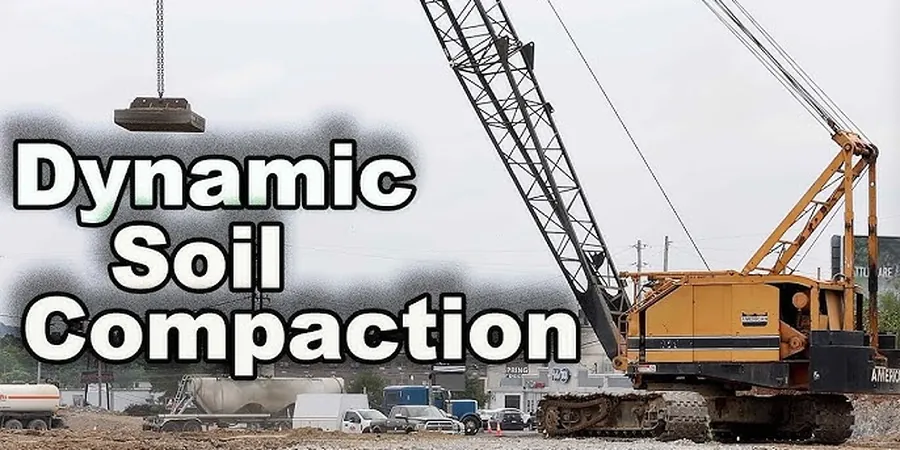
Dynamic compaction in Albuquerque typically raises SPT N-values from below 10 to over 20, reducing settlement potential by 60–70%.
Scope of work
- Drop weight: 10–20 t, with impact energy of 150–350 tm per blow
- Grid spacing: 3–6 m, typically in a triangular pattern
- Number of passes: 2–4, with intermediate grading
Area-specific notes
Consider a 10-story building in the Mesa Del Sol area with a mat foundation design. The geotechnical report showed loose silty sand with SPT N-values of 6–9 down to 8 m. Without dynamic compaction design in Albuquerque, the predicted total settlement exceeded 75 mm, with differential settlement risks under seismic loading. The solution involved a two-pass DC program with 15-ton weights dropped from 20 m on a 4.5 m grid, followed by verification borings. Post-treatment N-values reached 18–25, and the foundation design proceeded with a reduced mat thickness. The project saved an estimated 30% compared to deep pile alternatives.
Standards used
ASCE 7-16 seismic site classification, IBC 2021 Chapter 18, ASTM D1586-18 for SPT verification
Linked services
Pre-treatment Site Investigation
Boreholes with SPT, CPT, and MASW surveys to map loose zones and caliche layers. Includes laboratory tests for moisture-density relations and shear strength.
Energy Application Design
Determination of drop weight, height, grid spacing, and number of passes based on target depth and soil density. Real-time monitoring of crater depth and adjacent vibrations.
Post-treatment Verification
SPT borings, plate load tests, and CPT soundings at designated locations. Comparison of pre- and post-treatment values to confirm compliance with design criteria.
Typical parameters
Common questions
What is the typical cost range for dynamic compaction design in Albuquerque?
The cost for dynamic compaction design in Albuquerque typically ranges between US$1,110 and US$4,720, depending on the site area, depth of treatment required, and the number of verification tests. Larger projects with multiple passes and extensive post-treatment testing fall at the higher end of the range.
How deep can dynamic compaction treat loose soils in the Rio Grande valley?
With a 15-ton weight dropped from 20 m, the effective treatment depth in Albuquerque's sandy soils is typically 6–9 m. Deeper penetration requires heavier weights or a higher drop height. The presence of caliche layers may reduce the effective depth and require pre-ripping.
What verification methods confirm that treatment worked?
Post-treatment verification includes SPT borings at a rate of one per 500 m², plate load tests at foundation level, and CPT soundings to check the continuous profile. The target is an average N-value of 20 or more, with a minimum of 15 in any single test.