Ground improvement encompasses a suite of geotechnical techniques designed to enhance the engineering properties of soil and rock to support structural loads safely and economically. In Albuquerque, where subsurface conditions are notoriously variable, these methods are not merely optional—they are often essential for project viability. From the loose alluvial sands of the Rio Grande Valley to the expansive clays on the city's mesas, untreated ground can lead to excessive settlement, bearing capacity failures, or structural distress. This category covers everything from densification and reinforcement to drainage and chemical stabilization, providing engineers with the tools to mitigate site-specific risks.
Albuquerque's geology presents a unique challenge shaped by the Rio Grande Rift. The valley floor is underlain by thick sequences of unconsolidated fluvial deposits, including silts, sands, and gravels interbedded with clay layers. These soils can be loose and prone to liquefaction during seismic events—a real concern given New Mexico's moderate seismicity. On the West Mesa and foothills, expansive clay soils derived from weathered shale and volcanic ash can swell dramatically with moisture changes, exerting uplift pressures that damage slabs and foundations. Ground improvement must therefore address both the dynamic vulnerability of saturated sands and the volumetric instability of expansive formations.
Design and execution of ground improvement in Albuquerque must conform to the International Building Code (IBC) as adopted by the City of Albuquerque, alongside the New Mexico Commercial Building Code (NMCBC). These codes reference ASCE 7 for seismic design parameters and require site-specific geotechnical investigations per IBC Chapter 18. For liquefaction mitigation, practitioners follow guidelines from the New Mexico Bureau of Geology and Mineral Resources and often apply methodologies from FHWA and the U.S. Army Corps of Engineers. A critical local standard is the requirement for rigorous post-improvement verification testing—typically cone penetration tests (CPT) or standard penetration tests (SPT)—to confirm that acceptance criteria for bearing capacity and settlement are met.
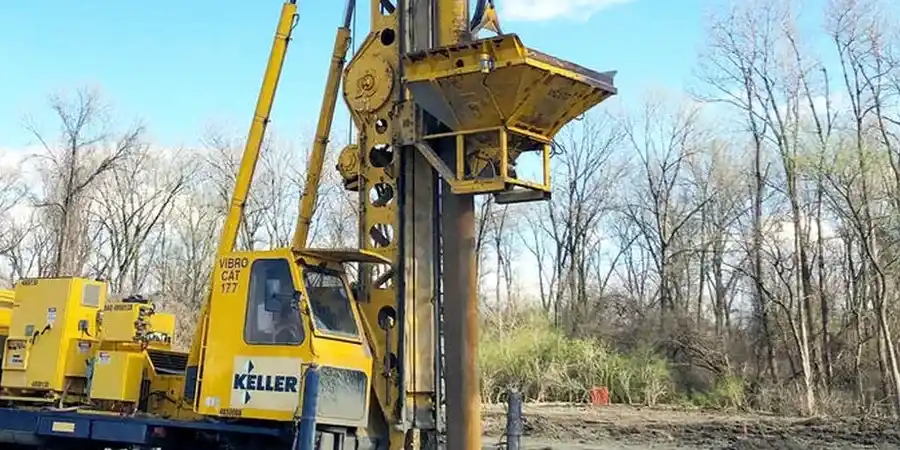
Projects requiring ground improvement in Albuquerque span infrastructure, commercial, and residential sectors. Bridge abutments and approach embankments over the Rio Grande often rely on stone column design to transfer loads through soft alluvium to competent bearing strata. Large warehouse and distribution centers in the Mesa del Sol area frequently employ vibrocompaction design to densify loose sands and minimize post-construction settlement under heavy floor loads. Water treatment plants, schools, and mid-rise structures on expansive soils may require deep soil mixing or chemical injection to create stiff, moisture-insensitive blocks. Even residential subdivisions increasingly incorporate ground improvement to stabilize fill slopes and reduce long-term maintenance costs. Each application demands a tailored approach that balances performance, constructability, and environmental constraints unique to the high desert.
Available services
Common questions
What is ground improvement and when is it needed in Albuquerque?
Ground improvement refers to altering soil properties to increase strength, reduce compressibility, or control permeability. In Albuquerque, it is needed when native soils—such as loose river sands prone to settlement or expansive clays that swell with moisture—cannot safely support proposed structures without excessive movement or risk of failure under design loads.
How do local soil conditions in the Rio Grande Valley affect ground improvement selection?
The valley's interbedded sands, silts, and clays often exhibit low relative density and high liquefaction potential during earthquakes. This dictates the use of densification methods like vibrocompaction or stone columns that displace and compact the matrix, while also providing drainage paths to dissipate pore pressures rapidly.
What building codes regulate ground improvement design in Albuquerque?
The City of Albuquerque adopts the International Building Code (IBC) with New Mexico amendments. IBC Chapter 18 requires a geotechnical investigation and references ASCE 7 for seismic criteria. Post-improvement verification testing is mandated to demonstrate that performance objectives for bearing capacity and settlement are achieved.
What types of projects typically require ground improvement in the Albuquerque area?
Common projects include bridge foundations over the Rio Grande, large-footprint warehouses on valley fill, mid-rise buildings on expansive mesa soils, and infrastructure like water tanks or pump stations. Any structure where soil-induced settlement or swelling could compromise serviceability or safety is a candidate for ground improvement.