A common mistake contractors make in Albuquerque is assuming that standard drainage layers alone can accelerate consolidation in the region's deep clay deposits. These soils, classified as CH under USCS, often have plasticity indices exceeding 40 and natural moisture contents near the liquid limit. Without proper prefabricated vertical drain design, excess pore pressures linger for months, leading to differential settlements that crack slabs and tilt retaining walls. The key is matching drain spacing to the coefficient of consolidation (cv) obtained from oedometer tests, not relying on default values from other arid regions. Before specifying PVDs, a site-specific assessment of the soil's hydraulic conductivity is critical, often complemented by an in-situ permeability test to validate lab results.
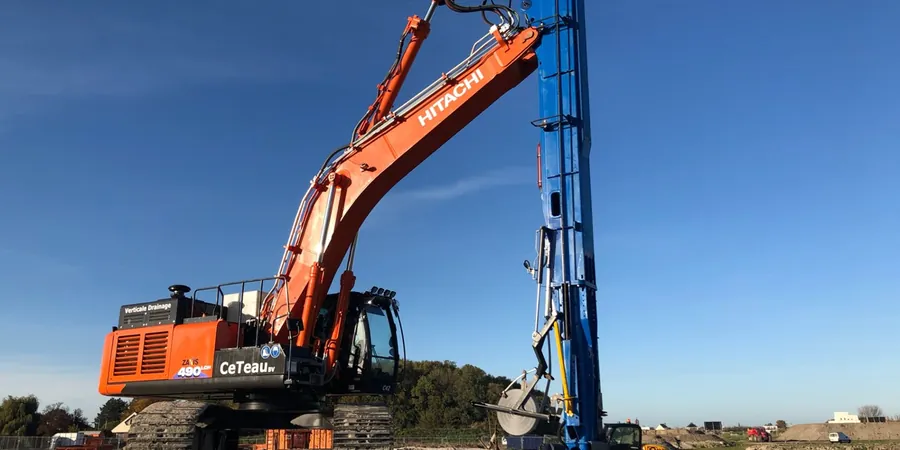
PVD spacing in Albuquerque's CH soils must be based on site-specific cv, not default values, to avoid prolonged consolidation and differential settlement.
Scope of work
Area-specific notes
Albuquerque sits at 5,312 feet above sea level, receiving less than 10 inches of annual precipitation. Yet the Rio Grande Valley's shallow water table creates a perched aquifer beneath many urban lots. When construction loads exceed preconsolidation pressure, those clay layers begin consolidating — and without prefabricated vertical drain design, the process can take years. The risk is compounded by seismic design category D per ASCE 7: during a moderate earthquake, undrained clays can lose strength rapidly. We've seen cases where delayed drainage caused foundation rotations exceeding 1:200, requiring expensive underpinning. A well-designed PVD system mitigates both consolidation time and post-seismic settlement potential.
Standards used
ASCE 7-22 (Chapter 18: Soil and Seismic) for site class and liquefaction screening, ASTM D2435-04 (Standard Test Method for One-Dimensional Consolidation), FHWA-RD-86-168 (Prefabricated Vertical Drains: Design and Construction Guidelines)
Linked services
PVD Layout & Spacing Optimization
We calculate optimal drain spacing and depth using consolidation test data from the specific lot. The design includes a smear zone correction factor, vacuum preloading recommendations when needed, and a time-settlement curve for the client's construction schedule. Deliverables include CAD-based layout plans and a specification sheet for the drain contractor.
Performance Monitoring & Verification
After installation, we install piezometers and settlement plates to track pore pressure dissipation and surface heave. Data is compared against the design curve, and adjustments (e.g., additional vacuum or surcharge) are recommended if consolidation is lagging. A final report documents achieved vs. predicted settlement for the structural engineer's closure.
Typical parameters
Common questions
How much does prefabricated vertical drain design cost in Albuquerque?
For a typical residential or light commercial lot, the design package (layout, spacing analysis, and settlement curves) ranges between US$950 and US$2,790. The final cost depends on lot size, number of borings, and whether vacuum preloading is required. Contact us for a site-specific quote.
What soil conditions in Albuquerque make PVDs necessary?
Albuquerque has extensive deposits of high-plasticity clay (CH) and clayey silt (MH) with low hydraulic conductivity — typically 10⁻⁷ to 10⁻⁹ cm/s. These soils exhibit high compressibility and long consolidation times when loaded by new fills or foundations. PVDs accelerate drainage by providing a vertical path for pore water, reducing the consolidation period from years to months on well-designed projects.
Can PVDs be used for brownfield redevelopment sites in the city?
Yes, but the design must account for potential changes in groundwater chemistry and the presence of buried debris or old foundations. We recommend a pre-installation test pit program to verify the alignment of drains and avoid obstructions. In such cases, the PVD layout is adjusted to maintain uniform spacing around known anomalies, and the discharge capacity criteria are reviewed to ensure filter compatibility with any dissolved salts or hydrocarbons.