In Albuquerque, many times we see that the high-plasticity clay and loose sand layers of the Rio Grande valley create a tricky combination for foundation design. A reliable factor of safety (FS) calculation demands site-specific shear strength data, not just default values from the IBC table. We routinely adjust FS targets based on the local soil profile, groundwater depth, and seismic zone — Albuquerque sits in Zone D for IBC seismic site classification. This is why we pair every FS analysis with a granulometry study to classify the soil matrix before assigning cohesion and friction angle parameters.
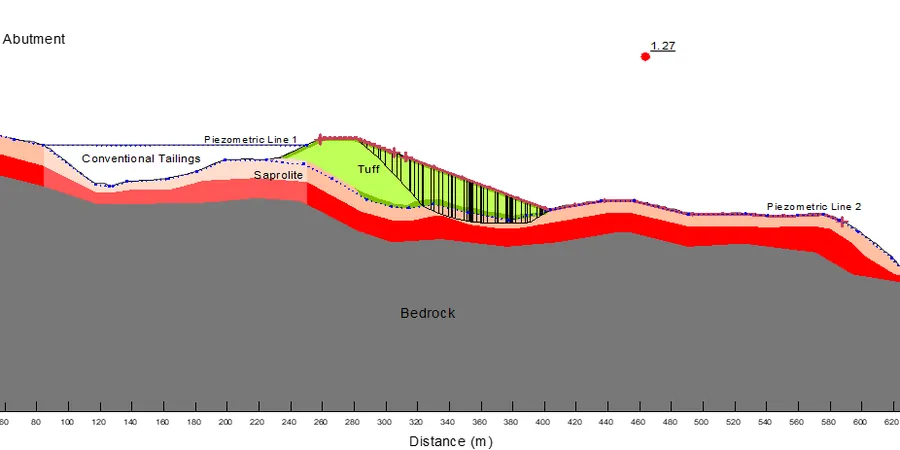
For collapsible soils on Albuquerque's east mesa, a static FS of 3.0 can drop to 1.1 under seismic loading if the groundwater rises during a wet monsoon cycle.
Scope of work
- Direct shear or triaxial testing on undisturbed samples
- Peak and residual strength envelopes for progressive failure assessment
- Seismic pseudo-static coefficient determination per ASCE 7-16 Section 11.8
Area-specific notes
A six-story apartment building near the intersection of I-25 and Paseo del Norte taught us a hard lesson about FS assumptions. The geotechnical report used a static FS of 2.0 for the mat foundation, but nobody accounted for the 8-foot-deep collapsible silt layer that had never been saturated. After three consecutive wet years, the water table rose 12 feet, the silt collapsed under load, and the foundation settled 4 inches differential. Our FS calculation now includes a wet-season groundwater scenario with partial saturation effects, following the procedure by Houston et al. for collapsible soils in the Rio Grande Rift.
Standards used
IBC 2021 (Chapter 16 & 18), ASCE 7-16 (Minimum Design Loads and Associated Criteria for Buildings), ASTM D4767-11 (Consolidated Undrained Triaxial Compression Test on Cohesive Soils), NCEER 1997 / Youd & Idriss 2001 (SPT-based liquefaction triggering)
Linked services
Slope Stability FS Analysis
Limit equilibrium analysis using Bishop, Spencer, and Morgenstern-Price methods for natural slopes and cut slopes in the Sandia foothills. Includes seismic pseudo-static and post-earthquake residual strength scenarios.
Foundation Bearing Capacity FS
Terzaghi and Meyerhof bearing capacity equations modified for Rio Grande valley soils. We apply partial safety factors per IBC 2021 and cross-check against CPT-based methods for shallow and deep foundations.
Retaining Wall Overturning & Sliding FS
Global stability check for MSE walls, cantilever walls, and soil nail walls. We compute sliding, overturning, and bearing FS under static and seismic conditions, including surcharge from adjacent traffic or structures.
Typical parameters
Common questions
What is the minimum factor of safety required by IBC for a slope in Albuquerque?
IBC 2021 requires a minimum FS of 1.5 for static slope stability under dead plus live loads. For seismic conditions, ASCE 7-16 allows a reduced FS of 1.1 for global stability, provided the pseudo-static coefficient is correctly determined based on the site class (typically D or E in Albuquerque).
How do collapsible soils in Albuquerque affect the factor of safety calculation?
Collapsible soils, common on the east mesa and alluvial fans, exhibit a sudden loss of shear strength when wetted. The FS calculation must include a wetted-state analysis using collapse potential from double-oedometer tests (ASTM D5333). We typically set a minimum FS of 2.0 for the wetted condition, which often becomes the governing case.
What is typical cost range for a factor of safety study in Albuquerque?
A standard FS calculation for a residential slope or retaining wall ranges between US$560 and US$1,910, depending on the number of cross-sections, laboratory tests required, and seismic analysis complexity. Complex commercial projects with multiple limit states and groundwater modeling fall at the upper end.
Can I use the same factor of safety for static and seismic conditions?
No. ASCE 7-16 and IBC 2021 allow lower FS values under seismic loading because the design earthquake is an extreme event with low probability of occurrence. For slopes, static FS target is 1.5, while seismic FS target drops to 1.1. For foundations, static bearing FS is 3.0, seismic bearing FS is 2.0. Using the same value for both conditions is conservative but uneconomical.