The hydraulic jack sits on a circular steel plate 300 to 760 mm wide. A reaction beam anchors it against a counterweight truck or screw piles. In Albuquerque the rig must handle the high-plasticity clay (CH) near the Rio Grande and the weathered basalt layers west of I-25. The crew runs at least two loading cycles per ASTM D1196-20. Dial gauges record settlement to 0.01 mm. The test gives the modulus of subgrade reaction (k) and the ultimate bearing capacity directly. Before the plate load test, the team digs a shallow pit to reach the foundation grade. That pit also lets them check for cobbles or old fill. Combining PLT with a survey of soil classification helps correlate the field modulus with lab results from the same layer.
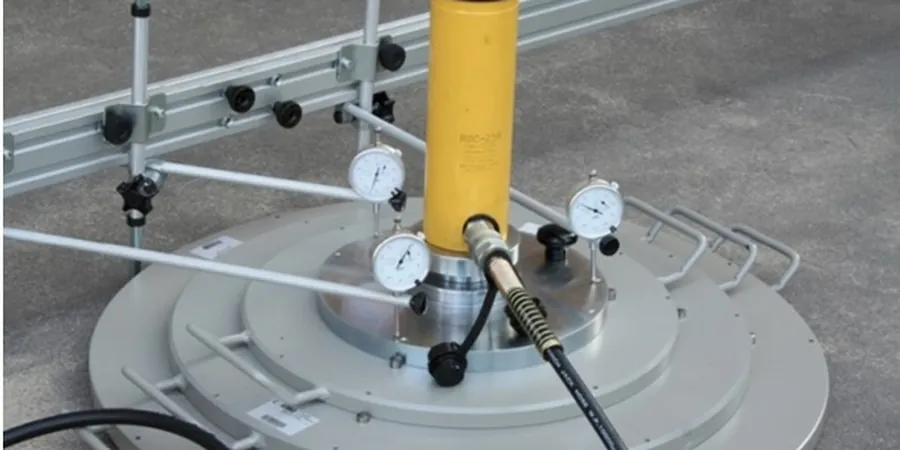
The plate load test measures real soil response under a footing-sized load. It catches non-linear settlement that lab tests miss.
Scope of work
Area-specific notes
A common mistake in Albuquerque is placing the plate on a thin compacted layer that does not represent the entire bearing stratum. Builders sometimes level the pit with loose sand, which gives an unrealistically high modulus. Another error: stopping the test after one cycle. The rebound cycle reveals whether the soil is elastic or plastic. In the volcanic tuff zones near the Sandia foothills, ignoring the fracture orientation can cause the plate to tilt. The test must be repeated at two adjacent spots to capture the natural variability. Without this, the foundation design may be 30% too stiff or too flexible for the actual ground.
Standards used
ASTM D1196-20, ASCE 7-22 (site class definition), IBC 2021 Chapter 18
Linked services
Standard PLT on Shallow Foundations
Single-plate test at foundation grade using 450 mm plate and 100 kN jack. Includes two loading cycles, settlement readings, and report with k-value and bearing capacity. Suitable for residential footings and light commercial slabs.
Extended PLT for Deep Foundations
Multi-depth test using 610 mm plate and 200 kN reaction beam. Tests at 0.5 m intervals down to 3 m depth. Includes correction for overburden stress and side friction. Used for bridge abutments, retaining walls, and multi-story buildings in Albuquerque’s alluvial soils.
Typical parameters
Common questions
What is the difference between PLT and a standard SPT blow count for bearing capacity?
The plate load test measures actual load–settlement behavior at the surface, while the SPT gives an indirect estimate through correlation (e.g., Terzaghi or Meyerhof). PLT provides the modulus of subgrade reaction (k) directly, which is critical for mat foundations and slab-on-grade design in Albuquerque’s variable soil conditions.
How much does a plate load test cost in Albuquerque?
A standard single-plate test with one location costs between $820 and $1,400. The price includes mobilization, two loading cycles, and a certified report. Multi-depth or two-location tests run $1,600 to $2,800. Cost varies with plate size, depth, and access conditions.
What soil types in Albuquerque require a PLT?
Sandy silts (ML), lean clays (CL), and weathered volcanic tuff are common. The PLT is essential on the west mesa where old alluvial fans have variable density. It is also used near the Rio Grande where soft clay (CH) and loose sand (SP) occur together. The test verifies whether the design bearing value from the geotechnical report is achievable.
Can the plate load test be performed on a slope or fill?
Yes, but the plate must be placed on the compacted fill after it has cured for 7 days minimum. On slopes, the reaction beam must be anchored with dead weights or screw piles to avoid lateral movement. The test results on fill are only valid if the fill material and compaction match the production specs. For natural slopes, the test pit must be benched into the slope face.