Albuquerque grew rapidly after the railroad arrived in 1880, spreading across the Rio Grande valley and onto the mesas. That expansion exposed a critical challenge: the soil is anything but uniform. Sandy river deposits, clay-rich alluvium, and caliche layers sit side by side. For any building taller than two stories, ignoring that variability means risking cracks in walls and uneven floors. Our team performs differential settlement analysis using consolidation tests and field data. We combine that with a soil classification study to map the site stratigraphy, and with a plate load test when we need direct modulus values. The result is a settlement estimate tied to real Albuquerque conditions.
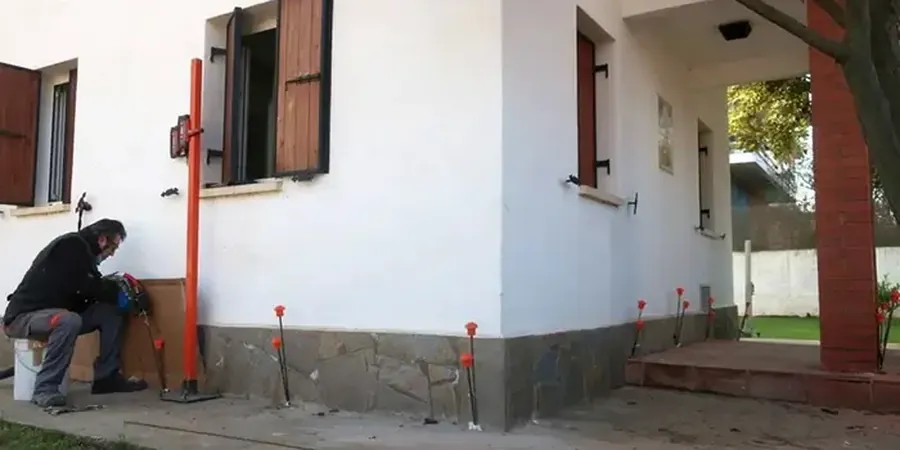
A 20-mm differential settlement we detected saved a six-story structure from long-term structural damage in Albuquerque's North Valley.
Scope of work
- Collect undisturbed samples with thin-wall Shelby tubes at intervals of 1.5 meters per borehole.
- Run one-dimensional consolidation tests (ASTM D2435) on the most compressible layers — typically the silty clays below 6 meters.
- Calculate immediate, primary, and secondary settlement separately using Casagrande's method for pre-consolidation stress.
- Cross-check predictions against consolidation data from nearby projects in the North Valley.
Area-specific notes
A common mistake we see in Albuquerque is assuming the caliche layer acts as a rigid bearing stratum. Caliche is brittle. Under load, it can fracture abruptly, producing localized settlement that cracks slab-on-grade floors. Contractors who skip a proper analysis end up with doors that jam and partition walls that separate from ceilings. We have documented cases where a 50-mm differential occurred within two years because the caliche was treated as rock. Our differential settlement analysis identifies those brittle zones and flags them before the foundation is poured.
Standards used
ASTM D2435-11 (One-Dimensional Consolidation), ASTM D4546-21 (Collapse Potential), IBC 2021 Section 1803.5.3 (Foundation Settlement)
Linked services
Consolidation Testing (ASTM D2435)
One-dimensional consolidation tests on undisturbed samples from depths of 3 to 18 meters. We determine compression index, pre-consolidation stress, and coefficient of consolidation for each soil layer.
Settlement Modeling & Prediction
We compute immediate, primary, and secondary settlement using Terzaghi's theory and finite-difference methods. Output includes total and differential settlement contours for the building footprint.
Caliche & Collapsible Soil Assessment
Specialized double-odometer tests to evaluate collapse potential of caliche and loose alluvial sands. We identify zones where wetting could trigger sudden settlement.
Field Verification & Monitoring
Installation of settlement plates and survey monuments. We monitor differential movement during construction and provide monthly reports comparing actual vs. predicted values.
Typical parameters
Common questions
What is the typical cost range for a differential settlement analysis in Albuquerque?
For a standard residential or low-rise commercial project, the analysis costs between US$840 and US$1,750. The price depends on the number of boreholes, sample quantity, and whether consolidation testing is needed. Contact us for a project-specific quote.
How deep do I need to drill to assess differential settlement in Rio Grande valley soils?
We recommend boreholes to at least 1.5 times the foundation width, or to refusal on competent material. In Albuquerque's valley, that typically means depths of 9 to 15 meters to capture the compressible clay layers beneath the sandy topsoil.
Can differential settlement be fixed after the building is already tilted?
Yes, but it is expensive. Options include underpinning with micropiles, slab jacking, or soil grouting. A proper analysis before construction costs a fraction of the repair.
What is the maximum allowable differential settlement under IBC for a concrete frame building?
The IBC 2021 recommends a maximum differential settlement of 25 mm (1 inch) for typical frame structures. For buildings with masonry walls or sensitive finishes, the limit drops to 12 mm. Our analysis compares predicted values against these thresholds.