The high desert climate of Albuquerque creates a unique geotechnical setting where the top few meters of soil are often dry and stiff, but deeper layers can shift dramatically. Seasonal monsoon rains briefly saturate the ground, altering wave propagation characteristics. This is where MASW surveys become indispensable — they map shear wave velocity profiles from the surface down to engineering bedrock without any borehole. In our experience, pairing MASW with a georradar GPR survey helps cross‑reference stratigraphy, while a tomografía sísmica provides 2‑D velocity sections for shallow anomalies. The resulting VS30 value directly determines the site class required by ASCE 7‑16 for seismic design in Albuquerque.
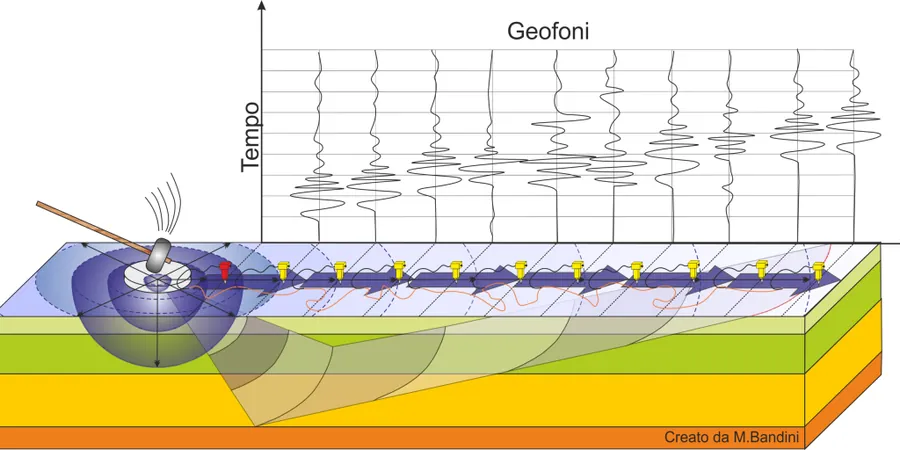
A reliable VS30 profile from MASW can upgrade a site from Class D to Class C, saving significant structural costs without sacrificing safety.
Scope of work
- VS30 — average velocity to 30 m depth
- Site class per ASCE 7 Table 20.3‑1 (A, B, C, D, E, F)
- Poisson’s ratio derived from P‑wave / S‑wave ratio
- Depth to engineering bedrock (VS ≥ 760 m/s)
For larger projects we complement these results with microtremores HVSR to validate the fundamental site frequency. The entire field program takes one day for a typical urban lot in Albuquerque, with lab processing requiring another two days.
Area-specific notes
One issue we see often in Albuquerque is the presence of a stiff surface crust over loose, saturated sands from the Rio Grande alluvium. If the MASW array is too short — say, less than 30 m — the inversion may miss the low‑velocity zone entirely, leading to an overestimated VS30 and an incorrect site class. Another risk is cultural noise: traffic on I‑40 and the Rail Runner can contaminate low‑frequency surface waves. We mitigate this by recording during low‑traffic hours and using a 1‑Hz sensor cutoff. Finally, assuming a horizontally layered earth when the geology is dipping (common near the Sandia foothills) introduces systematic error in the dispersion inversion.
Watch how it works
Standards used
ASTM D4428/D4428M‑19 — Standard Test Methods for Crosshole Seismic Testing, ASCE 7‑16, Chapter 20 — Site Classification for Seismic Design, IBC 2021, Section 1613 — Seismic Ground Motion Values
Linked services
MASW (Multichannel Analysis of Surface Waves)
1‑D shear wave velocity profiles from Rayleigh‑wave dispersion. Ideal for VS30 site classification and liquefaction screening. Includes dispersion curve extraction and inversion with uncertainty analysis.
VS30 for ASCE 7 Site Class
Direct calculation of average shear wave velocity in the top 30 meters per ASCE 7‑16. We provide a stamped report with site class (A–F) suitable for building permit submittal in Albuquerque.
ReMi (Refraction Microtremor)
Passive seismic method using ambient noise to derive VS profile. Useful in high‑noise environments where active MASW is impractical. Combines with MASW for deeper resolution.
Seismic Refraction Tomography
P‑wave and S‑wave refraction tomography for 2‑D velocity sections. Commonly used for rippability assessment, bedrock depth mapping, and input to FEM models for foundation design.
Typical parameters
Common questions
What is the difference between MASW and VS30 testing?
MASW is the field method that measures Rayleigh‑wave dispersion to derive a shear wave velocity (VS) profile. VS30 is a specific parameter — the average VS in the top 30 meters — that is calculated from that profile. MASW is the tool; VS30 is the result used for seismic site classification per ASCE 7.
How long does an MASW survey take in Albuquerque?
A typical urban lot in Albuquerque takes one day for field data acquisition. Processing and reporting require two additional days. If multiple lines or deeper investigation (beyond 30 m) are needed, add one extra field day.
What is the cost range for MASW / VS30 testing in Albuquerque?
For a standard MASW survey covering one 48‑m line with VS30 determination, the cost ranges between US$1.620 and US$3.230. This includes field work, data processing, and a signed site‑classification report. Larger or multi‑line projects are quoted individually.
Can MASW be used for liquefaction assessment?
Yes, VS30 is a key input for simplified liquefaction triggering analyses (e.g., Youd‑Idriss 2001, Idriss‑Boulanger 2008). MASW provides the shear wave velocity profile needed to compute the cyclic stress ratio (CSR) and cyclic resistance ratio (CRR) at various depths. However, we recommend combining MASW with SPT borings for a solid liquefaction evaluation.
What site classes are common in Albuquerque?
Most of the Albuquerque basin — especially the Rio Grande valley floor — falls into Site Class D (stiff soil, 180–360 m/s) or C (very dense soil, 360–760 m/s). The Sandia foothills and Mesa areas often reach Class B (rock, >760 m/s) within the top 10 m. Our MASW surveys help confirm the correct class, avoiding the conservatism of assuming Class D by default.