Albuquerque’s expansion from a dusty railroad stop into a sprawling metro area has pushed construction into increasingly complex ground, where undisturbed samples tell a story the blow counts miss. The Rio Grande rift carved deep sedimentary basins filled with interbedded sands, silts, and clays—deposits that behave differently under load depending on drainage conditions. When a structural engineer needs cohesion and friction angle to size a mat foundation in the North Valley or a developer questions whether a cut slope in the Sandia foothills will hold, the triaxial test becomes the definitive tool. Our laboratory runs consolidated-drained and consolidated-undrained triaxial programs on Shelby tube samples recovered from sites across Bernalillo County, generating effective stress parameters that feed directly into limit equilibrium analyses and finite element models. The data moves from the load frame to the design table without guesswork, which is exactly what the IBC and ASCE 7 demand for performance-based design in a seismically active basin.
Effective stress parameters from a triaxial test convert a messy core sample into a defensible friction angle—everything else is correlation.
Process and scope
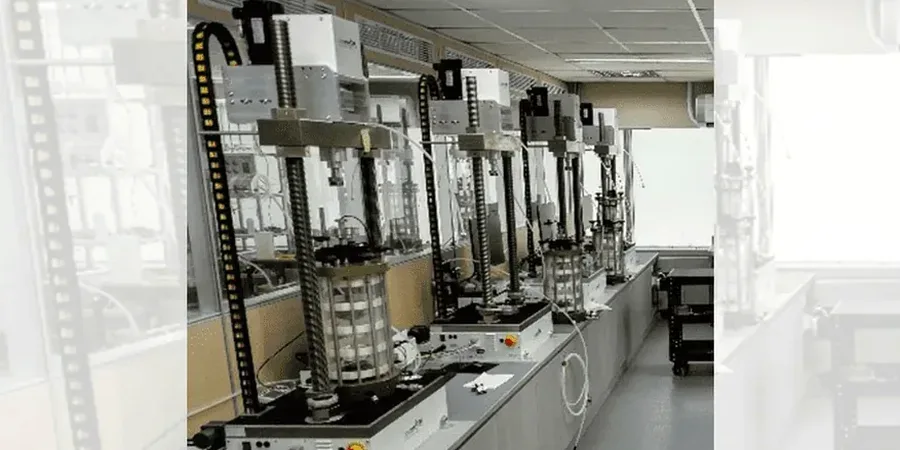
Area-specific notes
The Santa Fe Group sediments that underlie most of Albuquerque include thick sequences of fine-grained playa deposits and fluvial silts that can be partially saturated, preconsolidated by desiccation, and prone to strain-softening. Running a direct shear test on these materials gives a friction angle that looks fine on paper, but the lack of pore pressure measurement masks the real story: during undrained loading, excess pore pressure can climb and shear strength can drop by half before failure. That is the scenario triaxial testing is built to reveal. In the South Valley, where the water table sits within 10 feet of the surface in places, effective stress analysis is not academic—it is the difference between a footing that settles an inch and one that punches through. Our lab reports include p-q diagrams, stress paths, and Skempton’s A coefficient at failure so the design team sees exactly how the soil behaves from consolidation to post-peak. For deep excavation projects near the downtown corridor, combining triaxial-derived strength envelopes with deep excavations monitoring data closes the loop between lab prediction and field performance.
Relevant standards
ASTM D4767 – CU triaxial compression test, ASTM D2850 – UU triaxial compression test, ASTM D7181 – CD triaxial compression test
Linked services
Consolidated-Undrained (CU) Triaxial with Pore Pressure
The standard for effective stress analysis in saturated clays and silts. Three specimens consolidated to different effective stresses and sheared undrained, with continuous pore pressure measurement. We deliver c′ and φ′ for use in slope stability, retaining wall design, and foundation bearing capacity in Albuquerque’s basin sediments.
Unconsolidated-Undrained (UU) Triaxial
A rapid test for total stress parameters in fine-grained soils where immediate loading conditions control the design—like footing excavation in saturated clay. The UU test gives undrained shear strength (cᵤ) for short-term bearing capacity checks required by IBC Chapter 18.
Consolidated-Drained (CD) Triaxial
For free-draining sands and gravels where long-term drained conditions govern. The CD test runs at a slow strain rate to prevent pore pressure buildup, yielding the drained friction angle needed for permanent retaining structures and cut slopes in the Sandia foothills colluvium.
Typical parameters
Common questions
What is a triaxial test and why does Albuquerque need it?
A triaxial test measures the shear strength of a cylindrical soil specimen under controlled confining pressure, simulating the in-situ stress state. Albuquerque sits on the Rio Grande rift basin, a half-graben filled with interbedded granular and cohesive deposits where pore pressure behavior during loading varies dramatically between units. The IBC requires shear strength parameters for foundation design, and the triaxial test is the only method that captures the effective stress response needed for performance-based design in this seismic setting.
How much does a triaxial testing program cost?
A full triaxial program—three specimens at different confining pressures with pore pressure measurement plus the geotechnical interpretation report—typically runs between US$1,830 and US$2,560 depending on the test type (CU, UU, or CD), the number of confining pressures, and whether we are handling the sample extrusion and storage. We provide a fixed-price quote after reviewing the boring logs and sample quality.
How long does it take to get triaxial test results?
For a CU triaxial program with three specimens, expect 10 to 14 business days from sample receipt to the final report. Consolidated-drained tests on granular soils take longer because the shear stage runs at a slower strain rate to maintain drained conditions. If your project has a tight deadline, let us know upfront and we can stage the work to deliver preliminary parameters ahead of the full report.
What sample quality do you need for a reliable triaxial test?
We require undisturbed samples collected in thin-walled Shelby tubes per ASTM D1587, with a minimum tube diameter of 3 inches. The tubes must be sealed, transported upright, and kept at field moisture content. Samples showing signs of disturbance—cracks, gravel inclusions, or desiccation—may not yield representative strength parameters. Our lab inspects every tube before extrusion and will consult with the drilling crew if the sample quality is marginal.
Can triaxial testing help with a liquefaction assessment?
Yes, though the standard approach for liquefaction screening uses SPT or CPT data with the simplified procedure. Triaxial testing adds value when you need to calibrate a site-specific cyclic resistance ratio. We run cyclic triaxial tests on reconstituted specimens to determine the number of loading cycles to liquefaction at different cyclic stress ratios, which can justify a more favorable liquefaction classification for critical facilities.