The semi-arid climate of Albuquerque, with less than 9 inches of annual rainfall and over 310 sunny days per year, creates a unique challenge for pavement design: the near-surface soils dry out to high suctions but can collapse upon wetting during rare monsoon events. This cyclic moisture regime, combined with the presence of expansive clay layers from the Santa Fe Group, demands a rigorous approach to subgrade characterization. Our road geotechnics work in Albuquerque integrates in-situ CBR testing and laboratory compaction curves to evaluate bearing capacity under both soaked and unsoaked conditions. Before specifying pavement layers, we often run a density cone sand test on compacted fills to verify field compaction meets project specifications, a critical step in this region.
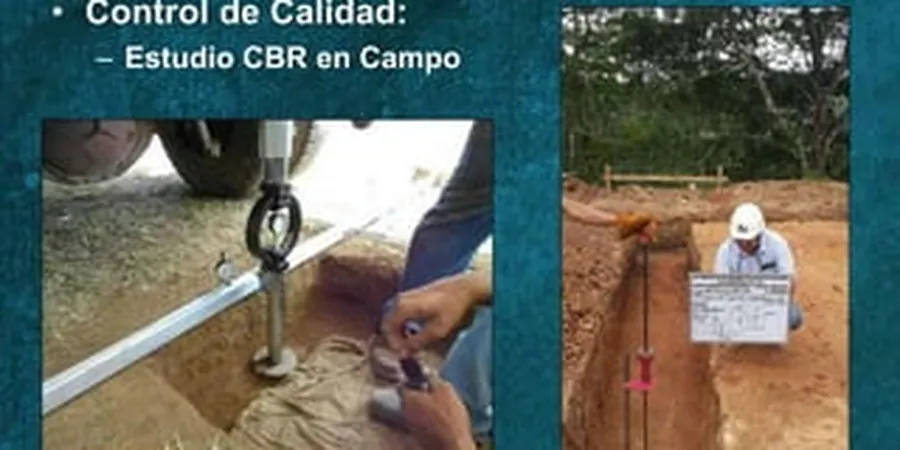
The deep water table and expansive clay lenses in Albuquerque create a subgrade that is highly sensitive to moisture changes, requiring soaked CBR values and lime stabilization for reliable pavement performance.
Scope of work
Area-specific notes
A common mistake in Albuquerque is designing pavement thickness based on CBR values from samples compacted only at optimum moisture without accounting for post-construction wetting. The collapsible nature of the silty sands in the east side of the city means that after a heavy rain, the subgrade can lose 50% or more of its original strength. Contractors who skip a soaked CBR or fail to perform a plate load test on the finished subgrade often face premature cracking and rutting within the first two years. The lesson is clear: treat Albuquerque's subgrade as moisture-sensitive and design for the worst-case wetting scenario, not the dry summer condition.
Standards used
AASHTO T-180 (Modified Proctor), ASTM D1883 (CBR), AASHTO Guide for Design of Pavement Structures (1993), ASTM D4318 (Atterberg Limits)
Linked services
Subgrade Investigation & Classification
Field borings, test pits, and sampling of subgrade soils at proposed road alignments. Laboratory classification per USCS (ASTM D2487) and AASHTO M 145, including natural moisture content, dry density, and Atterberg limits.
CBR & Resilient Modulus Testing
Soaked and unsoaked CBR tests (ASTM D1883) on compacted samples. Resilient modulus (Mr) estimated from CBR using the AASHTO correlation Mr = 2555 x CBR^0.64 for flexible pavement structural number calculation.
Pavement Design Recommendations
Structural section design for flexible or rigid pavements using AASHTO methodology. Includes traffic load analysis (ESALs), layer coefficient selection, and recommendations for subgrade stabilization with lime or cement when PI exceeds 25.
Typical parameters
Common questions
What is the typical CBR value for subgrade soils in Albuquerque?
For the clayey subgrades common in Albuquerque, soaked CBR values typically range from 2% to 8%. Sandy areas on the west mesa can reach 10-15%. We always recommend soaked CBR testing because the dry values (often 10-20%) are misleading and can lead to under-designed pavements that fail after wetting.
How much does a road geotechnics study for pavement design in Albuquerque cost?
A standard pavement subgrade investigation for a residential street (2-3 borings, CBR, Proctor, Atterberg) typically ranges between US$830 and US$2,100. For larger arterial road projects requiring 6+ borings and resilient modulus testing, the cost can reach US$4,110. The final price depends on the number of test locations, laboratory tests requested, and site accessibility.
Do I need lime stabilization for pavement subgrade in Albuquerque?
If the subgrade soil has a plasticity index (PI) above 25 and the soaked CBR is below 5%, lime stabilization is strongly recommended. The expansive clays in the Santa Fe Group can swell and shrink with moisture changes, leading to pavement roughness and cracking. A treatment rate of 3-6% hydrated lime per dry weight of soil is typical, and we verify the improvement with CBR testing after 7 days of curing.