Geotechnical laboratory testing in Albuquerque forms the critical bridge between field exploration and engineering design. The city's complex subsurface conditions demand precise characterization of soil and rock behavior to ensure safe, economical construction. This category encompasses the full spectrum of standardized physical and mechanical tests performed on soil samples recovered during subsurface investigations. From basic index properties that classify materials to advanced strength and compressibility assessments, laboratory programs generate the parameters engineers need to model foundation performance, slope stability, and earth retention systems. Without rigorous laboratory validation, geotechnical recommendations remain speculative in a setting where expansive clays, alluvial deposits, and fractured rock interfaces present overlapping challenges.
Albuquerque sits within the Rio Grande rift basin, where Quaternary alluvium, fluvial terrace deposits, and the Santa Fe Group sediments dominate the near-surface geology. These materials exhibit significant variability across relatively short distances. Fine-grained soils from the basin floor often display moderate to high plasticity, while coarser arroyo sediments and decomposed granitic materials along the Sandia foothills introduce entirely different engineering behaviors. Collapsible silts, dispersive clays, and cemented caliche layers all appear within the metropolitan area. A well-designed laboratory testing program, including Atterberg limits to quantify plasticity and grain size analysis (sieve + hydrometer) to define the full particle distribution, provides the essential framework for understanding how these local geomaterials will respond to moisture changes and structural loads.
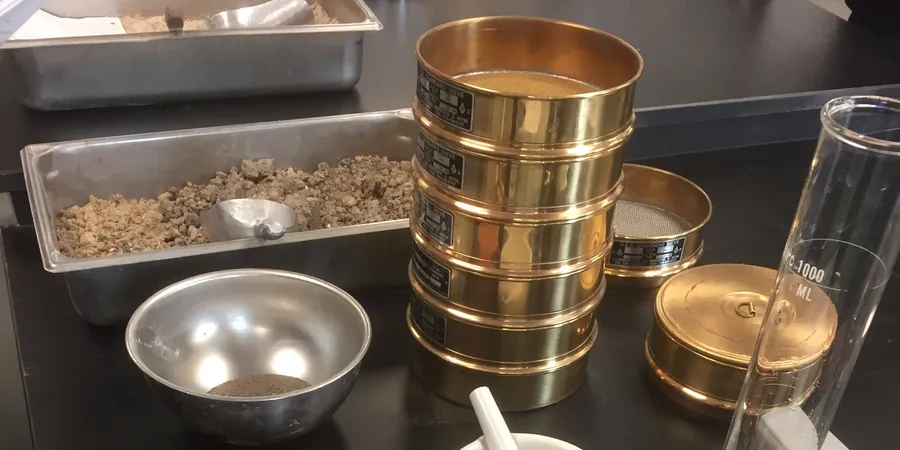
Testing protocols in the United States follow standards established by ASTM International, with additional guidance from AASHTO for transportation projects. Key ASTM standards governing this category include D422 for particle-size analysis, D4318 for liquid limit, plastic limit, and plasticity index, and D4767 for consolidated-undrained triaxial compression tests on cohesive soils. The New Mexico Building Code references the International Building Code, which in turn requires geotechnical investigations to conform to accepted engineering practice as defined by these consensus standards. Local agencies such as the Albuquerque Bernalillo County Water Utility Authority may impose supplementary requirements for projects involving earthwork near groundwater or in areas with documented expansive soil hazards. Laboratories performing this work typically maintain accreditation through the AASHTO re:source program or similar quality systems to demonstrate competence in executing these methods.
The demand for laboratory testing cuts across virtually every construction sector in the Albuquerque metro. Commercial building foundations on the west mesa require careful assessment of collapsible soil potential. Residential developments in the foothills need evaluation of cut slope stability in weathered rock. Public infrastructure projects, including roadway widenings along I-25 and bridge replacements over the Rio Grande, depend on triaxial tests to determine effective stress strength parameters for embankment and abutment design. School expansions, hospital additions, and utility trench backfill all trigger laboratory evaluation of compaction characteristics and corrosivity. Even smaller retaining wall and pool construction projects benefit from basic index testing to anticipate lateral earth pressures and drainage behavior. Each project type draws on a different subset of the available test methods, but all share the common need for reliable, repeatable data generated under controlled conditions.
Common questions
What distinguishes a commercial geotechnical laboratory from field testing alone?
Commercial laboratories provide controlled environments where temperature, humidity, and loading rates are precisely regulated according to ASTM standards. This yields repeatable, legally defensible data on intrinsic material properties such as shear strength, compressibility, and permeability. Field tests like Standard Penetration Tests offer valuable index information but cannot replace the fundamental parameter determination that laboratory tests provide for advanced engineering analyses.
How many soil samples are typically needed for a complete laboratory testing program in Albuquerque?
Sample quantity depends on project scale and subsurface variability, but a typical commercial building investigation might require 3 to 6 undisturbed thin-wall tube samples per boring for strength and consolidation testing, plus numerous disturbed bag samples for index testing. Stratigraphic changes encountered in Albuquerque's alluvial basin often necessitate sampling at closer vertical intervals than initially planned to capture transitional zones between clay, silt, and sand layers.
What quality assurance measures should I expect from a geotechnical laboratory?
Reputable laboratories maintain accreditation through programs like AASHTO re:source or ISO/IEC 17025, participate in proficiency sample programs, and employ registered professional engineers to review results. They should provide calibration certificates for testing equipment, follow ASTM-specified sample preparation and curing procedures, and deliver reports that clearly state the test methods used, any deviations from standard, and the qualifications of the testing personnel.
How long does a standard laboratory testing program take to complete?
Basic index tests such as moisture content and Atterberg limits can be completed within 2 to 3 working days of sample receipt. Consolidated-undrained triaxial tests with pore pressure measurement typically require 2 to 4 weeks due to the saturation, consolidation, and shear phases. Consolidation tests fall in a similar timeframe. Rush testing is often available, but projects should plan for a 4 to 6 week total turnaround when scheduling complex testing suites to avoid construction delays.