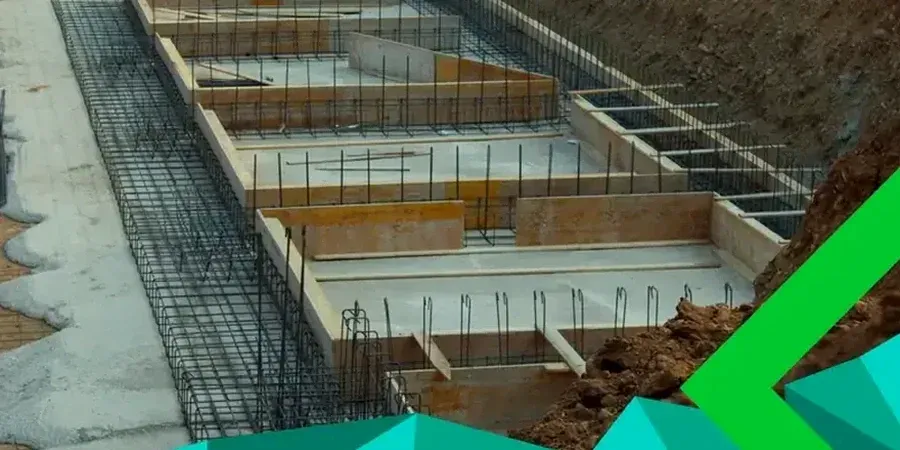
One mistake we see repeatedly in the Albuquerque area is pouring footings under the assumption that compacted desert soil offers uniform support. The reality is different. The Rio Grande Rift has deposited layers of sand, silty sand, and pockets of expansive clay across the metro area, from the Northeast Heights down to the South Valley. A footing that performs well at one end of a building pad can settle differentially at the other end if the subsurface profile shifts over just a few meters. When we tackle shallow foundation design here, we combine targeted SPT data from our SPT drilling crews with lab-based classification to identify these transitions before concrete is placed. The deliverable is a foundation plan that accounts for actual soil variability, not textbook assumptions. Licensed professional engineers stamp every report, meeting City of Albuquerque permit requirements and the IBC 2021 edition adopted by Bernalillo County.
Shallow foundations in Albuquerque fail more often from differential settlement in mixed soil profiles than from shear failure. We design for the transition zones.
Process and scope
Area-specific notes
Albuquerque’s urban expansion since the 1960s has pushed residential and commercial development onto terrain that earlier builders avoided: the wind-deposited sand sheets of the West Mesa and the clay-rich slopes of the North Valley. Older neighborhoods near Old Town and the University sit on relatively well-characterized river terrace deposits, but newer subdivisions often encounter undocumented fill, buried arroyo channels, or expansive clays that swell during the monsoon months of July and August. Skipping a site-specific shallow foundation investigation in these areas carries real consequences: cracked slabs, sticking doors, and structural distress that appears within the first three years. The IBC classifies much of the ABQ basin as Seismic Design Category B, so lateral demands are moderate, but the combination of low-density sand and rapid urbanization means that scour and internal erosion around footings need explicit evaluation. We address this with conservative embedment depths and positive drainage detailing.
Video overview
Relevant standards
IBC 2021 (adopted by City of Albuquerque & Bernalillo County), ASCE 7-22 Minimum Design Loads, ASTM D1586-18 Standard Penetration Test (SPT), ASTM D2487-17 Unified Soil Classification, ASTM D2435 Consolidation Properties (settlement analysis), ACI 318-19 Building Code for Structural Concrete (footing design)
Linked services
Bearing Capacity & Settlement Analysis
Footing sizing based on site-specific SPT blow counts and lab consolidation data. We provide allowable bearing pressure charts, total and differential settlement predictions, and modulus of subgrade reaction for slab-on-grade design.
Slab-on-Grade & Stiffened Raft Design
Post-tensioned and conventionally reinforced slab designs for expansive soil conditions. Includes moisture barrier specifications, underslab drainage plans, and perimeter insulation details suited to Albuquerque's 5,300-ft elevation climate.
Foundation Construction Inspection
Subgrade verification during excavation, proof-rolling observation, compaction testing, and rebar inspection prior to pour. We issue the stamped compliance letter required by ABQ building inspectors before the foundation backfill phase.
Typical parameters
Common questions
What is the typical bearing capacity for shallow foundations in Albuquerque?
Most native soils in the Albuquerque metro area support an allowable bearing pressure of 2,000 psf for continuous strip footings, assuming a minimum embedment of 18 inches below finished grade. We adjust this value upward when subsurface investigation confirms dense sand or cemented gravels at footing depth, and downward in areas with undocumented fill or expansive clay. Every design recommendation comes with a settlement estimate referenced to the IBC 1-inch total and 0.75-inch differential limits.
How much does shallow foundation design cost for a typical residential project in ABQ?
For a single-family home or small commercial building in Albuquerque, shallow foundation design services typically range from US$1,800 to US$3,620. The final fee depends on lot size, number of borings required, presence of fill or problem soils, and whether the project is in a hillside area requiring additional slope stability review.
Do you need to test for expansive soils in Albuquerque before designing footings?
Yes, absolutely. The Albuquerque Basin contains significant deposits of clay derived from weathered Mancos Shale and volcanic ash, particularly on the western and northern sides of the metro. We run Atterberg limits (ASTM D4318) and expansion index tests on representative samples. If the plasticity index exceeds 25, the design must incorporate a deepened perimeter beam, post-tensioned slab, or chemical soil treatment to control heave during the summer monsoon season.
How long does the foundation design and permitting process take?
A typical residential shallow foundation design package, from field investigation to stamped plans ready for City of Albuquerque permit submittal, takes 10 to 14 business days. Rush turnaround of 5 to 7 business days is available. Commercial projects with larger footprints and multiple boring locations may require 3 to 4 weeks. The timeline includes SPT drilling, lab testing, engineering calculations, and coordination with the project structural engineer.