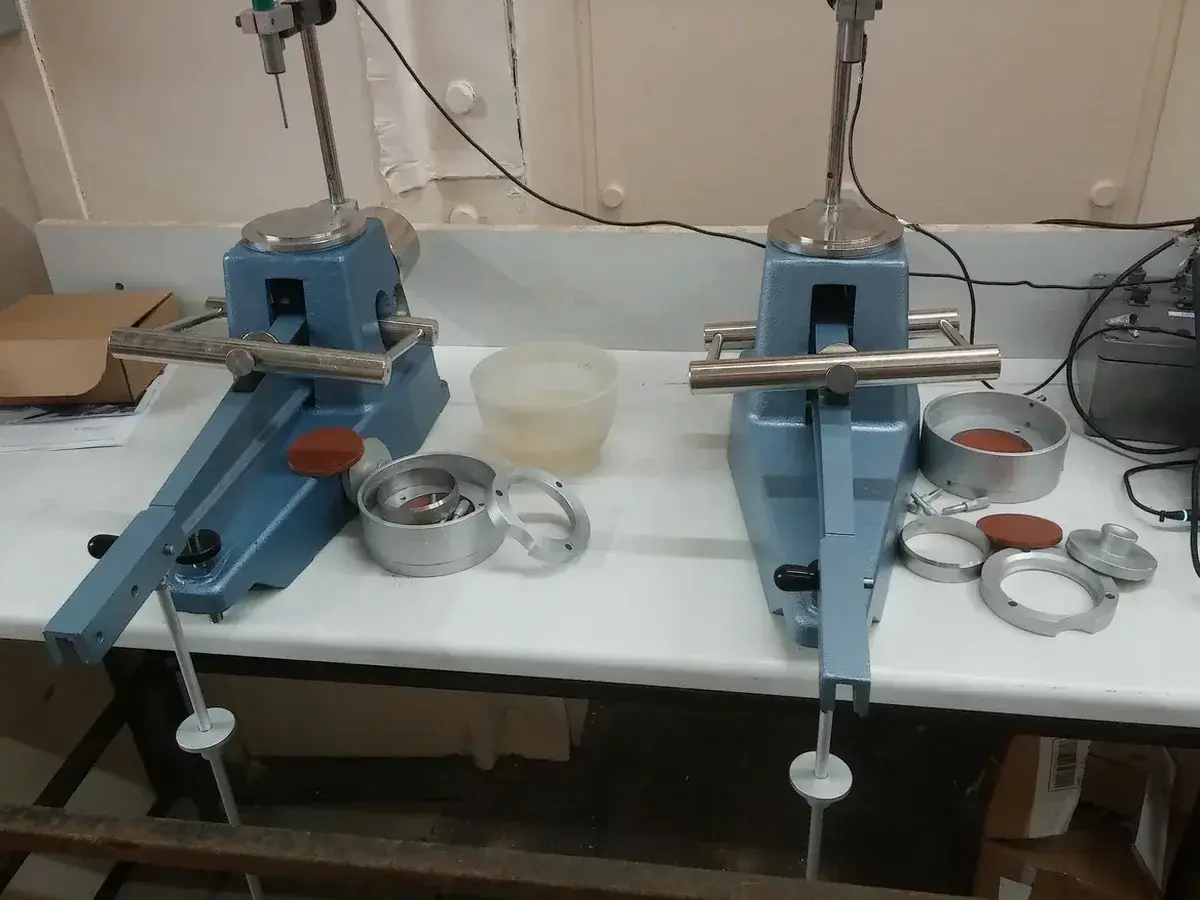
Albuquerque sits on a complex alluvial fan where the Rio Grande cuts through the basin. The soil here is not just sand. It shifts between silty deposits near the river and expansive clays on the east mesa. The diurnal temperature swing can exceed 30 degrees Fahrenheit, and the monsoon season dumps intense rainfall in July and August. This wet-dry cycling wreaks havoc on foundations if the soil's consistency isn't properly classified. We run the Atterberg limits test to pinpoint exactly how your subgrade behaves when moisture content changes. Our lab team processes samples from the Northeast Heights down to the South Valley, delivering liquid and plastic limits that align with ASTM D4318 standards. Pairing this with a grain-size analysis helps us build a complete picture of the soil's engineering profile before any grading begins.
A plasticity index above 25 in Albuquerque's east mesa clays means the soil can swell enough to lift a lightly loaded slab by two inches or more.
Process and scope
Area-specific notes
The risk profile changes dramatically between the North Valley and the foothills of Sandia Heights. In the North Valley, near the acequia network and shallow groundwater, we see silty clays with moderate plasticity. Foundations here are vulnerable to consolidation settlement when the water table drops during drought cycles. Drive 20 minutes east to the Sandia foothills and you are dealing with residual clays derived from weathered granite and limestone. These soils have liquid limits that can exceed 50 percent. A contractor who treats both sites the same way is asking for trouble. We have seen unclassified fill placed in the Northeast Heights that absorbed monsoon moisture and expanded unevenly, causing differential movement across a single slab within the first year. Atterberg limits testing is not optional in these conditions. It is the baseline data that determines whether you need to over-excavate, lime-treat, or switch to a structural floor system. The IBC Chapter 18 requires this classification for expansive soil zones, and Albuquerque falls squarely within that category.
Relevant standards
ASTM D4318-17e1: Standard Test Methods for Liquid Limit, Plastic Limit, and Plasticity Index of Soils, ASTM D2487-17: Standard Practice for Classification of Soils for Engineering Purposes (Unified Soil Classification System), IBC 2021 Chapter 18: Soils and Foundations (expansive soil provisions)
Linked services
Complete Atterberg Limits Suite
Liquid limit by Casagrande cup, plastic limit by thread rolling, and calculated plasticity index. Includes USCS classification and moisture content determination.
One-Point Liquid Limit
Single-point liquid limit test for projects with tight budgets and homogeneous soil units. Valid when the blow count falls between 22 and 28. We multiply the moisture content by a correction factor per ASTM D4318 Annex.
Shrinkage Limit & Linear Shrinkage
Additional index testing for highly plastic clays where volume change is a primary concern. We measure the water content below which further drying causes no volume reduction, and report the linear shrinkage bar result.
Typical parameters
Common questions
What does the plasticity index actually tell me about my Albuquerque building site?
The plasticity index gives you the range of moisture contents over which the soil behaves plastically. In Albuquerque's east mesa clays, a PI above 25 means the soil can absorb significant water before transitioning from a semi-solid to a plastic state. That translates directly to shrink-swell potential. A PI below 10 typically indicates silty material with low expansion risk, more common near the river. We use this number to specify foundation depths and to decide whether moisture conditioning or chemical stabilization is needed before placing fill.
How much does Atterberg limits testing cost for a residential lot in Albuquerque?
For a standard Atterberg limits suite on a single sample, you are looking at US$60 to US$90. That covers the liquid limit, plastic limit, and the report. If you need multiple samples from different depths or locations on the lot, the cost scales with the number of tests. We recommend at least two samples per boring when the soil profile changes with depth.
Can you run the test on soil from a hand auger or do I need a drill rig?
We can run Atterberg limits on disturbed samples from a hand auger, test pit, or drill rig. The method does not require undisturbed specimens. What matters is that the sample is representative of the layer you are classifying and that it arrives at the lab in a sealed bag to preserve the natural moisture content. We air-dry and process it through the No. 40 sieve before testing.
How long does the lab take to deliver Atterberg limits results in Albuquerque?
Standard turnaround is 3 to 5 business days from the time the sample arrives at the lab. If you are on a tight construction schedule, we offer a 24-hour expedited option. The test itself involves air-drying, sieving, and then running the Casagrande cup and plastic limit procedures, which are operator-dependent and cannot be rushed without compromising accuracy.