Albuquerque sits on the Rio Grande rift, where deep alluvial deposits and basin-fill sediments create a complex seismic response that standard borings alone cannot capture. The HVSR microtremor survey (Nakamura method) measures ambient vibrations to identify fundamental resonance frequencies and site amplification factors — critical data for IBC 2018 and ASCE 7-22 compliance. Without this passive seismic technique, designers risk assuming uniform ground motion across a site that actually amplifies long-period waves from distant earthquakes. We combine this survey with MASW-Vs30 profiling to cross-validate shear-wave velocity models before finalizing the seismic site class.
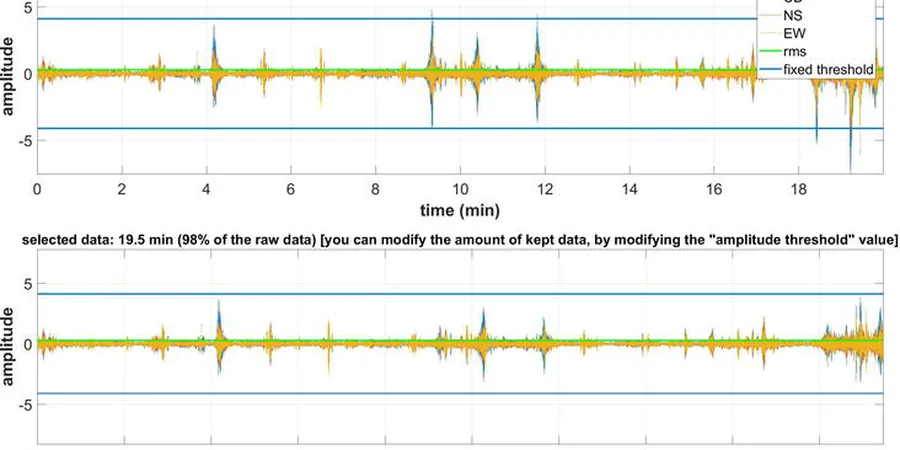
For deep alluvial basins like Albuquerque's, the H/V peak frequency alone can predict sediment thickness within ±15% when calibrated with a single borehole.
Scope of work
- Fundamental resonance frequency (f₀) — typically 0.3–2 Hz for deep basins
- Sediment thickness estimation using the f₀–depth relationship (e.g., Ibs-von Seht empirical curves)
- Site amplification factor (A₀) — directly applicable to NEHRP site class adjustments
Area-specific notes
ASCE 7-22 requires site-specific ground motion hazard analysis for Seismic Design Categories D, E, and F — common in Albuquerque's Rio Grande valley zone. Using generic NEHRP site classes without HVSR data can underestimate spectral accelerations by 30–50% at periods longer than 0.5 seconds, where flexible structures (steel frames, tall buildings) are most vulnerable. The Nakamura method directly identifies the site period; if this period coincides with the building's natural period, resonance occurs and ductility demand spikes. We flag this risk early in the design phase so that the structural engineer can adjust stiffness or add damping rather than discovering the mismatch during a post-earthquake review.
Standards used
SESAME (Site Effects Assessment using Ambient Excitations) — 2004 guidelines, ASCE 7-22 – Minimum Design Loads and Associated Criteria for Buildings (Chapter 21), IBC 2018 – International Building Code (Section 1613)
Linked services
Single-Station HVSR (Reconnaissance)
Ideal for preliminary screening of large sites (≥5 acres). One seismometer records ambient vibrations at multiple points along a grid, producing a resonance frequency map that identifies zones requiring detailed Vs30 profiling. Typical turnaround: 2 days for field + report.
Multi-Station HVSR Array (Detailed)
Simultaneous deployment of 4–6 seismometers across the site to capture spatial variation in sediment thickness and amplification. Output includes 2D cross-sections of the bedrock interface, directly usable for foundation design and liquefaction triggering analyses per NCEER 2001.
Typical parameters
Common questions
How much does an HVSR microtremor survey cost in Albuquerque?
For a typical single-station survey covering 2–5 points, the price ranges between US$1,630 and US$2,680, including field deployment, data processing, and a technical report. Larger multi-station arrays or surveys requiring calibration with a borehole may cost more depending on access and logistics.
What is the difference between HVSR and MASW for site classification?
HVSR measures the horizontal-to-vertical spectral ratio of ambient vibrations to find the fundamental resonance frequency (f₀) and amplification factor, while MASW directly measures shear-wave velocity (Vs) with depth. HVSR is faster and cheaper for identifying the site period, but MASW provides the Vs30 profile required by ASCE 7-22 for rigorous site class assignment. We often use HVSR as a screening tool before committing to a full MASW line.
Can HVSR detect the depth to bedrock in Albuquerque's valley?
Yes. The empirical relationship between f₀ and sediment thickness has been validated for the Albuquerque basin. For example, an f₀ of 0.4 Hz corresponds to roughly 150–200 m of sediment. Accuracy improves when we calibrate the H/V peak against a single borehole log or Vs30 profile from a nearby site.
Do I need HVSR for a single-family home foundation in Albuquerque?
For a typical residential foundation on competent soil (NEHRP site class C or D), a standard soil report with SPT borings is usually sufficient. HVSR becomes relevant when the structure exceeds three stories, or when the site is within 500 m of the Rio Grande or on the east mesa edge where basin-edge effects amplify shaking. We recommend it for any project in Seismic Design Category D or higher.