A pile foundation design for a building near the Rio Grande behaves quite differently from one placed on the West Mesa basalt flows. In the North Valley, loose alluvial sands and a high water table often demand driven piles or drilled shafts that derive capacity from skin friction. Uptown, where the ground is stiffer, end-bearing piles socketed into the Santa Fe Formation are the norm. That contrast shows why a single approach never works across Albuquerque. Before selecting a pile type, engineers typically run a cone penetration test to profile the soil resistance layer by layer. That data drives the design parameters for both axial and lateral loads.
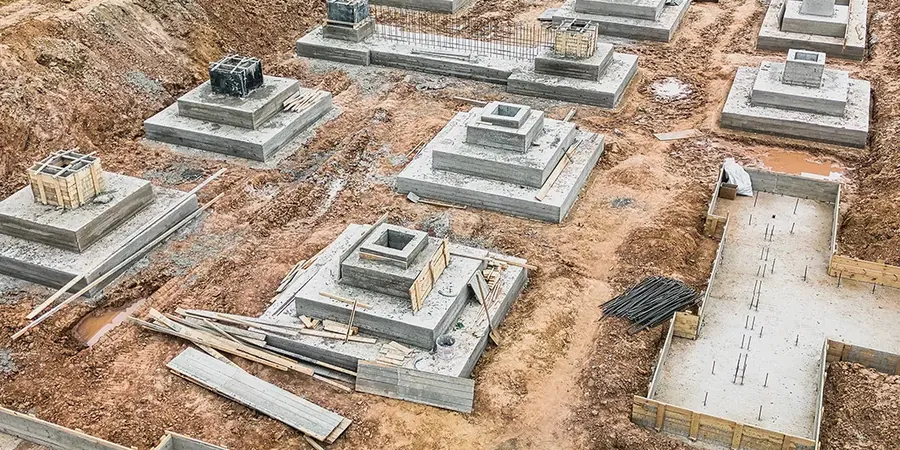
In Albuquerque, the biggest design variable is not the structure, but the 30 meters of variable alluvium beneath it.
Scope of work
- Unit shaft resistance from standard penetration test (SPT) blow counts (ASTM D1586) calibrated to local soil types
- End-bearing capacity in dense sands or cemented caliche layers using empirical correlations from O'Neill and Reese (1999)
- Downdrag potential when fill or soft clay overlies bearing strata
- Group efficiency for pile caps under concentrated column loads
Area-specific notes
Albuquerque's rapid suburban expansion since the 1970s pushed construction onto old river terraces and arroyo fills. Many subdivisions in the South Valley were built on undocumented fill placed decades ago. In those areas, pile foundation design must account for negative skin friction as the fill consolidates under its own weight. Collapsible soils also appear in the east foothills, where seasonal wetting can trigger sudden settlement around pile caps. We have seen projects where ignoring collapsible layers led to structural distress within two years. A phased field investigation, including soil moisture monitoring and plate load tests, helps avoid those outcomes.
Standards used
IBC 2021 – Chapter 18 (Foundations), ACI 543R-12 – Design, Manufacture, and Installation of Concrete Piles, ASTM D3966 – Standard Test Methods for Deep Foundations Under Lateral Load, FHWA-NHI-16-072 – Drilled Shafts: Construction Procedures and LRFD Design Methods
Linked services
Drilled Shaft Design & Load Testing
For structures requiring high individual pile capacity, we design drilled shafts (caissons) socketed into the Santa Fe Formation. We specify Osterberg cell or static load tests per ASTM D1143 to verify design assumptions. Our reports include settlement estimates and group interaction factors.
Pile Driving & Dynamic Analysis
When driven piles (H‑piles or precast concrete) are more economical for friction conditions, we perform PDA (Pile Driving Analyzer) testing per ASTM D4945. We correlate wave equation analysis with local blow-count records from the Rio Grande valley to optimize hammer energy and reduce refusal risks.
Typical parameters
Common questions
How does the high water table near the Rio Grande affect pile foundation design?
A shallow water table reduces effective stress in the upper soil layers, lowering shaft friction for driven piles. We recommend displacement piles (closed-end pipe piles) to minimize soil disturbance, and we specify concrete mixes with low permeability per ACI 318 to avoid deterioration in saturated conditions.
What is the typical cost range for a pile foundation design study in Albuquerque?
For a standard commercial project, the geotechnical investigation and design report for pile foundations typically costs between US$1,500 and US$6,050. The final price depends on the number of borings, depth of investigation, and whether load testing is included.
When should I use drilled shafts instead of driven piles in Albuquerque soils?
Drilled shafts are preferred when bearing strata are deep (over 15 m) or when large lateral loads are expected — for example, in parking structures with cantilevered slabs. They also avoid the vibration and noise concerns of pile driving near existing buildings in the Downtown area.
Do I need a pile foundation for a single-story house on the West Mesa?
Most single-story homes on the West Mesa can be supported on shallow spread footings because the basalt cap provides high bearing capacity. Pile foundations are generally reserved for sites with deep collapsible soils or when the structural loads exceed 200 kN per column. We recommend a site-specific evaluation to confirm.