I still remember a project on Central Avenue where a five-story parking structure started showing differential settlement after a wet monsoon season. The culprit was the loose, silty sand that underlies much of the valley floor near the Rio Grande. That's when the structural engineer called for a deep soil improvement solution. Jet grouting design in Albuquerque requires understanding how cement grout interacts with the local caliche-cemented layers and the high groundwater table that fluctuates with the river. Before we even start the design, we review the site's stratigraphy from previous borings and often combine the treatment with a drainage system to control pore pressures during curing. The key is to match the grout injection parameters — pressure, flow rate, rod rotation speed — to the actual soil conditions found on site.
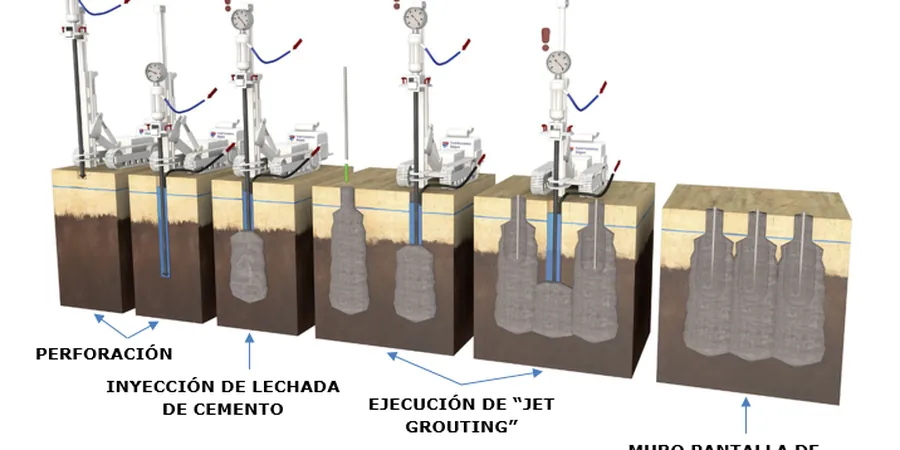
Jet grouting in Albuquerque's alluvial sands requires adjusting injection parameters for the caliche lenses that deflect cutting jets.
Scope of work
- Water/cement ratio between 0.8 and 1.2 depending on sand content
- Injection pressure from 350 to 450 bar for monterod systems
- Nozzle diameter and number (typically 2-4 nozzles of 2.5-3.5 mm)
- Rod withdrawal rate of 5-15 cm/sec based on target column diameter
Area-specific notes
Take two neighborhoods: the West Mesa, where you find dense caliche and volcanic tuff near the surface, versus the North Valley, where you hit loose silty sand and groundwater at 3 meters. If you apply the same jet grouting design in Albuquerque for both zones, you'll get very different results. On the West Mesa, the columns may under-ream due to the hard caliche binding the jet, while in the North Valley the high water table can cause the grout to mix with groundwater and lose strength. That's why we always run a trial column at every site before finalizing the production design parameters.
Standards used
ASCE 7-22 (Minimum Design Loads and Associated Criteria), IBC 2021 (International Building Code, Chapter 18 — Soils and Foundations), ASTM D1586-18 (Standard Test Method for Standard Penetration Test), ASTM D2487-17 (Standard Practice for Classification of Soils for Engineering Purposes)
Linked services
Structural Underpinning Design
For existing buildings showing settlement on the valley's loose sands, we design jet grout columns beneath the footings to transfer loads to competent strata. We adjust the column spacing and diameter to match the existing foundation layout and the soil's bearing capacity.
Groundwater Cutoff Walls
When excavating below the water table near the Rio Grande, a jet grout curtain can seal off seepage. We design the panel geometry and overlap to achieve a permeability of 1x10⁻⁶ m/s or less, considering the local silty sand gradation.
Bottom Seal for Deep Excavations
For deep basements or utility vaults, we design a jet grout bottom plug to control hydraulic uplift. The design accounts for the artesian pressure in the underlying gravel layer that is common in Albuquerque's deeper aquifers.
Typical parameters
Common questions
How does jet grouting design differ for Albuquerque's caliche soils?
Caliche is a cemented calcium carbonate layer that can deflect the cutting jet, reducing column diameter. We compensate by increasing injection pressure to 420-450 bar and reducing rod withdrawal rate to 8-10 cm/s to ensure the jet penetrates the caliche lenses. Trial columns are essential to verify the effective diameter.
What is the typical cost range for a jet grouting design in Albuquerque?
The design cost including laboratory testing, trial column verification, and final production parameters typically ranges from US$1.600 to US$6.180 depending on the number of trial columns and the complexity of the soil profile. This covers the geotechnical investigation, parameter optimization, and a detailed execution plan.
Which building codes apply to jet grouting design in Albuquerque?
We follow the 2021 International Building Code (IBC) and ASCE 7-22 for load combinations. The design must also comply with ASTM D1586 for soil characterization and the local amendments of the City of Albuquerque's building code, which includes specific requirements for deep foundations near the Rio Grande floodplain.
How deep can jet grouting columns reach in Albuquerque's soil conditions?
With modern equipment, we can design columns up to 25 meters deep. The practical limit is usually the presence of dense caliche layers below 20 meters, which can reduce the jet's cutting efficiency. For depths beyond 20 meters, we often recommend combining jet grouting with other soil improvement techniques like deep soil mixing.
What is the typical strength of a jet grout column in Albuquerque's sands?
For the silty sands of the Rio Grande Valley, we design for unconfined compressive strengths of 3 to 8 MPa at 28 days. The actual strength depends on the water/cement ratio and the in-situ density of the sand. We always run a trial column and test cores to confirm the design strength before proceeding with production columns.