Albuquerque sits at 5,312 feet above sea level on the Rio Grande rift, a tectonic setting that gives us a mix of alluvial fans, old river terraces, and basin-fill sediments. The soils here range from loose sands near the river to stiff, overconsolidated clays in the east mesa areas. For cohesive soils, the unconfined compression test (UCS) is one of the fastest ways to get undrained shear strength. We run it on undisturbed thin-wall tube samples, following ASTM D2166-16, to deliver quick numbers for immediate bearing capacity estimates. Before we go deeper, we often pair the UCS with a granulometría to classify the fines, and with límites de Atterberg to understand plasticity — both help us judge whether the sample is truly cohesive or has silt behavior that would need a different test.
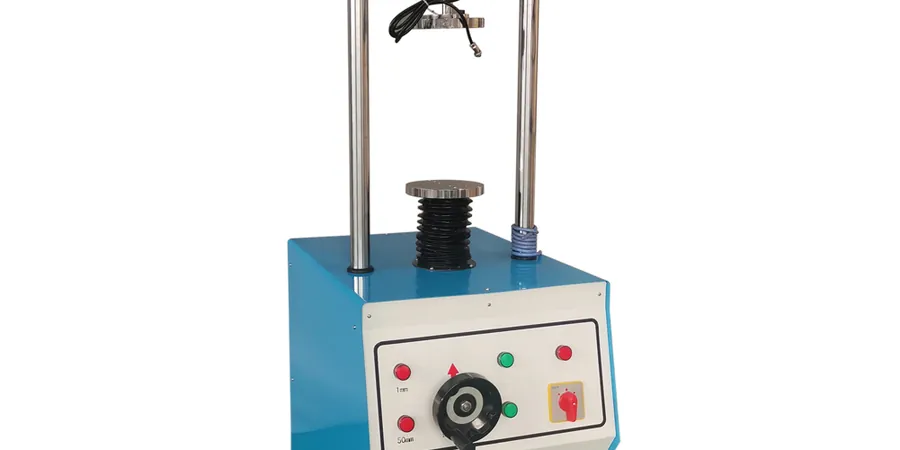
A UCS test on Albuquerque's high-plasticity clay can show undrained strength varying by a factor of three within a single borehole — moisture control is everything.
Scope of work
- UCS (qu) – 1.5 to 6.0 kg/cm² for stiff clays; soft lacustrine layers below 1.0 kg/cm²
- Strain at failure – 3% to 12%, with brittle samples failing at lower strain
- Undrained shear strength (su) – qu/2, typically 0.75–3.0 kg/cm²
- Sample quality – block samples from test pits or thin-wall Shelby tubes
Area-specific notes
The Rio Grande rift makes Albuquerque a moderate seismic zone (IBC Site Class C to D depending on the mesa). The biggest risk with UCS is assuming it represents in-situ strength for all loading conditions. In our experience, the high-plasticity clays on the west mesa can lose up to 40% of their undrained strength when saturated — and Albuquerque's monsoon events (July–September) can raise the water table temporarily. If you design based only on a dry-season UCS, you might under-design for a wet year. That is why we always check natural moisture content and recommend a suelos expansivos assessment when plasticity index exceeds 25.
Watch how it works
Standards used
ASTM D2166-16 – Standard Test Method for Unconfined Compressive Strength of Cohesive Soil, ASTM D1587-15 – Standard Practice for Thin-Walled Tube Sampling of Fine-Grained Soils, ASTM D2487-17 – Standard Practice for Classification of Soils for Engineering Purposes (USCS), IBC 2021 – Section 1803 (Geotechnical Investigations) and Section 1613 (Seismic)
Linked services
UCS Test on Thin-Wall Tube Samples
Standard unconfined compression test on 50 mm or 75 mm diameter undisturbed samples. Includes trimming, moisture content, density determination, and stress-strain curve. Results in 48 hours.
UCS with Suction Measurement
For unsaturated clays common in the east mesa, we add matric suction measurement using the filter paper method (ASTM D5298). This gives a more realistic undrained strength value for slope stability and shallow foundation design.
Typical parameters
Common questions
What is the difference between UCS and unconsolidated undrained (UU) triaxial test?
UCS applies no confining pressure — it is a quick test for cohesive soils that can stand unsupported. The UU triaxial test (ASTM D2850) applies a confining stress to simulate in-situ lateral pressure, giving a more accurate undrained strength for deeper foundations. We recommend UU for depths below 3 meters or when the soil is fissured.
How much does the unconfined compression test cost in Albuquerque?
The typical cost for a single UCS test in Albuquerque ranges from US$330 to US$450, including sample preparation and a basic report. Volume discounts apply for multiple samples from the same project.
When should I use UCS instead of a triaxial test for my Albuquerque project?
Use UCS for preliminary investigations, small residential slabs, or pavement subgrade evaluation where the soil is clearly cohesive and the failure surface is shallow. For retaining walls, deep excavations, or any structure where lateral stress matters, a triaxial test is mandatory.
What sample quality is required for a reliable UCS result?
We need undisturbed samples from thin-wall Shelby tubes (ASTM D1587) or block samples from test pits. Samples must be sealed immediately and tested within 2 weeks. Disturbed or dried-out samples give artificially high strength values that can lead to unsafe foundation designs.