A five-story mixed-use building going up near Central Avenue and I-25 hit a snag last year. The geotechnical team drilled three boreholes and ran SPT tests every 1.5 meters. At 6 meters depth, the blow counts dropped from 18 to 6 in sandy silt with gravel. That told us the bearing layer was deeper than the structural drawings assumed. Without that data, the foundation design would have been under-designed for the actual soil profile. That is why SPT in Albuquerque is not a checkbox — it is the backbone of safe foundation design in this valley.
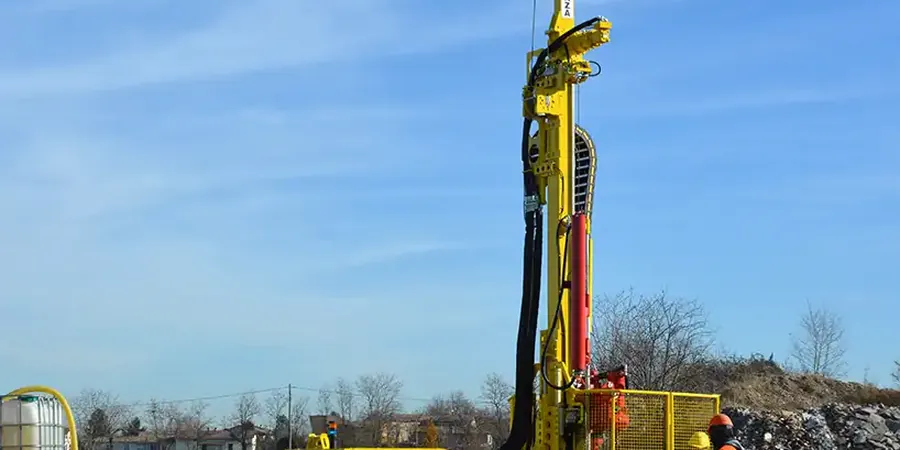
The SPT N-value is the single most important field parameter for estimating bearing capacity and liquefaction resistance in granular soils.
Scope of work
Area-specific notes
Albuquerque sits on the Rio Grande rift, a geologically active zone with deep alluvial deposits, ancient river terraces, and buried channels. The urban expansion since the 1970s has pushed development onto older floodplains and colluvial slopes where soil density varies drastically over short distances. A single house lot near the Sandia foothills can have loose sands overlaying stiff clay — or vice versa. If the SPT is not run deep enough to identify the competent bearing layer, differential settlement can crack slabs and tilt retaining walls within the first five years.
Standards used
ASTM D1586-18 — Standard Test Method for Standard Penetration Test (SPT), ASTM D2487-17 — Standard Practice for Classification of Soils for Engineering Purposes (USCS), IBC 2021 — Section 1803 (Geotechnical Investigation Requirements)
Linked services
Standard SPT with Soil Sampling
Full split-spoon sampling at 1.5 m intervals, log of blow counts per ASTM D1586, and visual classification of recovered soil. Samples bagged for lab testing.
Liquefaction Screening (SPT-based)
N-value correction for fines content, overburden, and energy ratio. We apply the Youd-Idriss 2001 method to flag liquefaction-prone layers in seismic zones.
Bearing Capacity Estimation
Using Terzaghi and Meyerhof methods with corrected N-values to calculate allowable bearing capacity for shallow and deep foundations. Results delivered in a clear table.
SPT with Shelby Tube Sampling
Alternate sampling: SPT blows at 1.5 m intervals plus thin-walled Shelby tube (ASTM D1587) in cohesive layers for undisturbed triaxial or consolidation testing.
Typical parameters
Common questions
How is the SPT N-value corrected for depth in Albuquerque's deep alluvium?
We apply the overburden correction factor (Cn) per NCEER 1997. For depths greater than 6 m in loose sands, Cn can increase N by 30% to 50%. The corrected N₆₀ is the value used for liquefaction assessment and bearing capacity calculations.
What is the typical SPT refusal condition in Albuquerque soils?
Refusal is defined as 50 blows for a 300 mm advance, or 100 blows total for the full 450 mm. In the Albuquerque area, refusal often occurs in the cemented caliche layers or in the dense gravels of the ancestral Rio Grande terrace deposits.
Can SPT detect liquefaction-prone layers in Albuquerque?
Yes. We use the SPT-based method by Youd and Idriss (2001) to calculate the cyclic resistance ratio (CRR). Layers with N₁,₆₀ below 15 in saturated sands within 15 m depth are typically flagged. In Albuquerque, these occur near the Rio Grande floodplain and old channel fills.
How much does an SPT test cost in Albuquerque?
A standard SPT borehole with sampling at 1.5 m intervals to 15 m depth typically ranges between US$550 and US$860, depending on access, number of boreholes, and whether Shelby tube samples are required. We provide a firm quote after reviewing the site plan.