A 10-story hotel going up near the I-25 and I-40 interchange hit a delay when the geotechnical report showed variable clay layers under the site. The design team needed numbers—how much would the foundation settle over time? That is where the oedometer consolidation test comes in. For Albuquerque projects built on the expansive clay soils of the Santa Fe Group, measuring consolidation parameters is not optional. Our lab runs the test per ASTM D2435 to give you the compression index and preconsolidation pressure directly. We have seen projects where ignoring these numbers led to cracked slabs and misaligned floors within two years. Before you pour concrete, combine this data with a granulometry test to understand the full soil profile.
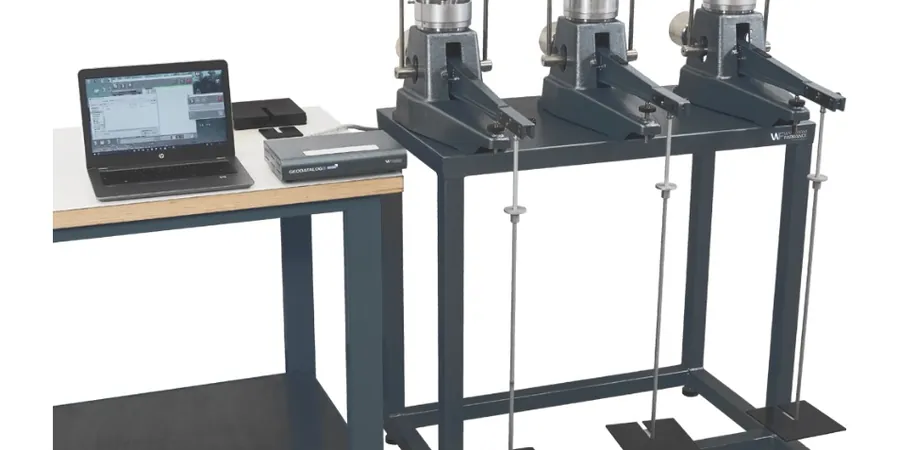
For Albuquerque projects on Santa Fe Group clays, the oedometer test gives the settlement numbers that prevent cracked slabs and misaligned floors.
Scope of work
Area-specific notes
A common mistake we see in Albuquerque is skipping the oedometer test for projects on the east mesa or near the Rio Grande valley. The clay layers there have moderate to high plasticity, and the consolidation behavior changes with depth. Without the compression index, engineers guess the settlement magnitude. That guess often leads to over-designed foundations or, worse, differential settlement after occupancy. We have documented cases where 15 cm of settlement occurred in five years because the design assumed 5 cm. The oedometer consolidation test eliminates that guess. It gives you the hard numbers to size footings correctly and plan for post-construction settlement.
Watch how it works
Standards used
ASTM D2435-11 — Standard Test Methods for One-Dimensional Consolidation Properties of Soils, ASTM D4546 — Standard Test Methods for One-Dimensional Swell or Collapse of Soils, IBC 2021 Section 1803 — Geotechnical Investigation Requirements
Linked services
Standard Incremental Loading Oedometer
Six to eight load increments with 24-hour hold per step. Delivers Cc, Cr, Cv, and preconsolidation pressure. Ideal for routine foundation design in clay soils.
Consolidation with Swell Pressure Measurement
Adds a swell test under a nominal load to measure heave potential. Essential for sites with expansive clays common in the Albuquerque area.
Multi-Stage Oedometer for Deep Fills
Extended load sequence up to 1600 kPa for projects with high embankments or surcharge loads. Includes rebound and reload cycles for elastic parameters.
Typical parameters
Common questions
How long does an oedometer consolidation test take in Albuquerque?
A standard test with six to eight load increments takes 7 to 10 days. Each load step holds for 24 hours, plus time for sample preparation and data analysis. If you need results faster, we can discuss a reduced load schedule, but the full curve gives the best settlement prediction.
What is the cost range for an oedometer consolidation test?
The typical range for a single oedometer test in Albuquerque is between US$210 and US$440. The final price depends on the number of load steps, whether swell pressure is included, and the total number of specimens. Contact us for a quote specific to your project scope.
When should I request an oedometer test instead of a triaxial test?
Use the oedometer when the main concern is vertical settlement under a static load—like a building foundation or a fill embankment. The triaxial test measures shear strength, not consolidation. For Albuquerque clay sites, both tests are often needed: the oedometer for settlement and the triaxial for bearing capacity.