Albuquerque sits on the eastern edge of the Rio Grande Rift, a geologically active zone with deep alluvial sands, gravels, and occasional clay lenses. For projects that require transferring loads to competent strata at depth — like historic building retrofits in Old Town or new construction on the West Mesa — micropile design is a practical solution. We follow IBC Chapter 18 and ASCE 7-22 for lateral and axial load resistance, adapting each layout to the local soil profile. Before finalizing the micropile arrangement, our team often runs a MASW survey to map shear-wave velocity contrasts across the site, which directly influences pile embedment depth and group efficiency.
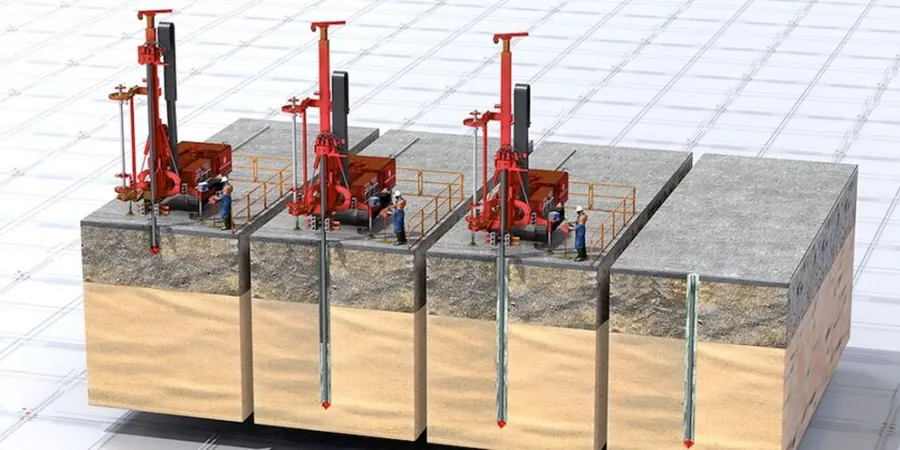
In Albuquerque's rift-zone soils, a properly designed micropile transfers structural loads through loose sands and into competent bedrock or dense alluvium, reducing settlement risk.
Scope of work
- Axial capacity verification via static load tests (ASTM D1143)
- Corrosion protection for the steel casing per IBC 1808.8
- Grout mix design targeting 5,000 psi minimum compressive strength
Area-specific notes
A common mistake we see in Albuquerque is assuming that a shallow footing will work on the sandy soils near the valley floor. Builders sometimes skip deep foundation analysis and end up with uneven settlement after the first monsoon season. Micropile design avoids that risk by reaching competent layers that don't shift with moisture changes. Without it, a structure on these alluvial deposits can experience differential settlement of over an inch within the first year, cracking slabs and misaligning utility connections. We've seen this happen on mid-rise apartment projects along Central Avenue — it's an expensive lesson that proper deep foundation design would have prevented.
Standards used
IBC 2021 Chapter 18 (Foundations), ASCE 7-22 (Minimum Design Loads), FHWA-NHI-16-072 (Micropile Design & Construction), ASTM D1143/D1143M (Static Axial Compressive Load Test)
Linked services
Design for Structural Retrofit & Seismic Upgrade
Many older buildings in Albuquerque's downtown and historic districts need foundation reinforcement to meet current seismic codes. We design micropiles that can be installed with low headroom and minimal vibration, preserving existing structures while adding capacity for lateral and vertical loads.
Design for Hillside & Slope Construction
Homes and retaining structures on the Sandia foothills or West Mesa bluffs require foundations that resist both axial loads and lateral earth pressure. We design micropile systems tied into the bedrock, often combining them with grade beams to create a unified foundation mat.
Typical parameters
Common questions
What is the typical cost range for a micropile design in Albuquerque?
For a standard residential or small commercial project in Albuquerque, the design and testing phase typically runs between US$1,560 and US$4,970, depending on the number of piles, required load testing, and site access conditions. This includes the geotechnical interpretation, structural calculations, and construction drawings.
How deep do micropiles need to go in Albuquerque's soils?
Depths vary widely across the city. In the Rio Grande valley, we often reach 30 to 60 feet to find dense alluvium or the Santa Fe Group bedrock. On the East Mesa near the mountains, competent rock may be encountered at 15 to 25 feet, so the piles can be shorter but still require a rock socket for end-bearing capacity.
Can micropiles be installed next to existing foundations without damage?
Yes — that's one of their main advantages. Using a small-diameter drill rig, we can work within 3 feet of an existing footing without causing settlement or vibration damage. This makes micropiles ideal for underpinning historic structures in Albuquerque's older neighborhoods, where access is tight and preserving the original building is critical.