When tunneling through soft soils in Albuquerque, the local geology demands rigorous analysis under ASCE 7 and IBC. The Rio Grande valley fill here can be loose, with shallow groundwater in many areas. That makes a proper geotechnical investigation non-negotiable — especially when you're working beneath the city's volcanic basalt cap or through the unconsolidated Santa Fe Group sediments. Our lab follows ASTM D1586 for standard penetration testing and ASTM D2487 for soil classification, ensuring every tunnel alignment is backed by real data. Before you break ground on any soft ground tunnel, you need to pair this with a focused study of liquefaction potential to understand seismic risk, and a deep dive into groundwater infiltration patterns that could destabilize the face during excavation.
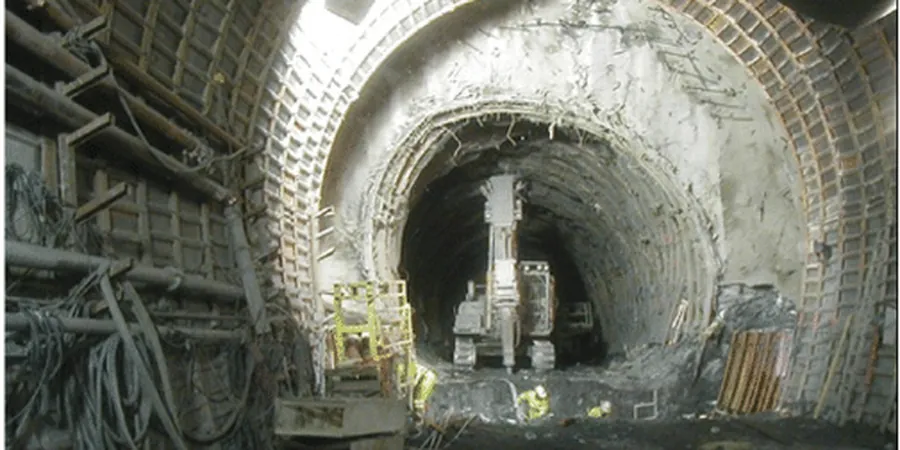
In Albuquerque's alluvial soils, a single missing data point on groundwater can turn a stable tunnel face into a collapse risk.
Scope of work
Area-specific notes
In Albuquerque, we often see tunnel projects stumble because the investigation skipped the shallow groundwater fluctuations along the Rio Grande corridor. A dry test pit in October can be a flooded face in March. That variability can wash out the tunnel face or cause sudden settlements above. Another common issue is the presence of buried cobble lenses within the soft matrix — they act like hard spots that deflect the TBM or damage cutter heads. Without a thorough geotechnical analysis for soft soil tunnels that maps these heterogeneities, you risk expensive delays and structural damage to adjacent utilities.
Standards used
ASCE 7-22 (Minimum Design Loads, including Seismic), IBC 2021 (International Building Code, Chapter 18), ASTM D1586-18 (Standard Penetration Test), ASTM D2435-11 (Consolidation Properties)
Linked services
Field Exploration & Sampling
Boreholes up to 30 meters with continuous SPT sampling. We also deploy Shelby tubes for undisturbed samples and install standpipe piezometers to track the water table across the tunnel alignment.
Advanced Lab Testing
Consolidation, triaxial (CU & UU), and direct shear tests on soft soil specimens. We also run index tests — Atterberg limits, grain size, and organic content — to fully classify each stratum.
Seismic & Deformation Analysis
We compute ground response using site-specific vs30/" data-interlink="1">shear wave velocity profiles (MASW) and run 2D finite element models to predict tunnel-induced settlements and lining loads under seismic conditions.
Typical parameters
Common questions
How much does a geotechnical analysis for soft soil tunnels cost in Albuquerque?
The typical range for a comprehensive tunnel geotechnical investigation in Albuquerque is between US$3,770 and US$17,320. The final cost depends on the number of boreholes, depth of exploration, lab testing volume, and whether seismic analysis is required. Contact us for a scope-specific quote.
What soil conditions are most problematic for tunnels in Albuquerque?
The biggest challenges come from the Santa Fe Group's interbedded sands, silts, and clays — especially where groundwater is shallow. Loose, saturated sands can run into the tunnel face, while stiff clay layers can cause squeezing. Buried cobble lenses also pose TBM cutter wear issues.
Do I need a seismic analysis for a tunnel in Albuquerque?
Yes. Albuquerque is in a moderate-to-high seismic zone (Site Class C to D per ASCE 7). The IBC requires a site-specific ground motion analysis for critical tunnels. We evaluate liquefaction potential and compute ground deformation under the design earthquake using NCEER and Youd-Idriss methods.
How deep should boreholes be for a tunnel investigation?
Boreholes should extend at least one tunnel diameter below the invert, and ideally 1.5 to 2 diameters to capture softer layers beneath the excavation. For shallow tunnels in Albuquerque's valley fill, we typically drill to depths of 15 to 25 meters.