We were called to a site near I-25 where a contractor was placing fill for a new retail center. The material looked good, but nobody had run a Proctor test on it. Within a week we saw differential settlement in the slab. That is exactly why we insist on proper compaction control. For every fill project in Albuquerque we run the Standard or Modified Proctor test to define the moisture-density curve. The soil here ranges from silty sands to clayey gravels, and each behaves differently. Without that curve you are guessing. We pair the Proctor with a granulometría to understand the full gradation before setting compaction specs.
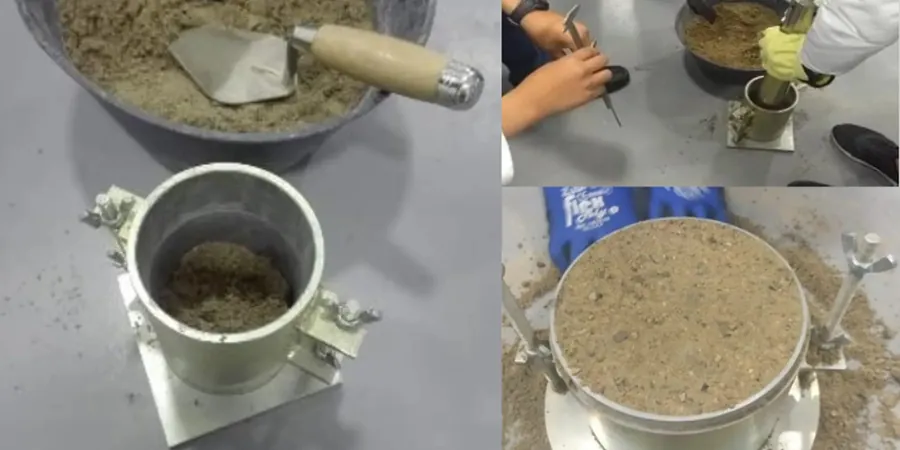
Without a proper Proctor curve, you are placing fill blind — and Albuquerque's alluvial soils will settle unevenly every time.
Scope of work
Area-specific notes
The most common mistake we see in Albuquerque is contractors using the Proctor from a similar project without testing the actual fill. The soils change block by block in this valley. One load of borrow from the east mesa can have a plasticity index double that of material from the west. If you compact at the wrong moisture, you get low density and high future settlement. Another error is running only the Standard Proctor on a subgrade that will see heavy truck traffic. The Modified test gives you a higher target density, which means less rutting and longer pavement life.
Standards used
ASTM D698-12 (Standard Proctor), ASTM D1557-12 (Modified Proctor), IBC 2021 Chapter 18 – Soil Compaction
Linked services
Standard Proctor Test (ASTM D698)
Suitable for general fills, residential slabs, and light commercial projects. Uses a 5.5 lb hammer dropped 12 inches to simulate light compaction equipment.
Modified Proctor Test (ASTM D1557)
Required for highway embankments, heavy industrial floors, and deep fills. Uses a 10 lb hammer dropped 18 inches to match heavy roller compaction.
Typical parameters
Common questions
What is the difference between Standard and Modified Proctor?
The Modified Proctor applies about 4.5 times more compactive energy. It gives a higher maximum dry density and a lower optimum moisture content. Use Standard for light fills and Modified for heavy traffic or structural fills.
How much does a Proctor test cost in Albuquerque?
A typical Proctor test runs between US$100 and US$210, depending on whether it is Standard or Modified and how many moisture points are required. Volume discounts apply for multiple samples.
Do I need a Proctor test for every lift of fill?
No, but you need one for each distinct soil type. If the borrow source changes, run a new Proctor. Field density tests (such as nuclear gauge or sand cone) then verify that each lift achieves 95% of the target density.
How long does the Proctor test take to complete?
The lab test itself takes 2 to 4 days from sample receipt. That includes drying, compaction at 5 moisture points, and plotting the curve. We can expedite to 24 hours for critical path work.