Many times in Albuquerque we see pavement distress show up just a few years after resurfacing. The culprit is often a subgrade that was never properly evaluated before the overlay went down. A thorough existing pavement evaluation catches those hidden weak zones before you commit to a new surface course. We combine falling weight deflectometer readings with coring and laboratory testing to give you a complete picture of what is left in the existing structure. This approach saves money by avoiding premature failures and lets you design overlays that actually last. We also integrate pavement evaluation with CBR testing when the subgrade needs a direct strength assessment.
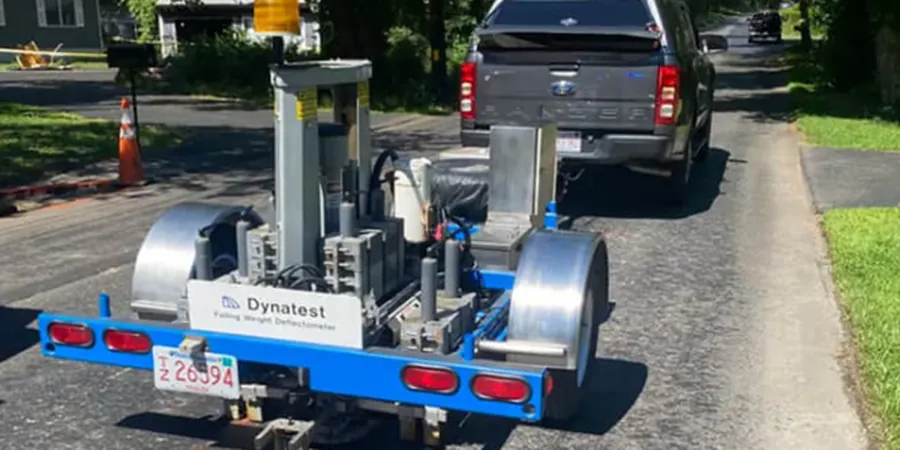
A thorough existing pavement evaluation catches hidden weak zones before you commit to a new surface course, saving money by avoiding premature failures.
Scope of work
Area-specific notes
Albuquerque sits on the Rio Grande rift, a geologically active zone with variable alluvial soils. The city has expanded rapidly over old agricultural land and arroyo deposits, so pavement performance can change dramatically within a single block. Without a proper existing pavement evaluation, you risk overlaying a section that has a soft subgrade from buried organic material or a base that has already lost its structural integrity. That leads to reflective cracking within months and a lawsuit from the property owner. A thorough investigation identifies those problem areas before the paver rolls in.
Standards used
ASTM D1586-18 (SPT for subgrade exploration), ASTM D4694-09 (Falling Weight Deflectometer), AASHTO T 307-99 (Resilient Modulus of Soils), ASTM D2487-17 (Unified Soil Classification for base/subbase)
Linked services
Pavement Coring & Layer Thickness Survey
Extract full-depth cores (asphalt, base, subgrade) at intervals specified by project scope. Measure each layer thickness, document distress patterns, and photograph cores for the report.
Falling Weight Deflectometer (FWD) Testing
Non-destructive deflection testing along the pavement section. Back-calculate layer moduli (E1, E2, E3) using AASHTO back-calculation software to determine remaining structural capacity.
Dynamic Cone Penetrometer (DCP) & Subgrade Assessment
In-situ DCP profiles at core locations to assess subgrade strength variability. Results are correlated to CBR and resilient modulus for overlay design inputs.
Typical parameters
Common questions
How much does an existing pavement evaluation cost in Albuquerque?
For a typical urban arterial section, costs range between US$1,130 and US$3,990 depending on the number of core locations, FWD test points, and laboratory tests required. We provide a firm quote after reviewing the project scope.
What standards do you follow for pavement evaluation?
We follow ASTM D4694/D4695 for FWD testing, ASTM D1586 for subgrade SPT borings, and AASHTO T 307 for resilient modulus of subgrade soils. All laboratory work is performed under our ISO 17025-accredited quality system.
When should I schedule a pavement evaluation before an overlay project?
Ideally at least two months before the paving contract is let. That gives time for coring, laboratory curing if needed, and report generation. In Albuquerque's freeze-thaw climate, fall evaluations are preferred to capture worst-case subgrade moisture conditions.