High desert climate in Albuquerque means low rainfall but deep seasonal moisture changes. On the West Mesa and along the Rio Grande valley, we find silty sands and clayey alluvium prone to long-term settlement under load. Preloading with surcharge design accelerates that settlement before construction. It's a controlled method: place a temporary fill that exceeds the final load, let the soil consolidate, then remove the excess and build. Before any design, we run a site investigation including standard penetration tests to profile the subsurface and consolidation tests to determine compression indices. Without those parameters, you cannot calculate the required surcharge height or wait time. We have done this in Albuquerque for warehouse districts, tank farms, and road embankments where tight schedules meet soft ground.
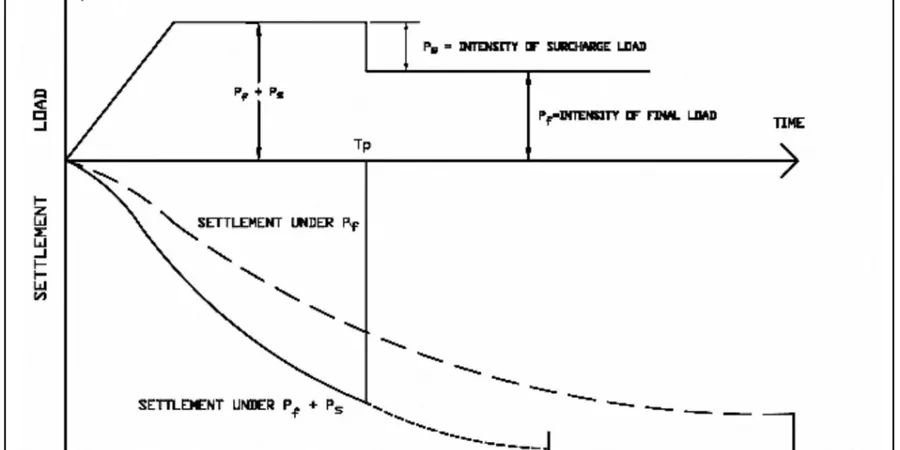
Surcharge design cuts post-construction settlement from inches to tolerable levels. Without it, Albuquerque's alluvial clays can settle unevenly for years.
Scope of work
- Determine primary consolidation settlement from oedometer tests (ASTM D2435) at multiple depths.
- Calculate surcharge ratio — typically 1.2 to 1.5 times the design load — to reduce post-construction creep.
- Monitor settlement plates and piezometers during the preloading phase to verify rate and magnitude of consolidation.
- Complement with vertical drains if the clay layer exceeds 3 m, to shorten drainage path and reduce wait time from months to weeks.
Area-specific notes
In Albuquerque, many engineers assume the sandy soils won't settle much. That's wrong. The silty clay lenses in the valley can compress under heavy storage loads — we have seen warehouses settle 100 mm in two years without surcharge. The biggest risk is under-designing the surcharge height. If you use too little fill, the soil never reaches full pre-consolidation and you get delayed differential settlement. Another risk: groundwater mounding during surcharge loading. The water table in the South Valley is shallow (2-4 m). We always install relief drains or vacuum-assisted systems when needed. Preloading with surcharge design in Albuquerque must account for these local conditions or the project budget blows up.
Standards used
ASTM D2435 (One-Dimensional Consolidation), IBC Chapter 18 (Soils and Foundations), ASCE 7 (Minimum Design Loads and Site Class), ASTM D1586 (Standard Penetration Test)
Linked services
Preloading Design with Settlement Analysis
Full geotechnical design including oedometer testing, consolidation settlement calculations, surcharge ratio determination, and staged loading schedule. We deliver a report with settlement-time curves, required fill height, and monitoring plan.
Field Monitoring and Performance Verification
Installation and reading of settlement plates, piezometers, and inclinometers during the preloading phase. We compare actual settlement rates against predicted values and recommend surcharge removal date or adjustments. Weekly reporting included.
Typical parameters
Common questions
How much does preloading with surcharge design cost in Albuquerque?
For a typical industrial site in Albuquerque, the design and monitoring package ranges between US$720 and US$2,140. The final cost depends on site area, number of boreholes, and monitoring duration. We provide a fixed-price quote after the initial site visit.
How long does preloading with surcharge take in Albuquerque's soils?
It depends on clay layer thickness and drainage conditions. In the Rio Grande valley, where clay lenses are 2 to 6 m thick, primary consolidation typically takes 3 to 8 months. With wick drains, we cut that to 4 to 8 weeks. The design phase itself takes 2 to 3 weeks including lab testing.
Can preloading with surcharge work on the West Mesa where soils are sandier?
Yes, but the mechanism is different. On the West Mesa, the sands are loose and prone to immediate elastic settlement, not consolidation. Surcharge preloading here helps densify the sand and reduce long-term creep under repeated loading. We recommend running plate load tests (ASTM D1194) before and after surcharge to confirm improvement.