Under the 2021 International Building Code and ASCE 7-22, all risk-category II or higher structures in Albuquerque must incorporate site-specific ground motion parameters when the soil profile meets certain conditions. The Rio Grande rift places the city in a moderate seismic zone, but the deep alluvial deposits of the Albuquerque Basin can amplify long-period waves significantly. A proper site response analysis for Albuquerque starts with measuring shear-wave velocity profiles down to 30 meters using MASW or downhole methods. We then correlate those velocities with the NEHRP site classification system to determine whether the default Fa and Fv coefficients apply or if a full site-specific response spectrum is needed. This is particularly relevant where soft Holocene soils overlie the Santa Fe Group bedrock, often requiring a MASW-Vs30 survey to capture the velocity contrast accurately.
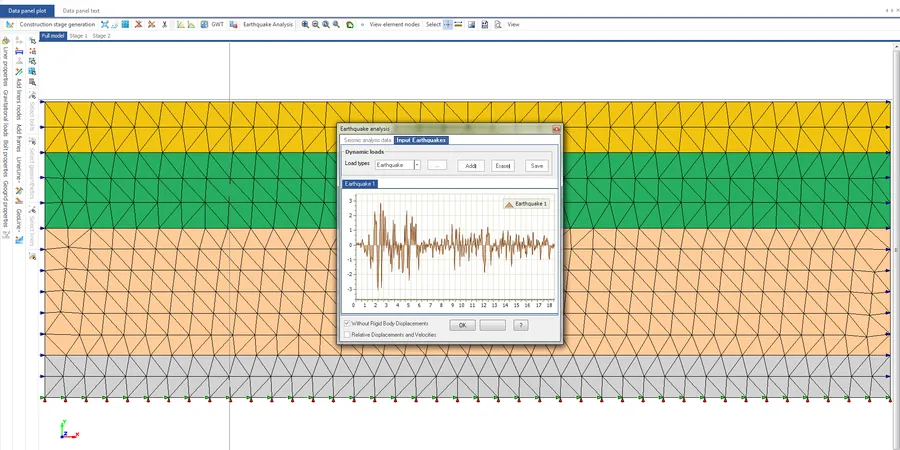
The deep alluvial basin beneath Albuquerque can amplify long-period ground motions by a factor of two or more relative to rock sites, making site-specific response analysis essential for mid- and high-rise structures.
Scope of work
Area-specific notes
A common mistake we see in Albuquerque is assuming all sites on the West Mesa or near the Sandia foothills qualify as rock sites without verification. The caliche layers and cemented sands can mask softer underlying deposits that control the site period. If the design spectrum is based on a default Site Class B or C without a proper site response analysis for Albuquerque, the building may experience unexpected resonance during a moderate earthquake. The 2018 review of the Albuquerque Seismic Hazard Zone map revealed that several neighborhoods near the Rio Grande actually fall into Site Class E conditions due to deep soft soils, yet many older designs used Class D. Relying on generic amplification factors without site-specific shear-wave profiles can lead to either unconservative designs or unnecessary overdesign. We recommend instrumented geotechnical monitoring during construction to verify the assumed soil properties against measured dynamic response.
Watch how it works
Standards used
ASCE 7-22 Section 21.1 (Site-Specific Ground Motion Procedures for Seismic Design), IBC 2021 Chapter 16 (Structural Design) and Section 1613 (Seismic Design Criteria), NEHRP Recommended Seismic Provisions (FEMA P-1050) – Site Classification and Response Spectral Matching
Linked services
Shear-Wave Velocity Profiling (MASW / Downhole)
Non-invasive MASW arrays and downhole seismic tests to determine Vs30 profiles for NEHRP site classification. We deploy 24-channel seismographs with 4.5 Hz geophones for shallow depths and 1 Hz sensors for deeper basin profiles.
1D Equivalent-Linear and Nonlinear Analysis
Using DEEPSOIL and Strata for equivalent-linear analysis with modulus reduction curves (Darendeli 2001, Meng 2003). For high-risk projects, we run nonlinear time-history simulations with 5-7 spectrum-compatible motions from the NGA-West2 database.
Design Spectrum Development and Peer Review Support
We generate acceleration response spectra for MCE_R and DBE levels, adjusting for site-specific basin effects. Deliverables include spectral acceleration tables, design spectrum plots, and a technical report suitable for third-party peer review under IBC requirements.
Typical parameters
Common questions
How much does a site response analysis cost for a typical Albuquerque project?
For a standard commercial building in Albuquerque with MASW profiling and 1D equivalent-linear analysis, the cost ranges between US$1,120 and US$3,690, depending on the number of profiles, depth of investigation, and whether nonlinear time-history simulations are required. Higher-risk facilities with peer review add approximately 30% to the scope.
What is the difference between NEHRP site classification and a full site response analysis?
NEHRP classification uses only average Vs30 to assign a site class (A through F). A full site response analysis models the actual soil column layering, modulus reduction, and damping to compute a site-specific design spectrum. In Albuquerque, where deep alluvial deposits create basin-edge effects and long-period amplification, the NEHRP default coefficients may underestimate spectral accelerations at periods above 0.5 seconds. The site-specific analysis captures those basin effects directly.
Do I need a site response analysis for a low-rise building in Albuquerque?
Not always. Per IBC 2021, a site response analysis is required when the soil profile contains more than 3 meters of soft clay (Site Class E or F) or when the structure falls into Seismic Design Category D, E, or F with a period exceeding 0.5 seconds. For Albuquerque, many one- and two-story buildings on stiff alluvium (Site Class C or D) can use default spectral acceleration values. However, if the building is in a critical facility category (Risk III or IV) or located near the Rio Grande floodplain where soft soils are mapped, the analysis is mandatory regardless of height.