Any contractor who has broken ground in the North Valley or along Tramway Boulevard knows that Albuquerque's subsurface tells a complicated story. The transition from coarse river deposits to fine wind-blown silts happens over very short distances, and a uniform foundation assumption rarely survives the first excavation. A soil mechanics study here must account for the Rio Grande rift's influence on local stratigraphy, where buried channel sands and low-plasticity clays alternate in ways that directly control bearing capacity and shrink-swell behavior. Our laboratory processes undisturbed samples under ASTM D2435 and D4767 protocols, converting raw field data into settlement predictions and shear strength parameters that structural engineers can actually use. When the site sits near the Sandia piedmont, we often pair the mechanics program with a MASW survey to capture the sharp impedance contrast at the bedrock interface, which the IBC requires for Site Class determination in Zone 4.
Albuquerque soils lose apparent cohesion when wetted: a mechanics program that ignores partial saturation can overestimate bearing capacity by 40 percent or more.
Process and scope
Area-specific notes
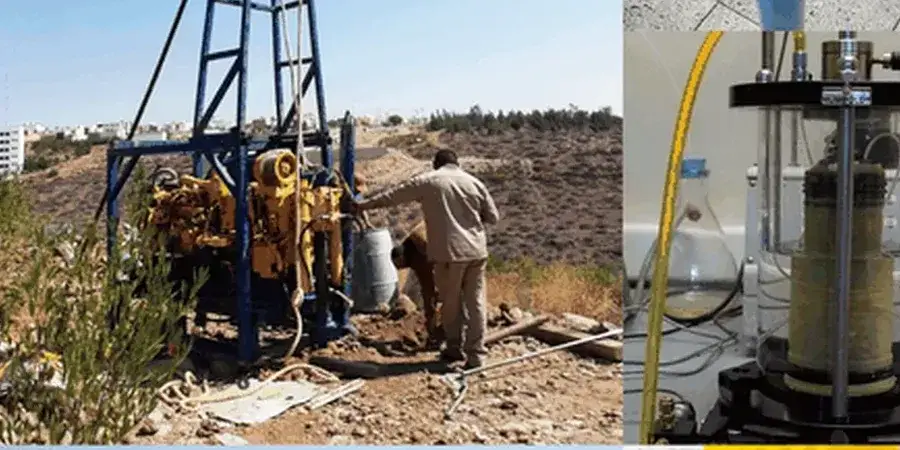
The split-spoon sampler driven by a 140-pound hammer dropping 30 inches is the workhorse of Albuquerque exploration, but interpreting the N-value in gravelly sands near the Sandia foothills requires local experience. Refusal on cobbles can mask a softer layer just beneath, and we have seen projects where the blow count jumped from 18 to refusal in six inches, only for the excavation to reveal a thin boulder lens overlying medium-dense sand. Our field crews log every drive increment and note the hammer cushion condition, because energy correction factors for the local CME automatic hammers typically run 0.75 to 0.85, and applying the wrong factor shifts the liquefaction assessment by a full safety margin. When the boring reaches the groundwater table, usually encountered between 8 and 25 feet across the basin, we stabilize the hole and install a monitoring well so the effective stress calculation reflects actual pore pressure, not an assumed hydrostatic profile.
Relevant standards
ASTM D2487-17: Unified Soil Classification System, ASTM D4767-11: Consolidated Undrained Triaxial Compression Test, ASTM D2435-20: One-Dimensional Consolidation Properties, ASCE 7-22: Minimum Design Loads (Site Class D/E defaults for Albuquerque basin)
Linked services
Triaxial and Consolidation Testing Suite
Consolidated-undrained and drained triaxial tests on undisturbed specimens, paired with incremental oedometer consolidation to generate the complete stress-strain-time relationship for settlement analysis under sustained structural loads.
Bearing Capacity and Settlement Reports
Calculations following Terzaghi, Meyerhof, and Vesic methods with site-specific shear strength inputs, including immediate settlement from elastic half-space theory and consolidation settlement from the full stress path.
Typical parameters
Common questions
How deep should borings go for a soil mechanics study in Albuquerque?
Depth depends on the foundation type and the site's location within the basin. For shallow footings in the valley, we typically extend borings to 20 or 30 feet to capture the full stress bulb and any compressible layers beneath. On the east side near the Sandia piedmont, shallow refusal on cemented gravels may limit depth, and we supplement with geophysical methods to confirm the bedrock profile. Taller structures with deep foundations require borings that penetrate the bearing stratum by at least 10 feet.
What is the typical cost range for a residential soil mechanics report in Albuquerque?
For a standard single-family residential lot, the soil mechanics study generally ranges from US$3,150 to US$5,030 depending on the number of borings, the depth of exploration, and the laboratory testing program required. Sites with difficult access, steep terrain, or suspected problem soils may fall toward the upper end of that bracket.
How long does the laboratory testing phase take?
Consolidation tests require a minimum of 24 hours per load increment, and a full incremental oedometer run typically spans five to seven days. Triaxial testing with pore pressure measurement adds another week for specimen preparation, saturation, consolidation, and shear. Including report writing, a complete mechanics program from sampling to final deliverable runs three to four weeks under normal scheduling.
Do Albuquerque soils require special consideration for expansive clay?
The clay fractions in Albuquerque basin soils are predominantly low-plasticity silts and sandy clays with liquid limits below 40, so the swell potential is generally low to moderate compared to the high-plasticity clays found in other parts of the Southwest. That said, localized deposits of the Santa Fe Group can exhibit moderate swell, and we always run Atterberg limits and a swell-consolidation test per ASTM D4546 when the USCS classification flags CH or CL material near the foundation zone.