The sandy arroyos of the North Valley and the clay-rich soils near the West Mesa behave completely differently under a landfill load. In the North Valley, loose alluvial sands demand deep compaction and careful seepage control, while the expansive clays of the West Mesa require rigorous moisture conditioning to prevent differential settlement. Landfill geotechnics in Albuquerque must account for these contrasts to build containment systems that stay tight for decades. Before designing any liner or cap, we run a site-specific investigation that combines test pits with a permeability field test to measure the actual hydraulic conductivity of the native soil.
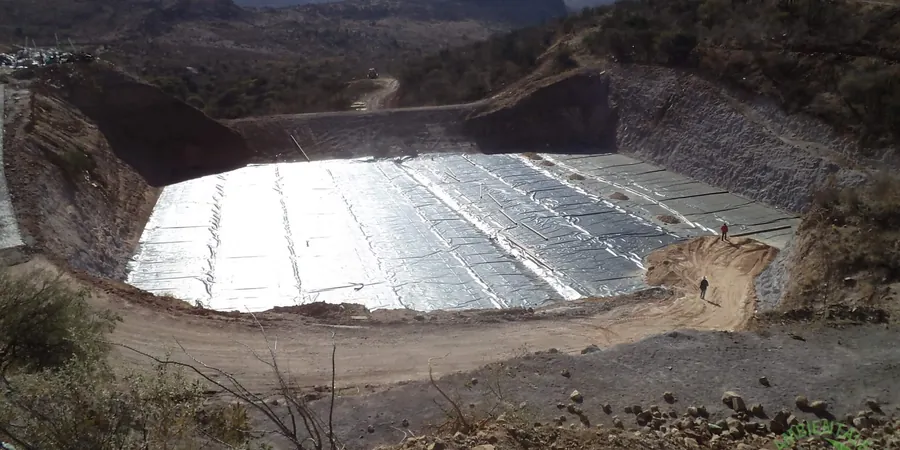
A 1×10⁻⁷ cm/s clay liner is not built in the lab — it is built in the field, layer by layer, at the right moisture and compactive effort.
Scope of work
- Standard Proctor (ASTM D698) for compaction curves
- Flexible-wall permeameter (ASTM D5084) for low‑k verification
- Modified compaction (ASTM D1557) for high‑stress zones
Area-specific notes
A common mistake we see in Albuquerque is assuming that the native sandy soils need only a thin clay liner because the climate is dry. That assumption overlooks two realities: first, the monsoon season can saturate a thin liner in hours, and second, the sandy subgrade has high differential settlement potential that cracks the clay. We have inspected cells where the liner was placed directly on uncompacted arroyo sand without a bedding layer — within three years the geomembrane punctured and the clay cracked. Landfill geotechnics must include a 30 cm sand bedding layer, a geotextile separation fabric, and a cover soil with at least 45 cm of low‑permeability material to prevent desiccation cracking.
Standards used
40 CFR Part 258 (Subtitle D – RCRA), ASTM D5084 (Hydraulic conductivity of saturated porous materials), ASTM D698 (Standard Proctor compaction), NMAC 20.9.1 (New Mexico Solid Waste Management Regulations), ASTM D1586 (Standard Penetration Test – foundation support)
Linked services
Liner System Design & Permeability Testing
We design composite liner systems (clay + geomembrane) and verify in‑field hydraulic conductivity with sealed‑double‑ring infiltrometers. Our lab runs flexible‑wall permeameter tests on compacted clay specimens to meet the 1×10⁻⁷ cm/s target.
Leachate Collection & Drainage Layer Design
We size the granular drainage layer and pipe network to prevent leachate mounding above the liner. Calculations follow the SW−884 method (USEPA) and the local Albuquerque Bernalillo County Water Utility Authority stormwater criteria.
Final Cover & Slope Stability Analysis
We evaluate the long‑term stability of the final cap under static and seismic loading using limit‑equilibrium software (SLOPE/W). The cover system includes a 60 cm barrier layer, a 30 cm drainage layer, and a topsoil layer for vegetation.
Typical parameters
Common questions
What is the typical cost of a landfill geotechnics study in Albuquerque?
For a small‑ to medium‑sized cell (2–5 acres), the investigation and design study ranges between US$2.270 and US$9.460. This covers test pits, permeability testing, liner design, and a stability report. Larger facilities or sites with complex soil conditions may exceed this range.
How deep should test pits be for a landfill liner design?
Test pits should extend at least 1.5 m below the proposed liner bottom to verify that the subgrade has adequate bearing capacity and low permeability. In Albuquerque's alluvial deposits, we often encounter a 2–4 m depth to the water table, so we adjust pit depth accordingly.
Can I use native Albuquerque soil as the clay liner?
Only if the native soil meets the hydraulic conductivity requirement of ≤ 1×10⁻⁷ cm/s after compaction. The sandy loam and silty clay found near the West Mesa may achieve this with proper moisture conditioning and compaction. The Rio Grande alluvium typically does not and requires imported clay.
What maintenance does a landfill cap need in Albuquerque's climate?
The cap should be inspected after every heavy monsoon event for erosion rills, ponding, and animal burrows. Vegetation cover must be re‑established if it dies back during droughts. Annual slope stability monitoring with inclinometers is recommended for caps steeper than 3H:1V.