The high desert climate of Albuquerque, with its 9.5 inches of annual rainfall and intense summer monsoon events, creates unique challenges for soil stabilization. The Rio Grande valley deposits a mix of silty sands and highly plastic clays that swell when wet and shrink when dry. For any project in Albuquerque, lime and cement stabilization modifies these problematic soils at a fundamental level, reducing plasticity and improving workability before compaction. The chemical reaction between calcium-based stabilizers and clay minerals is well understood, but local soil variability demands site-specific testing. Before designing a stabilization blend, we typically run Atterberg limits and Proctor compaction on representative samples, and we often recommend a soil classification study to confirm the dominant clay mineralogy across the site.
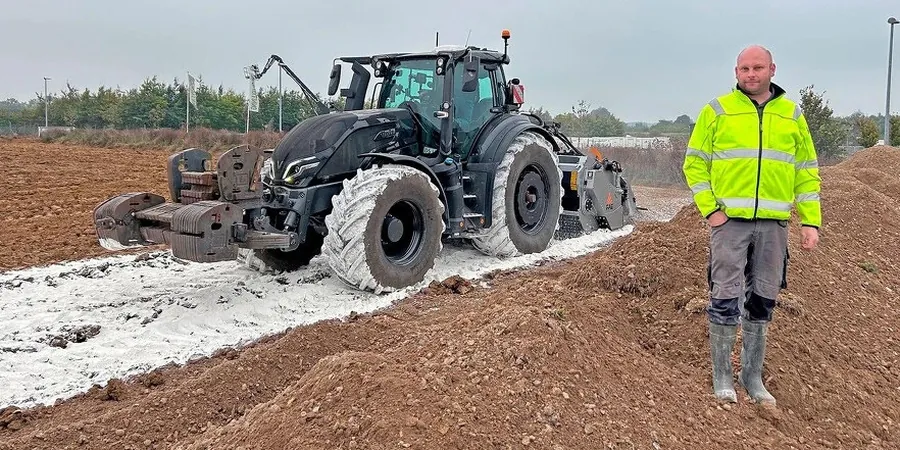
Lime stabilization transforms expansive Albuquerque clays by reducing plasticity index from 40+ to below 15, preventing differential heave under foundations and pavements.
Scope of work
Area-specific notes
Albuquerque's post-war boom saw rapid suburban expansion onto collapsible alluvial fans and expansive clay plains. Many early subdivisions were built without soil treatment, and today those neighborhoods show cracked slabs, tilted sidewalks, and heaving roadways. The risk is not limited to old construction: new developments in the South Valley and along the Petroglyph National Monument boundary encounter the same high-plasticity clays. Skipping stabilization on these soils means accepting long-term differential movement that can exceed two inches. A proper mix design, verified by laboratory testing and field quality control, eliminates that risk and provides a uniform platform for foundations, utilities, and pavements in Albuquerque.
Standards used
ASTM C977 – Standard Specification for Quicklime and Hydrated Lime for Soil Stabilization, ASTM D1633 – Standard Test Method for Compressive Strength of Molded Soil-Cement Cylinders, ASTM D6276 – Standard Test Method for Using pH to Estimate the Soil-Lime Proportion Requirement, IBC Chapter 18 – Soils and Foundations (adopted in Albuquerque), AASHTO M 216 – Standard Specification for Lime for Soil Stabilization
Linked services
Lime Stabilization for Expansive Clays
Treatment of high-plasticity clays (PI > 30) with hydrated lime to reduce swell potential and improve workability. Includes pH determination, mix design, field application supervision, and compaction testing. Ideal for foundation subgrade and roadway subbase in the North Valley and East Mesa areas of Albuquerque.
Cement Stabilization for Silty Sands and Roadway Bases
Mechanical blending of Portland cement with silty sands (SM) and low-plasticity soils to achieve a rigid base layer with CBR values above 80. We perform Proctor compaction, unconfined compressive strength testing, and moisture-density control during placement. Commonly used for arterial roads and industrial slabs in Albuquerque.
Typical parameters
Common questions
How does lime stabilization work on Albuquerque's expansive clays?
Lime reacts with clay minerals in a pozzolanic reaction that reduces the plasticity index and swell potential. The calcium ions replace sodium and potassium on the clay particle surfaces, flocculating the particles into a more granular, less expansive structure. In Albuquerque clays, a 5-8% lime addition typically drops the PI from 40-50 down to 12-18.
What is the typical cost range for lime and cement stabilization in Albuquerque?
For a standard project, the cost ranges between US$920 and US$2,360 depending on treatment depth, soil conditions, and total volume. This includes laboratory mix design, field application oversight, and compaction testing. Exact pricing depends on site-specific factors like accessibility and required strength targets.
How long does the stabilization process take from start to finish?
Lab testing takes 5-7 days for mix design and pH determination. Field application, including spreading, mixing, watering, and compaction, typically takes 1-2 days per lift. A minimum curing period of 3 days for cement and 7 days for lime is required before placing structural loads or paving.
Can stabilization be used for both new construction and existing soil repair?
Yes, it works for both. For new construction, we treat the subgrade before placing footings or pavement. For existing sites with heaving or settlement issues, we can stabilize the upper 12-18 inches after removing damaged slabs, then reconstruct the base. In both cases, proper moisture control and compaction are critical.
What tests confirm that the stabilization was done correctly in the field?
We perform field density tests using a nuclear gauge or sand cone method (ASTM D6938 or D1556) and compare results to the Proctor curve. We also take samples for unconfined compressive strength testing at 7 and 28 days. For lime stabilization, we verify pH remains above 12.4 after the curing period.