For projects in Albuquerque, we follow ASTM D5092 and USBR 7300 standards to run field permeability tests using the Lefranc and Lugeon methods. The city sits on the Rio Grande Rift, where alluvial fans and basin-fill deposits create highly variable aquifer conditions. A 14-story building near I-25 might encounter gravel lenses with k values of 10⁻² cm/s, while a site in the North Valley sees silty clays at 10⁻⁶ cm/s. That variability makes in-situ testing essential. Before designing dewatering systems, we often combine the field permeability test with a drainage geotechnical study to map preferential flow paths.
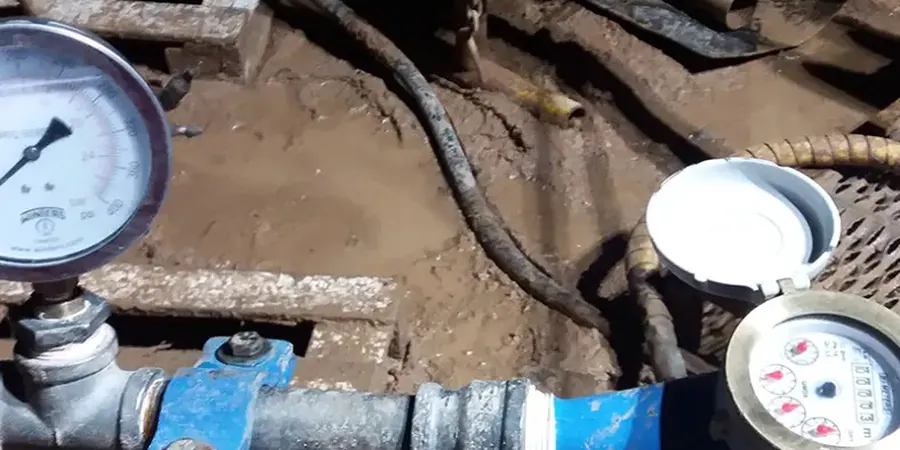
In Albuquerque, permeability contrasts of up to 5 orders of magnitude occur within 50 meters. Field tests catch what lab tests miss.
Scope of work
Area-specific notes
Albuquerque expanded rapidly after the railroad arrived in 1880, filling the valley floor and mesa tops with infrastructure. But the subsurface here stores a memory of that growth. Old irrigation canals, unrecorded fill, and perched aquifers from leaky pipes create hidden groundwater paths. A foundation that looks dry in summer can face artesian seepage during spring snowmelt from the Sandias. If you skip field permeability testing, you risk underestimating uplift pressures under slabs or getting surprised by seepage in shored excavations. We have seen both in the South Valley and near the West Mesa.
Standards used
ASTM D5092-04(2016): Standard Practice for Design and Installation of Groundwater Monitoring Wells, USBR 7300: Permeability Tests in Boreholes (Constant Head and Packer Tests), ASTM D4631-18: Standard Test Method for Determining Transmissivity and Storage Coefficient of Low-Permeability Rocks
Linked services
Lefranc Constant Head Test
For soils and soft rock. We use single or double packers to isolate 1.5 m intervals, inject water at a fixed head, and measure steady-state flow. Results give k values in cm/s directly.
Lugeon Packer Test
For fractured rock and cemented alluvium. We apply 3 to 5 pressure steps (0.5 to 10 bars) in each interval and record flow decay. The Lugeon value (LU) quantifies rock mass permeability for dam foundations and tunnel design.
Falling Head / Variable Head Test
For low-permeability soils (clays, silts) where steady flow takes too long. We measure the rate of water level drop inside the casing and use Hvorslev's method to estimate k. Common in the North Valley and near the Rio Grande.
Typical parameters
Common questions
What is the difference between Lefranc and Lugeon tests?
The Lefranc test uses a constant head and is best for soils and soft rock — it gives hydraulic conductivity in cm/s. The Lugeon test applies step pressures and is designed for fractured rock, reporting permeability in Lugeon units (LU). In Albuquerque, we choose based on the material: Lefranc for alluvial sands and clays, Lugeon for the Santa Fe Formation sandstone and basalt flows.
How much does a field permeability test cost in Albuquerque?
The reference range for a field permeability test (Lefranc or Lugeon) in Albuquerque is US$580 to US$1,060 per test interval. This includes mobilization, packer setup, data recording, and a field report. Total cost depends on the number of intervals, borehole depth, and site accessibility.
When do I need a Lugeon test instead of a Lefranc test?
You need a Lugeon test when the ground is rock — cemented gravels, sandstone, or basalt. In Albuquerque, that applies to sites on the West Mesa or in the East Mountains. The Lugeon method applies enough pressure to open rock fractures and measure true permeability. For soil sites along the river or in the valley floor, the Lefranc test is sufficient.
How many test intervals are typically needed for a building foundation?
For a typical building foundation in Albuquerque, we recommend 1 test interval per 5 to 8 meters of depth, with at least 3 intervals per borehole. If the site has layered geology — say sand over clay over gravel — we place intervals at each layer boundary. A 4-story building on a 15-meter-deep mat foundation usually requires 5 to 8 intervals total across 2 or 3 boreholes.
Can field permeability tests detect perched water tables?
Yes, they are the most reliable method. A Lefranc test will show a sudden increase in flow when the packer interval crosses a perched zone. In Albuquerque, we often find perched water above clay lenses left by ancient Rio Grande channels. The test gives both the k value and the exact depth of the perched layer, which is critical for dewatering design and slab-on-grade construction.