We worked on a mid-rise project near I-25 where the geotechnical report showed clean sand down to 20 feet. The client needed drainage layer specs for a retaining wall backfill. We ran constant head permeability tests on undisturbed samples. The coefficient of permeability came in at 3.2 x 10^-2 cm/s. That value confirmed the sand could drain freely under the wall. We also used the data to size the weep hole spacing. A good lab permeability test saves time and money on site. It prevents overdesign of drainage systems and avoids costly rework. The test is methodical and straightforward when you have the right equipment.
The coefficient of permeability drives drainage design. A 10x error in k-value can double your gravel layer thickness.
Scope of work
Area-specific notes
The Rio Grande Valley has shallow groundwater in many parts of Albuquerque. Depth to water can be as low as 5 to 15 feet near the river. A high water table combined with permeable sands creates serious dewatering problems during excavation. If the lab test shows k above 10^-3 cm/s you will need a dewatering system. We have seen projects where the contractor assumed low permeability and ended up with a flooded excavation. That costs time and money. The lab test avoids that risk. It gives you the number before you break ground.
Standards used
ASTM D2434-19 (Constant Head Permeability of Granular Soils), ASTM D5084-16a (Falling Head Permeability of Fine-Grained Soils), ASTM D854-14 (Specific Gravity of Soil Solids)
Linked services
Constant Head Permeability Test
For granular soils with k > 10^-4 cm/s. Uses a fixed hydraulic gradient and a steady flow measurement. Runs on undisturbed tube samples or remolded specimens. Provides k, void ratio, and dry density. ASTM D2434 compliant.
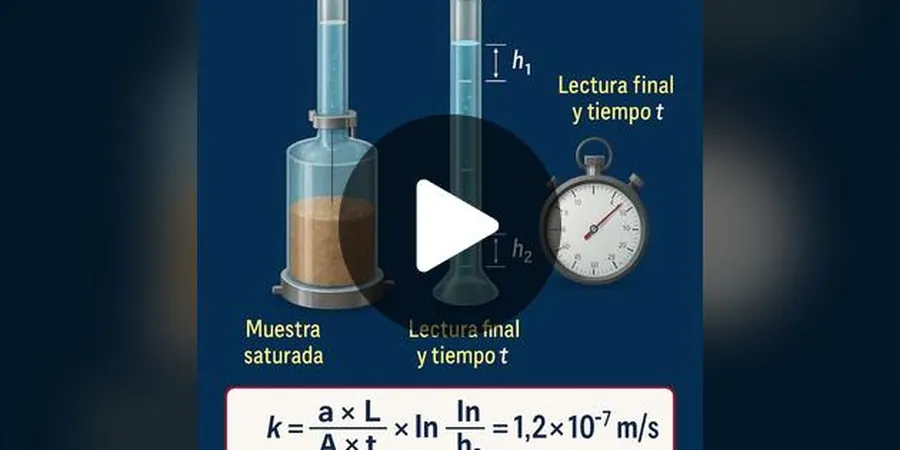
Falling Head Permeability Test
For fine-grained soils with k < 10^-4 cm/s. Measures the rate of water level drop in a standpipe. Suitable for silts and clays common in the river terraces. ASTM D5084 compliant with back-pressure saturation.
Typical parameters
Common questions
How much does a laboratory permeability test cost in Albuquerque?
A standard constant head or falling head test ranges between US$470 and US$570 per sample. The price includes sample preparation, saturation verification, two to four gradient stages, and a report with k at 20°C, void ratio, and dry density. Higher-volume projects or multiple samples may qualify for a lower per-test rate.
What is the difference between constant head and falling head tests?
Constant head is used for clean sands and gravels where water flows through quickly. A steady hydraulic gradient is maintained, and the flow rate is measured directly. Falling head is for silts and clays where flow is slow. The water level in a standpipe drops over time, and the rate of drop gives the permeability. The choice depends on the soil type and expected k range.
Can you test undisturbed samples from Albuquerque?
Yes. We test undisturbed tube samples from Shelby tubes, thin-walled samplers, or block samples. The sample is extruded, trimmed to fit the permeameter cell, and set up with filter paper and porous stones. We measure the initial moisture content and dry density. The test preserves the in-situ fabric and void ratio as much as possible.
How long does the test take to complete?
A constant head test on sand takes about 2 to 3 hours per sample, including saturation and two gradient stages. A falling head test on silt or clay can take 24 to 48 hours because the flow is slower. We provide a preliminary result within 24 hours for constant head tests and within 3 business days for falling head tests.