In Albuquerque, the alluvial soils along the Rio Grande and the piedmont deposits on the West Mesa behave very differently under load. What we see time and again is that standard penetration tests give you a blow count, but they don't tell you the whole story about structure or consolidation. That's where undisturbed sampling with a Shelby tube becomes essential. It recovers a relatively intact soil cylinder, preserving density, fabric, and moisture content so lab tests like consolidation or triaxial shear reflect actual field conditions. For projects near the river or in the Northeast Heights, this distinction often makes the difference between a safe foundation design and one that might settle more than expected. The method follows ASTM D1587, and our team pairs it with a clasificación de suelos to confirm the material matches visual descriptions before shipping to the lab.
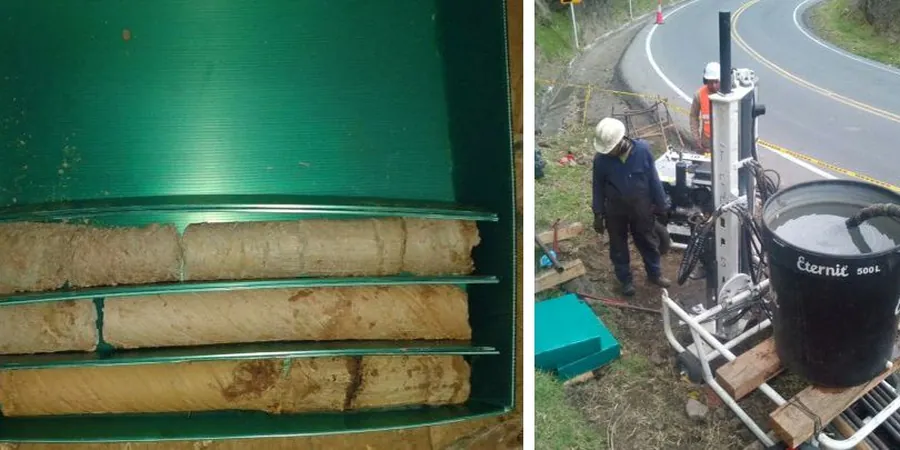
A Shelby tube sample preserves the in-situ density and fabric that a split-spoon sample simply cannot deliver for consolidation or shear testing.
Scope of work
Area-specific notes
Albuquerque's climate creates a tricky condition for undisturbed sampling. The region averages less than 10 inches of precipitation per year, so near-surface soils often sit at low moisture content — sometimes below the plastic limit. Pushing a Shelby tube into dry, stiff clay can cause the sample to fracture or the tube to buckle. We mitigate this by pre-wetting the borehole slightly and using thin-walled tubes with a sharp cutting edge. Another risk comes from gravel layers common in the alluvial fans east of the city. If the tube hits a pebble, the sample can become unrepresentative or the tube can deform. That's why we always log the borehole during drilling and adjust the sampling interval based on real-time conditions.
Standards used
ASTM D1587-15 (Standard Practice for Thin-Walled Tube Sampling), ASTM D4220-17 (Standard Practices for Preserving and Transporting Soil Samples), ASTM D2435/D2435M-11 (Standard Test Methods for One-Dimensional Consolidation), ASTM D2850-15 (Standard Test Method for Unconsolidated-Undrained Triaxial Compression Test)
Linked services
Shelby Tube Field Sampling
Mobilization of a CME-75 or similar rig with hydraulic push capability. We use 3-inch thin-walled tubes with a 60-degree cutting edge. Each sample is labeled with depth, GPS coordinates, and visual log before sealing.
Lab Testing on Undisturbed Samples
Our ISO 17025-accredited lab runs consolidation (ASTM D2435), unconfined compression (ASTM D2166), and UU triaxial (ASTM D2850) directly on the recovered tube samples. Results are reported with stress-strain curves and void ratio data.
Sample Preservation & Transport
Tubes are wax-sealed, wrapped in moisture-proof plastic, and placed in padded crates for transport to the lab. Temperature logs are maintained per ASTM D4220 to ensure sample integrity during the 2-hour drive from Albuquerque.
Typical parameters
Common questions
How does undisturbed sampling differ from SPT for Albuquerque soils?
SPT provides a disturbed sample and a blow count for relative density. Undisturbed sampling preserves the natural soil structure, which is critical for consolidation and shear strength tests. In Albuquerque's clay-rich valley soils, consolidation parameters from SPT samples can be off by 30% or more.
What is the typical cost range for Shelby tube sampling in Albuquerque?
The cost for undisturbed sampling per depth interval typically ranges between US$400 and US$1,170 depending on depth, access conditions, and number of tubes. This includes rig time, tube, sealing, and standard preservation. Additional lab tests are billed separately.
Can you sample sandy soils with a Shelby tube in Albuquerque?
Shelby tubes work best in cohesive soils. Clean sands or gravelly sands tend to collapse or drain during push, making recovery unreliable. For sandy layers, we recommend a piston sampler or a combination of SPT and direct push logging instead.