The difference between building on the sandy, well-drained soils of the Northeast Heights versus the silty, clay-rich alluvium of the South Valley is night and day. A geocell design that works perfectly for a retaining wall along Tramway Boulevard might fail entirely on a drainage swale near the Rio Grande. We tailor every confinement solution to the specific soil plasticity and groundwater conditions found on your Albuquerque lot, combining field assessment with laboratory index testing to predict long-term performance under the city's semi-arid climate.
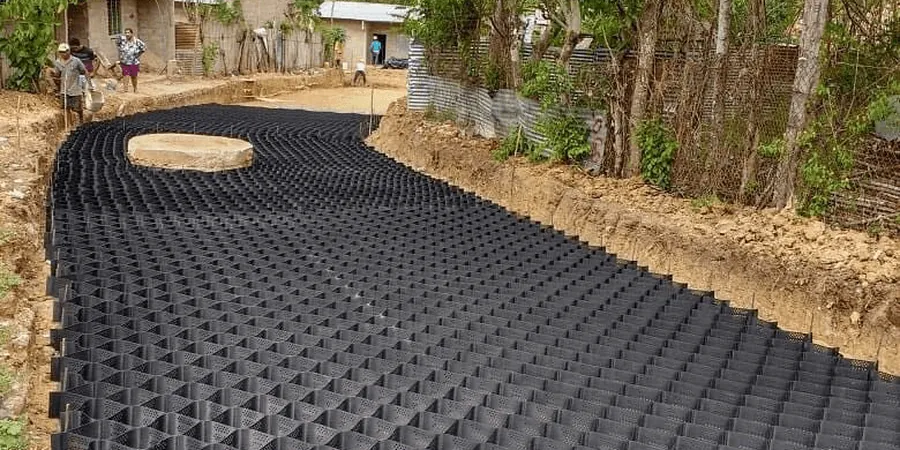
A properly designed geocell system can reduce base course thickness by 40% while extending pavement life on Albuquerque's expansive subgrades.
Scope of work
Area-specific notes
IBC 2021 and ASCE 7-22 specify load combinations that directly impact geocell design, especially for slope and retaining wall applications. In Albuquerque's seismic zone, where the peak ground acceleration can approach 0.20g, a poorly designed geocell system can lead to slope creep or lateral spreading. The risk is compounded when infill materials are not properly compacted — a common oversight that reduces the system's confinement efficiency by up to 50%. Our designs always include a factor of safety of 1.5 against sliding and bearing failure.
Standards used
ASTM D4885 (Tensile Properties of Geocells), ASTM D5321 (Direct Shear of Geosynthetics), FHWA NHI-00-044 (Geosynthetic Design & Construction Guidelines), IBC Chapter 18 (Soils and Foundations)
Linked services
Slope Stabilization Design
Analysis of critical slip surfaces and design of geocell-reinforced slopes for cut and fill projects along city arroyos and highway embankments.
Channel & Erosion Control
Design of geocell-lined channels and spillways to handle high-velocity flows in Albuquerque's stormwater systems, with infill selection for scour resistance.
Load Support for Roadways
Subgrade improvement design using geocells for unpaved roads, parking lots, and temporary access roads on low-bearing-capacity soils common in the South Valley.
Retaining Wall Systems
Design of geocell-faced retaining walls for height up to 6 m, including global stability checks and internal reinforcement detailing for seismic loads.
Typical parameters
Common questions
How does the geocell design differ for sandy soils in the Heights versus clay soils in the South Valley?
For sandy soils, the geocell primarily provides confinement to prevent lateral spreading and increase bearing capacity. In clay soils, the design must account for potential swelling and shrinkage, requiring careful selection of infill material and cell depth to maintain confinement under moisture changes. We always run a swell-consolidation test on clay samples before finalizing the design.
What is the typical cost range for a geocell design study in Albuquerque?
A comprehensive design study for a standard residential or commercial project typically ranges between US$840 and US$2,540. This includes site visit, soil sampling, laboratory testing, numerical modeling, and a final report with construction drawings. Costs vary with project complexity, site access, and required testing.
What is the minimum cell depth required for a residential driveway on a 10% slope?
For a 10% slope with typical Albuquerque subgrade (SP or SM soils), we recommend a minimum cell depth of 100 mm. This provides adequate confinement to prevent rutting and erosion under light vehicle traffic. For steeper slopes or heavier loads, we increase the depth to 150-200 mm.