According to ASTM D2573-15, the field vane shear test (VST) is the standard method for measuring the undrained shear strength (Su) of saturated fine-grained soils in situ. In Albuquerque, this test is particularly relevant because the Rio Grande valley and its alluvial terraces contain soft clay and silt deposits that can be highly compressible and sensitive to remolding. We routinely apply the VST in the South Valley, along the Bosque corridor, and near the river levee system, where shallow foundations and embankments must account for low-strength soils. The test provides a direct measure of peak and residual undrained strength, which feeds directly into stability analyses for slope stability and bearing capacity calculations under undrained conditions.
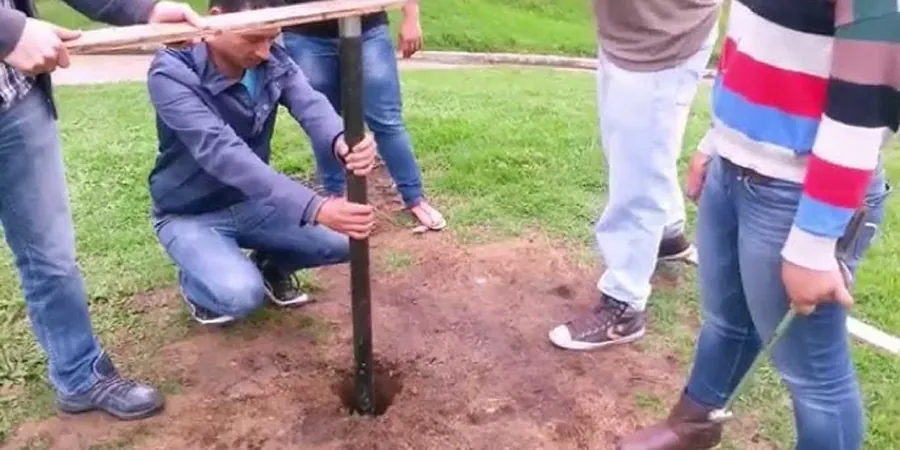
In Albuquerque's alluvial clays, the vane shear test provides the only direct in-situ measure of undrained strength without sample disturbance.
Scope of work
Area-specific notes
In Albuquerque, we often see that standard penetration tests (SPT) in soft clays produce unreliable N-values because the hammer energy blows the soil sideways rather than shearing it. The field vane shear test avoids that pitfall entirely. However, the biggest risk we encounter locally is interpreting VST results in partially saturated soils — the Rio Grande alluvium can be moist but not fully saturated, and the vane test assumes full saturation for accurate Su values. If the water table is deeper than 3 m, we advise running a complementary infiltration test to confirm saturation conditions before relying on the vane results for undrained analyses.
Standards used
ASTM D2573-15 — Standard Test Method for Field Vane Shear Test in Saturated Fine-Grained Soils, ASTM D2487-17 — Standard Practice for Classification of Soils for Engineering Purposes (Unified Soil Classification System), IBC 2021 — Chapter 18: Soils and Foundations, Section 1806 (Presumptive Load-Bearing Values)
Linked services
Borehole Vane Shear Testing
Performed from the bottom of a borehole at multiple depths, this variant allows us to profile undrained shear strength with depth — ideal for deep foundations and slope stability studies along the Rio Grande bluffs.
Remolded Strength & Sensitivity Testing
After the peak vane test, we rotate the vane rapidly to remold the soil and measure residual strength. Sensitivity values (St > 4) indicate quick clay behavior, which requires special design considerations in Albuquerque's alluvial deposits.
In-Situ Torvane & Pocket Penetrometer Correlation
For rapid field screening, we correlate VST results with handheld torvane and pocket penetrometer readings on split-spoon samples. This provides a quick check for consistency across multiple test locations.
VST for Embankment & Levee Design
The Middle Rio Grande Conservancy District requires undrained shear strength data for levee stability analyses. We perform VST arrays at planned levee alignments and borrow sources to support factor-of-safety calculations.
Typical parameters
Common questions
What is the difference between a field vane shear test and a laboratory unconfined compression test?
The VST measures undrained shear strength in situ, preserving the natural soil fabric, pore pressure, and stress state. A lab unconfined compression test on an undisturbed sample can give similar Su values, but sample disturbance during extraction and transport often reduces the measured strength by 20-40%. For soft clays in Albuquerque, the VST is therefore considered more reliable for design.
At what depth can the vane shear test be performed?
The vane can be advanced from the bottom of a borehole to any depth reachable by standard drill rods. In practice, we have performed VSTs from 1.5 m to 30 m depth in Albuquerque. The upper limit is typically 1 m below the borehole bottom to avoid disturbed soil from drilling.
How much does a field vane shear test cost in Albuquerque?
A single VST at one depth typically costs between US$720 and US$1,510, including mobilization within the Albuquerque metro area, borehole preparation, and a written report with torque and Su values. The price varies with depth, number of tests per hole, and site access conditions.
Can the VST be used in gravelly or sandy soils?
No. The vane shear test is only valid for saturated fine-grained soils (clays and silts) where the vane can rotate without encountering gravel particles. In Albuquerque's alluvial fan deposits, which often contain gravel lenses, we recommend using the SPT or a cone penetration test (CPT) instead of the VST.