Albuquerque sits on the eastern edge of the Rio Grande Rift, where the valley floor is dominated by alluvial sands and silty clays from the Rio Grande and its tributaries. Below the surface, you often find a mix of poorly-graded sands (SP) interbedded with lenses of clayey silt (ML). These layers shift abruptly, sometimes within a single meter of depth. That is why grain size analysis is so critical here — a standard sieve alone cannot pick up the fines that control drainage and settlement. For projects near the river or on the West Mesa, we routinely combine sieve with hydrometer testing to catch the full particle size curve. The distribution of fines often dictates whether a site needs deeper drenaje-geotecnico measures or if shallow foundations will suffice. In our experience, skipping the hydrometer on silty soils is a common mistake that leads to underestimated compressibility.
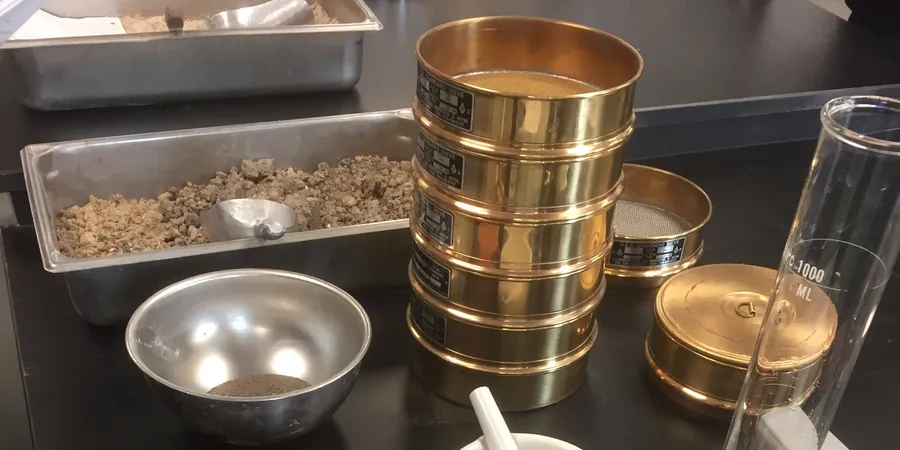
Combining sieve and hydrometer on Albuquerque's alluvial soils often reveals a dual-gradation that affects compaction targets and drainage design.
Scope of work
Area-specific notes
The main risk in Albuquerque is misclassifying silty sand (SM) as clean sand (SP) because the fines are not fully dispersed. Under IBC 2018 and ASCE 7-16, site class F requires a site-specific study if the soil profile has more than 3 m of soft clay — but that clay is often hidden in a sand matrix. Without a hydrometer, the fines percentage can be off by 10–15%, leading to an overestimated site class. That mistake affects lateral earth pressures and foundation design. We follow ASTM D422 strictly, including the 24-hour soak with dispersant, to break up the clay lumps. For critical projects near the Rio Grande bosque, we also check the gradation on the clasificacion-suelos report before recommending a footing depth.
Standards used
ASTM D422-63 (hydrometer analysis), ASTM D6913-17 (sieve analysis), AASHTO T-88 (particle size of soils), ASTM D2487-17 (USCS classification)
Linked services
Dry Sieve Analysis
Standard dry sieving on granular soils with a stack of 8 to 12 sieves from 3/4 in to No. 200. Suitable for clean sands and gravels with less than 5% fines.
Wet Sieve Analysis
Wet sieving on soils with more than 5% fines, using a No. 200 wash to remove silt and clay before drying and re-sieving the coarse fraction.
Combined Sieve + Hydrometer
Full gradation curve for soils with significant fines ( >12% passing No. 200). Includes hydrometer sedimentation readings over 24 hours and dispersant treatment.
Particle Size for Base Course
Gradation testing on road base and subbase materials per AASHTO T-88, with specific attention to the percent passing No. 40 and No. 200 for compaction control.
Typical parameters
Common questions
Why do I need both sieve and hydrometer for soils in Albuquerque?
Many soils here, especially along the Rio Grande valley, contain a mix of sand and silt that the sieve alone cannot fully characterize. The hydrometer catches the sub-75 micron particles that control plasticity and drainage. Without it, you might classify a silty sand as clean sand and miss settlement risks.
How much does a grain size analysis cost in Albuquerque?
A combined sieve and hydrometer test typically ranges from US$100 to US$190 per sample, depending on the number of sieve sizes and whether wet sieving is required. Bulk discounts are available for multi-sample projects.
What is the difference between ASTM D422 and D6913?
ASTM D6913 covers dry and wet sieve analysis for particles retained on the No. 200 sieve (75 µm and larger). ASTM D422 covers hydrometer analysis for the fraction passing the No. 200 sieve, down to about 1 µm. For a full gradation curve, both methods are run in sequence on the same sample.
How long does it take to get results?
A standard dry sieve analysis can be completed in 2 to 3 business days. When hydrometer testing is added, the sedimentation readings require a full 24-hour cycle, so the combined test takes 4 to 5 business days. Rush service is available for an additional fee.