If you dig in the North Valley near the Rio Grande, you hit sandy loam with high moisture. Head east toward the foothills of the Sandia Mountains and you find clayey gravel with cobbles. That contrast defines why a CBR study for road design matters in Albuquerque. The subgrade under Tramway Boulevard behaves nothing like the soil under Central Avenue downtown. We have tested both zones extensively. That variation directly affects pavement thickness, material selection, and long-term performance. Before we run a CBR test in the lab, we classify the soil using granulometria and Atterberg limits to understand its basic behavior. That step saves time and avoids surprises when we compact the specimen.
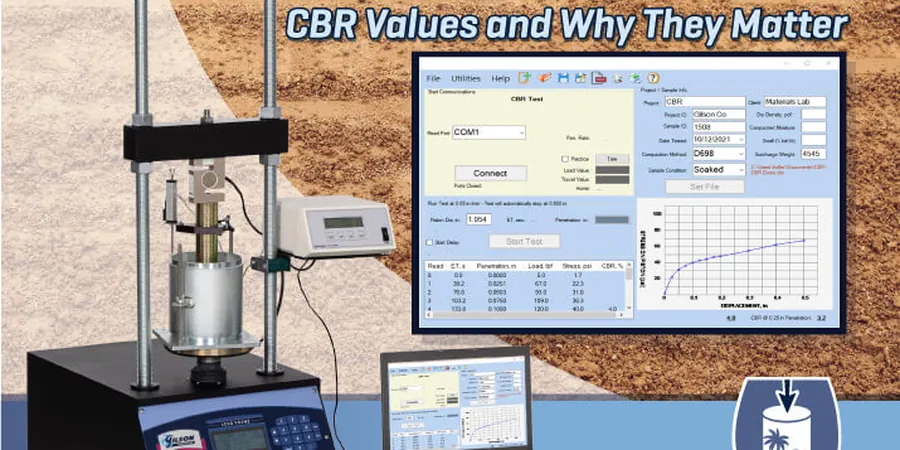
A soaked CBR below 3% in Albuquerque’s clayey soils usually triggers a full pavement redesign or subgrade stabilization.
Scope of work
- Soaked CBR values typically range from 2% to 15% depending on soil type.
- Unsoaked values can be double but are not used for design.
- We report CBR at 95% and 100% of maximum dry density.
Area-specific notes
Albuquerque sits at 5,312 feet elevation with less than 10 inches of annual rainfall. But when the monsoon hits in July, those dry soils turn into a problem. Clay-rich layers near the West Mesa expand when wet and lose bearing capacity quickly. A CBR study for road design done in May might show 12%. The same soil soaked for four days drops to 4%. That is the real condition during a wet season. We always run the soaked test because the dry value is misleading. Combine that with the frost heave potential in the North Valley and you get pavement failures within two years if the CBR is overestimated.
Standards used
ASTM D1883-21, AASHTO T-193, ASTM D698 (Standard Proctor), ASTM D4318 (Atterberg Limits)
Linked services
Soaked CBR Test
Standard four-day soaked test per ASTM D1883 for pavement design. We report values at 0.1 and 0.2 in penetration with the expansion record.
Unsoaked CBR Test
Quick turnaround test for quality control during compaction. Useful for comparing field density with lab values on the same day.
CBR with Swell Measurement
We monitor vertical expansion during soaking. Critical for expansive clays found in Albuquerque’s West Side. The swell percentage is reported with the CBR value.
Typical parameters
Common questions
What CBR value is minimum for road subgrade in Albuquerque?
Most city and county specifications in Albuquerque require a minimum soaked CBR of 5% for subgrade. Below that, you typically need a stabilized layer or geotextile reinforcement. For arterial roads with high traffic, 8% to 10% is common.
How much does a CBR study for road design cost in Albuquerque?
The typical range for a full CBR test including sample prep, compaction, soaking, and penetration is between US$170 and US$340 per test. Volume discounts apply for multiple samples from the same project.
How many CBR tests are needed for a 1-mile road project?
For a typical 1-mile collector road in Albuquerque, we recommend one CBR test per 500 feet of alignment, plus one per change in soil type. That gives 10 to 12 tests minimum. For major arterials with varied geology near the river or foothills, we increase to every 300 feet.