Many contractors in Albuquerque assume that a simple spread footing is enough for any project. That mistake costs time and money when the sandy loam and caliche layers settle unevenly or lose bearing capacity under load. A proper shallow foundation design in Albuquerque accounts for the varied soil conditions across the Rio Grande Valley and the West Mesa. Without site-specific data from ensayo SPT and Atterberg limits, you risk differential settlement that cracks slabs and damages superstructures. We combine local geological knowledge with standardized testing to deliver designs that match the actual ground conditions, not a textbook assumption.
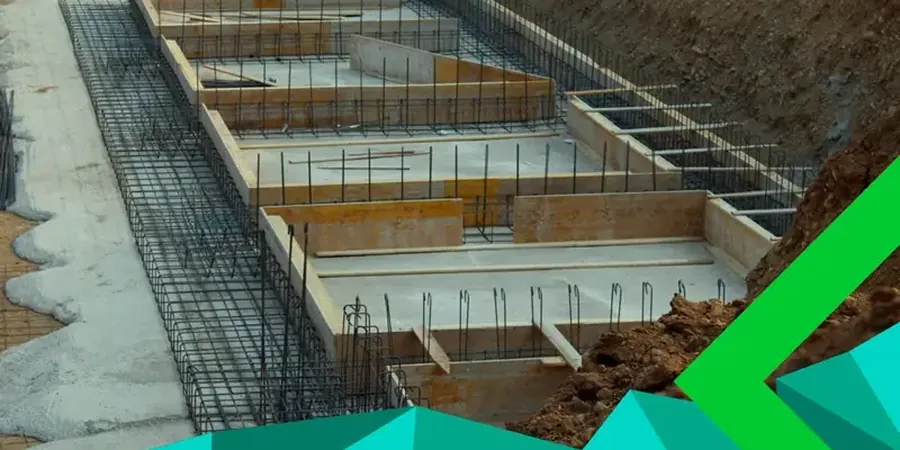
Albuquerque's deep water table favors shallow foundations, but loose surface sands demand rigorous compaction control and plate load verification.
Scope of work
Area-specific notes
Albuquerque grew rapidly after WWII, with subdivisions spreading onto the mesa tops and into the North Valley. Many older homes were built on shallow spread footings without soil testing. Today, those same soils are experiencing new loading from additions, pool excavations, and neighboring basement construction. The main risk in shallow foundation design in Albuquerque comes from the collapsible nature of dry sands: when wetted by irrigation or broken water lines, these soils can lose 50% or more of their bearing strength. That is why we always include a collapse potential test (ASTM D5333) for any residential or commercial project in the city.
Watch how it works
Standards used
IBC 2021 Section 1806 (Allowable Bearing Pressures), ASCE 7-22 (Seismic Loads and Site Class), ASTM D1586-18 (Standard Test Method for SPT), ASTM D5333-19 (Collapse Potential of Soils)
Linked services
Bearing Capacity Analysis
Using SPT data, plate load tests, and laboratory triaxial results, we determine the allowable bearing pressure for each soil layer. We follow IBC Table 1806.2 and adjust for groundwater, eccentric loads, and nearby excavations.
Settlement Prediction
We compute immediate and consolidation settlements using Schmertmann's method and the Hough method for granular soils. For mat foundations, we run finite element modeling to ensure total settlements stay below 1 inch and differential settlement below 1/2 inch.
Collapse Potential Evaluation
For dry sands typical of the West Mesa and South Valley, we perform single-oedometer collapse tests (ASTM D5333) at natural moisture and after wetting. We provide mitigation recommendations such as deep dynamic compaction or pre-wetting if the collapse potential exceeds 2%.
Typical parameters
Common questions
What is the typical bearing capacity for shallow foundations in Albuquerque?
For well-compacted sands and silty sands (SM, SP), allowable bearing capacities range from 2,000 to 5,000 psf. For cemented caliche layers, it can reach 8,000 psf. We always verify with SPT or plate load testing before finalizing the design.
Do I need a shallow foundation design if I'm building a small addition?
Yes. Even a small addition can cause differential settlement if the existing foundation is on collapsible soil. We have seen 3-inch cracks in brick veneer from un-wetted soil collapse. A quick SPT and collapse potential test is cheap compared to fixing a cracked slab.
How much does a shallow foundation design study cost in Albuquerque?
A typical residential shallow foundation design study including 2 SPT borings, lab testing, and a written report costs between US$1,800 and US$3,620. Commercial projects with larger footprints are on the higher end. Contact us for a free quote based on your specific lot size.
What is the difference between shallow and deep foundations in Albuquerque?
Shallow foundations (spread footings, mats) transfer loads to the top 10-15 feet of soil. Deep foundations (piles, drilled shafts) go deeper to bypass collapsible sands or reach firm strata. In Albuquerque, shallow works well where soils are dense or cemented, but deep foundations are needed for heavy structures or where loose fill exceeds 15 feet.