Albuquerque sits on a mix of alluvial sands and clayey silts from the Rio Grande Valley, with shallow groundwater often found between 3 and 8 meters depth. For MSE wall design, the retained and reinforced soil zones demand precise classification and shear strength data. We routinely run direct shear and triaxial tests on backfill materials to define internal friction angles. In addition, we check gradation through granulometria to meet the FHWA's gradation bands for reinforced fill. Without that data, the wall's long-term performance against lateral earth pressures becomes guesswork. Our lab follows ASTM D3080 and D4767 to deliver values the design engineer can trust for each lift.
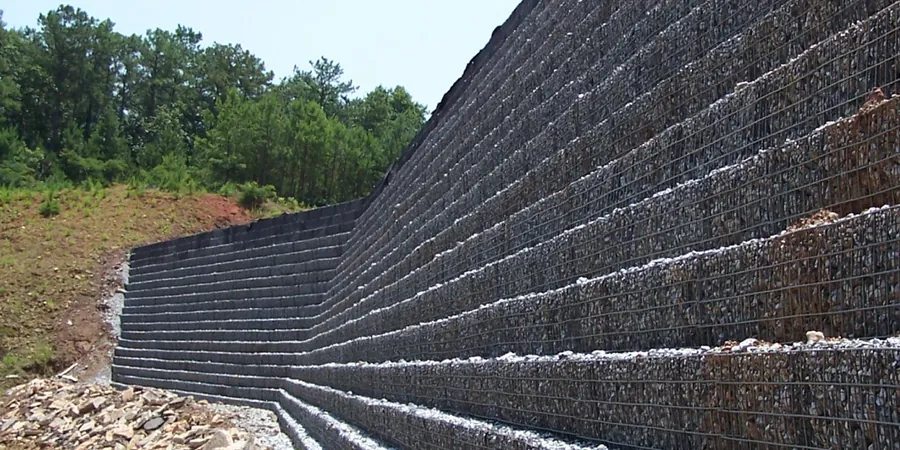
In Albuquerque, fines content above 15 percent in MSE backfill often leads to drainage failure and reduced pullout capacity of the reinforcement layers.
Scope of work
Area-specific notes
ASCE 7-16 requires MSE walls in Albuquerque to consider seismic earth pressures because the city falls in Seismic Design Category C. The peak ground acceleration can reach 0.3g, which nearly doubles the static lateral load on the wall. If the backfill isn't properly compacted or the reinforcement length is too short, the wall can tilt or face sliding during a moderate earthquake. We have seen cases where ignoring the seismic increment led to tension cracks behind the wall face within two years of construction. Our lab measures cyclic direct shear to characterize the interface friction between soil and geogrid under dynamic loading, giving the designer a realistic value for seismic stability checks.
Standards used
ASTM D3080 (Direct shear test for friction angle), ASTM D2487 (Unified Soil Classification System), FHWA-NHI-10-024 (MSE wall design guidelines), ASCE 7-16 (Seismic load requirements)
Linked services
Backfill Characterization
Gradation, fines content, Atterberg limits, and modified Proctor compaction to verify the fill meets FHWA gradation bands and compaction requirements.
Reinforcement Pullout Testing
Laboratory pullout tests on geogrid or steel strips embedded in the proposed backfill to determine the coefficient of interaction and ultimate pullout resistance.
Seismic Interface Shear
Cyclic direct shear tests on soil-geosynthetic interfaces under simulated earthquake loading, delivering the friction angle and adhesion for dynamic stability analyses.
Typical parameters
Common questions
What soil types in Albuquerque are suitable for MSE wall backfill?
Granular soils classified as GW, GP, SW, or SP per ASTM D2487 work best. The fines content must stay below 15 percent to ensure adequate drainage and pullout capacity. Silty sands and low-plasticity clays are sometimes accepted if drainage layers are added, but we always recommend testing first.
How does seismic design affect MSE wall dimensions in Albuquerque?
Seismic loads increase the required reinforcement length by 20 to 40 percent compared to static conditions. For a 20-foot wall, that often means extending the geogrid from 14 feet to 18 or 20 feet behind the face. Our cyclic direct shear tests provide the interface friction values needed for that calculation.
What is the typical cost range for MSE wall design testing in Albuquerque?
Between US$1.350 and US$4.950 depending on the number of tests required. A standard package includes gradation, Proctor, direct shear, and one pullout test. Larger walls or projects requiring seismic interface testing fall at the higher end of that range.