Albuquerque’s urban expansion, particularly along the Rio Grande valley and into the West Mesa, has placed increasing demand on infrastructure that must contend with a challenging mix of alluvial, aeolian, and collapsible soils. The city’s history of rapid development in the mid-20th century often outpaced thorough ground investigation—many older embankments now show signs of differential settlement or slope distress. Modern road embankment design in this setting requires a clear understanding of how these soils will behave under both static and dynamic loading. We combine field exploration with lab testing to define compaction targets and drainage requirements before any fill is placed, and we frequently complement this work with evaluation of pavement support to ensure the entire road structure performs as a system from subgrade up.
In Albuquerque’s arid soils, achieving optimum moisture content often requires active water addition—dry compaction alone leads to high post-construction collapse.
Scope of work
Area-specific notes
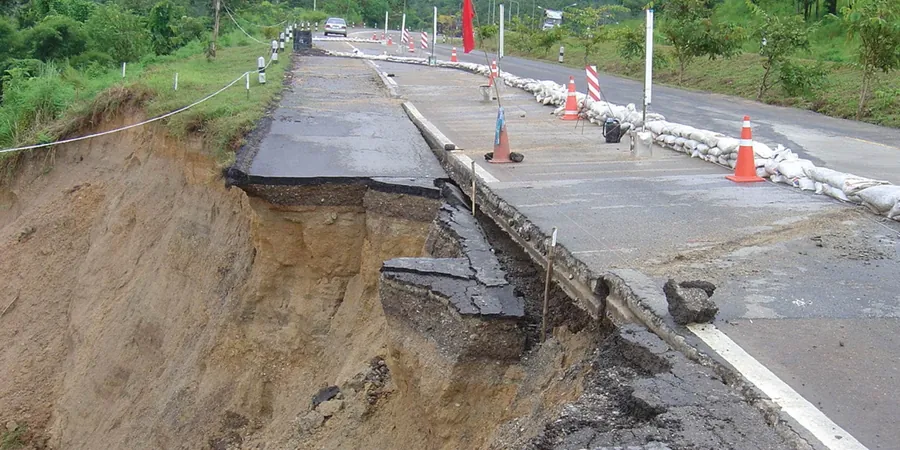
In Albuquerque, many times we see that embankment failures are not caused by weak soils alone but by inadequate drainage control. The city’s intense monsoon-season storms can saturate a well-compacted fill in hours, reducing effective stress and triggering shallow slides. Another local issue is the presence of buried paleochannels—old river courses filled with loose sand and gravel—that are not visible at the surface but cause sudden differential settlement when loaded. Our site investigation always includes a review of historical aerial imagery and, where needed, resistivity surveys to map these hidden features. Ignoring these risks during the design phase leads to costly remediation after construction.
Standards used
IBC 2021 (Chapter 18 – Soils and Foundations), ASCE 7-22 (Seismic Loads – Site Class determination), AASHTO LRFD Bridge Design Specifications (Section 11 – Abutments and Retaining Walls), ASTM D698 (Standard Proctor compaction), ASTM D2487 (Unified Soil Classification System)
Linked services
Subsurface Investigation & Lab Testing
Boreholes, test pits, and SPT per ASTM D1586 to characterize soil strata; laboratory compaction, shear strength, and collapse testing to define design parameters for embankment fills.
Slope Stability & Settlement Analysis
2D limit-equilibrium slope stability modeling (Bishop, Spencer) under static and seismic conditions; one-dimensional consolidation and collapse settlement estimates using site-specific soil data.
Typical parameters
Common questions
How does the arid climate in Albuquerque affect embankment compaction?
The natural moisture content of surface soils in Albuquerque is often below optimum for Standard Proctor compaction. This means water must be added during placement to reach the target density—otherwise the fill remains dry, loose, and prone to collapse when wetted later. We monitor moisture closely with nuclear gauges and adjust the water application rate based on real-time field tests.
What is the typical cost range for a road embankment design study in Albuquerque?
For a standard highway fill project, including subsurface investigation, lab testing, and geotechnical report, the cost typically ranges between US$1.100 and US$4.170. The variation depends on the number of borings, depth of exploration, and the complexity of slope stability analyses required. We recommend contacting us for a scope-specific estimate.
Which soil types most commonly require stabilization before embankment construction here?
Collapsible sands (SP/SM with low fines) and expansive clays (CH) from the Rio Grande floodplain are the most problematic. Collapsible sands lose volume when wetted, while expansive clays heave with moisture changes. Stabilization with lime (for clays) or cement (for sands) is often specified, and we can design the mix based on unconfined compressive strength targets.
Is seismic slope stability a major concern for Albuquerque embankments?
Yes, because Albuquerque sits in a moderate seismic zone (peak ground acceleration 0.2–0.3 g per ASCE 7-22). Embankments on soft alluvial soils or near the Sandia fault zone require pseudo-static slope stability analysis with a horizontal coefficient kh = 0.1–0.2. We also evaluate liquefaction potential of saturated sands in the valley floor using NCEER (Youd-Idriss 2001) criteria.