Albuquerque sits at 5,312 feet above sea level on the southern edge of the Colorado Plateau, and its subsurface is a mixture of Rio Grande alluvium and basin-fill deposits. For structures here, a properly sized raft foundation spreads column loads across a wide footprint, reducing contact pressure to roughly 50–80 kPa on typical sand strata. We combine borehole data with cone penetrometer readings to calibrate the modulus of subgrade reaction for each site. Before pouring, we also run a plate load test to verify bearing capacity and a permeability test to check drainage below the slab — both critical for long-term performance.
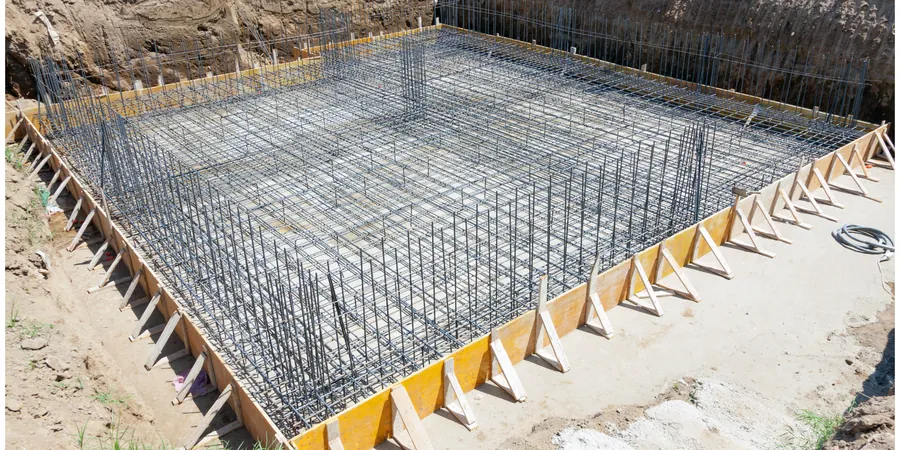
Raft foundation design in Albuquerque must account for the city's site class C and D soils, where modulus values can vary 40% within 10 meters.
Scope of work
Area-specific notes
We use a 20-ton hydraulic excavator with a 1.2-m-wide bucket to dig test pits down to 4.5 m across the building footprint. In Albuquerque, that means cutting through cemented caliche layers that can fool a driller into thinking bedrock is shallow. If the slab is designed without recognizing caliche's brittle collapse behavior, post-construction cracking can exceed 8 mm within two years. We map these zones with continuous SPT profiles and adjust the raft's edge thickness to span across the discontinuities.
Watch how it works
Standards used
ASCE 7-22 (seismic loads and site class), IBC 2021 (Chapter 18 – foundations), ASTM D1194-94 (bearing capacity of soil), ASTM D1586-18 (SPT)
Linked services
Site investigation and soil profiling
Boreholes to 15 m with SPT, undisturbed sampling, and laboratory testing for strength and consolidation parameters.
Finite element raft analysis
3D modeling of slab-soil interaction using SAFE or PLAXIS 3D, accounting for variable subgrade modulus across the site.
Settlement and tilt verification
Prediction of immediate and long-term settlements under service loads, including differential movement between adjacent columns.
Typical parameters
Common questions
What is the difference between a raft foundation and a spread footing for Albuquerque soils?
A raft foundation distributes loads over the entire footprint, which suits the city's loose to medium-dense sands where individual footings might cause differential settlement. Spread footings work well on competent strata, but in many Albuquerque lots the upper 3 m have variable density — a raft provides a stiffer, more uniform support.
How does the seismic site class affect raft design in Albuquerque?
Albuquerque falls mostly into site class C (very dense soil) or D (stiff soil) per ASCE 7. The raft must be designed with a higher seismic coefficient for class D, which increases base shear by about 20% compared to class C. We run site-specific response analyses using measured vs30/" data-interlink="1">shear wave velocities to refine the design spectrum.
What soil parameters are most critical for raft foundation design?
The modulus of subgrade reaction (k-value) and the cohesion for undrained conditions are key. In Albuquerque's alluvial sands, the k-value typically ranges from 15 to 40 MN/m³, but it can drop below 10 MN/m³ near old river channels. We calibrate k using plate load tests and back-analysis of local settlement records.
How much does a raft foundation design study cost in Albuquerque?
A complete study including site investigation, laboratory testing, and structural design typically ranges between US$1,070 and US$4,360, depending on the number of borings, laboratory tests, and the complexity of the finite element model. Contact us for a detailed quote based on your project scope.