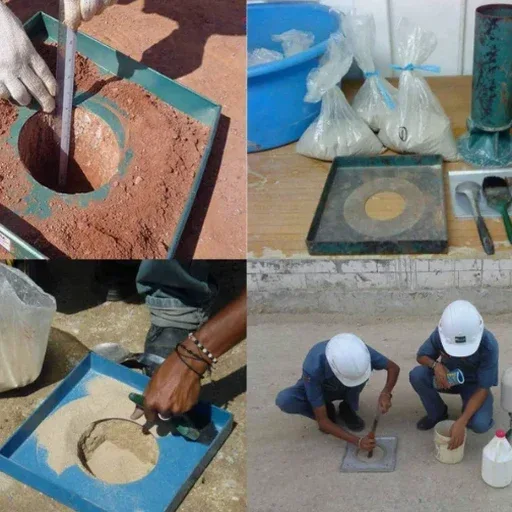
Albuquerque’s expansion east of the Rio Grande and into the Sandia foothills brought a mix of alluvial deposits and engineered fill that demands tight compaction control. The field density test with the sand cone method gives us a direct, reliable measurement of in-place density on pads, utility trenches, and roadway subgrades. In a city where summer monsoons can saturate the upper colluvium and winter freezes cycle through the valley floor, verifying compaction before covering lifts is not optional. We run the procedure per ASTM D1556 on site, coupling it with Proctor tests to establish the reference maximum dry density, and with grain-size analysis when fill material changes between borrow sources. Whether your project sits on the West Mesa’s sandy loess or the decomposed granite of the foothills, the sand cone delivers results that inspectors and geotechnical engineers can depend on.
A sand cone test gives you the number that proves your compaction effort, right at the lift surface, before the next layer hides it.
Process and scope
Area-specific notes
IBC Chapter 18 requires soil compaction verification for structural fill, and Albuquerque’s building officials enforce it strictly on commercial and residential foundations. The biggest risk we see is skipping density checks on deep utility trenches in the valley—when sandy alluvium settles after backfill, it pulls away from pavement layers and creates linear depressions along roads. Another local failure mode is differential settlement between cut and fill zones on sloping lots in the Northeast Heights. A sand cone test on every lift, combined with moisture control and proper Proctor reference, prevents these problems before the concrete goes in. If the contractor changes fill material mid-project, we re-run the Proctor and adjust the compaction target. Without that loop, density readings become meaningless and the engineer loses the basis for acceptance.
Relevant standards
ASTM D1556: Standard Test Method for Density of Soil in Place by the Sand-Cone Method, ASTM D698: Standard Test Methods for Laboratory Compaction Characteristics of Soil Using Standard Effort, IBC Chapter 18: Soils and Foundations
Linked services
Sand Cone Density Testing
In-place density measurement per ASTM D1556 on any compacted lift: building pads, road subgrade, pipe bedding, and MSE wall backfill.
Proctor Compaction Testing
Standard and modified Proctor tests (ASTM D698 / D1557) to establish the moisture-density relationship for your fill material before field testing begins.
Compaction Inspection & Reporting
Complete field logs with GPS coordinates, lift numbers, wet and dry densities, moisture content, and percent compaction for submittal to the geotechnical engineer.
Typical parameters
Common questions
How much does a field density test using the sand cone method cost in Albuquerque?
A single sand cone density test typically ranges from US$90 to US$140, depending on site location within the Albuquerque metro area and the number of tests per mobilization. Projects requiring multiple lifts or several test pads benefit from reduced per-test rates.
How does the sand cone test compare to a nuclear gauge for compaction testing?
The sand cone method is a direct volume measurement and does not require a radioactive source license. It works well in Albuquerque's dry granular soils. Nuclear gauges are faster but need frequent calibration and operator certification. Many local agencies still prefer the sand cone for acceptance testing on public works.
When should field density tests be performed during construction?
We test each compacted lift before the next layer is placed. For structural fill under foundations, the frequency is usually one test per 2,500 square feet per lift, or as specified by the geotechnical engineer. Utility trenches require tests every 50 linear feet at minimum.
What are the limitations of the sand cone method?
The test is not suitable for soils with large gravel or rock fragments that prevent a clean excavation. It also requires dry conditions—the calibrated sand must flow freely. In saturated soils or deep lifts, we may recommend alternative methods or combine the sand cone with verification at deeper levels.