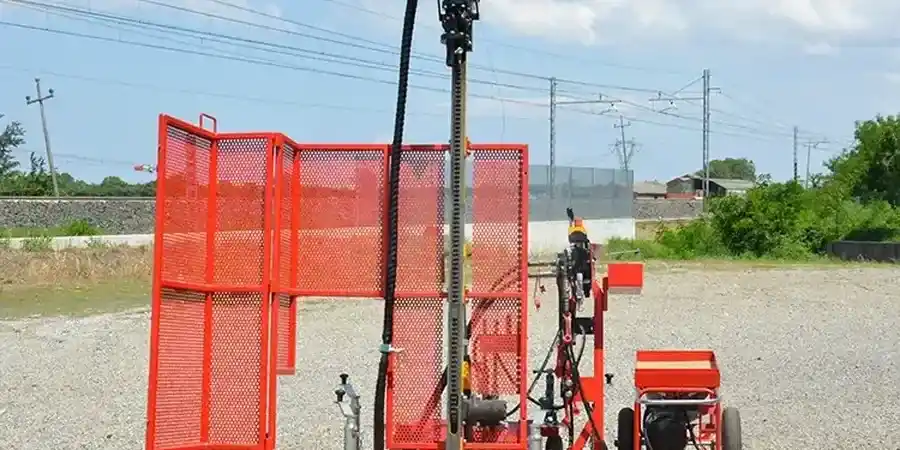
A crew drilling near the Sandia foothills hit refusal at 15 feet last month. The site was on a 20-foot alluvial fan deposit overlying decomposed granite. Without an SPT to quantify that transition, the foundation design would have been a guess. We run the standard penetration test in Albuquerque every day because the soil profile here changes drastically over short distances. The split-spoon sampler is driven 18 inches into the borehole, and we record the blows per 6-inch increment. The N-value from the middle 12 inches tells the engineer exactly what they are dealing with. We cross-check field data with the grain-size analysis from the recovered sample to confirm the soil classification, because the Rio Grande basin mixes clays, silts, and sands in ways that can fool a visual inspection. That combined approach gives structural engineers the parameters they need for bearing capacity and settlement calculations under the IBC framework.
An SPT N-value without an energy correction is just a number. In Albuquerque's variable alluvium, the corrected N60 is what keeps foundations from settling differentially.
Process and scope
Area-specific notes
Albuquerque's expansion since the 1960s pushed development from the well-drained East Mesa onto the more problematic West Mesa and valley floor sediments. Old neighborhoods near Old Town sit on compacted river deposits that give decent blow counts, but subdivisions built on former agricultural land west of the river often float on loose silty sands with N-values below 10 in the upper 15 feet. Those soils liquefied during distant earthquakes in the past, and the New Mexico Bureau of Geology has mapped liquefaction susceptibility along the Rio Grande corridor. Skipping an SPT investigation on those sites means you are blind to a known hazard. The test also reveals collapsible soils: fine wind-blown silts that lose strength when wetted, a condition that has caused floor slab failures in several Southwest Albuquerque commercial buildings. A boring log with SPT data every 5 feet is the minimum defense against these local ground problems.
Relevant standards
ASTM D1586-18 Standard Test Method for Standard Penetration Test (SPT) and Split-Barrel Sampling of Soils, ASTM D2487-17 Standard Practice for Classification of Soils for Engineering Purposes (Unified Soil Classification System), IBC 2021 Section 1803 Geotechnical Investigations, ASCE 7-22 Chapter 20 Site Classification Procedure for Seismic Design
Linked services
Standard SPT with Mud Rotary Drilling
Full SPT sampling at 5-foot intervals using mud rotary methods to stabilize the hole through the sandy and gravelly layers common in the Rio Grande Valley. Includes field logging by an experienced technician.
Energy-Calibrated SPT (N60)
Every blow count is corrected for hammer energy ratio using instrumented rod measurements. We provide the raw N-value and the N60 side by side on the boring log.
Combined SPT and Soil Sampling
Recovered split-spoon samples are sealed, transported to our lab, and subjected to moisture content, Atterberg limits, and sieve analysis. A single trip gives you both in-situ and lab data.
Liquefaction Screening Package
Using SPT blow counts corrected for fines content and overburden, we run a Seed-Idriss simplified procedure analysis to flag liquefiable layers per the NCEER workshop recommendations.
Typical parameters
Common questions
How much does an SPT boring cost in Albuquerque?
For a standard SPT boring to 30 feet with sampling every 5 feet, budget between US$550 and US$860 per boring. The final figure depends on access conditions, rig mobilization distance across town, and whether we need to core through caliche or basalt stringers.
How deep do you typically drill for SPT in Albuquerque?
It depends on the structure. For a single-family home on a spread footing, 15 to 20 feet is common. For a commercial building with a basement, we often go to 40 or 50 feet. We drill until we hit competent bearing material or refusal on bedrock, whichever comes first.
How long does an SPT field investigation take?
A single boring to 30 feet in the sandy soils of the valley floor usually takes half a day. If we hit thick caliche layers near the West Mesa or need to core rock near the foothills, it may stretch to a full day per hole.
What makes Albuquerque soils different for SPT testing?
The Rio Grande Rift geology means we encounter interbedded sands, silts, gravels, and occasional cemented caliche in a single borehole. The N-values can jump from single digits in a loose sand to refusal in a caliche crust within two feet. That variability makes the 5-foot sampling interval critical here.