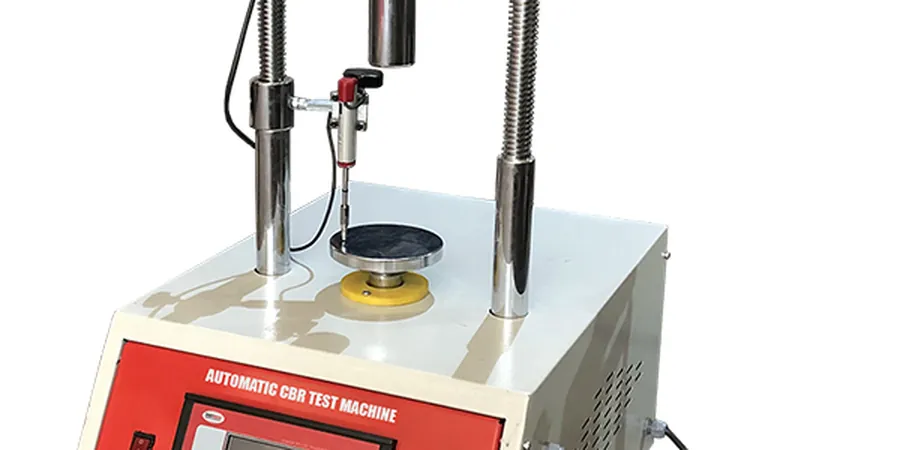
Albuquerque's growth from a railroad water stop into a sprawling high-desert metro put real stress on its pavement infrastructure. The city sits on a mix of young alluvial fans, windblown sand, and ancient Rio Grande deposits that behave very differently under traffic loads. When I-40 was widened through the East Gateway, the design team had to reconcile CBR values from the sandy West Mesa with the silty clays near the river. We run the CBR test for road design in our soil mechanics lab under controlled moisture and density conditions, so the final pavement section reflects what that subgrade will do after years of service, not just on the day it was compacted. That distinction matters a lot in a semi-arid climate where subgrade moisture can shift with irrigation and monsoon cycles.
A soaked CBR value tells you more about pavement performance than any compaction curve: it reveals what the subgrade becomes when the irrigation system leaks or the monsoon arrives.
Process and scope
Area-specific notes
The Rio Grande rift defines Albuquerque's subsurface: deep unconsolidated basin fill with interbedded sands, silts, and clays that can change every few hundred feet. Water table depth varies from less than 10 feet near the river to over 200 feet on the Northeast Heights, which means the same CBR value carries different risk depending on where you build. In the South Valley, we have seen subgrades that compact beautifully at optimum moisture but turn to jelly after a single irrigation line break. The soaked CBR protocol catches that failure mode before the asphalt goes down, but only if the geotechnical report specifies the correct surcharge and compaction energy. Skipping the soak or using a standard Proctor when the spec calls for modified can overstate the bearing capacity by a factor of two or more, and that mistake costs millions in premature rutting and fatigue cracking on arterial roads like Central Avenue or Tramway Boulevard.
Relevant standards
ASTM D1883-21: Standard Test Method for California Bearing Ratio (CBR) of Laboratory-Compacted Soils, ASTM D1557-12(2021): Standard Test Methods for Laboratory Compaction Characteristics of Soil Using Modified Effort, ASTM D698-12(2021): Standard Test Methods for Laboratory Compaction Characteristics of Soil Using Standard Effort, AASHTO T 193: Standard Method of Test for The California Bearing Ratio
Linked services
Soaked and Unsoaked CBR Determination
We prepare specimens at three compaction efforts and test both as-compacted and after 96-hour soaking, giving designers the worst-case subgrade strength for flexible and rigid pavement thickness calculations.
Subgrade Resilient Modulus Correlation
For AASHTOWare pavement ME design, we provide empirical correlations from CBR to Mᵣ using the NCHRP 1-37A model calibrated for typical New Mexico basin-fill materials.
Compaction Quality Control Package
Combined Proctor and CBR testing on the same borrow source material so the field density spec and the pavement design share a single reference curve, avoiding the mismatch we often see when two labs run the tests independently.
Typical parameters
Common questions
How much does a laboratory CBR test cost in Albuquerque?
For a single-point CBR test with the corresponding Proctor compaction curve and moisture-density relationship, budget between US$110 and US$230 per specimen. The range depends on whether you need standard or modified Proctor energy and whether we test at one, two, or three compaction points. A full three-point soaked series for pavement design typically runs toward the upper end.
Why does Albuquerque DOT require a soaked CBR instead of unsoaked?
The semi-arid climate masks the real risk: subgrade moisture increases over time from irrigation, utility trench backfill acting as a French drain, and seasonal monsoon infiltration. A soaked CBR simulates the equilibrium moisture condition the subgrade will reach after several years in service, which is almost always wetter than the as-built condition.
How many CBR specimens do I need for a typical commercial project?
It depends on the site variability. For a uniform site underlain by a single soil type, three specimens compacted at different moisture contents (usually two points below optimum and one above) give a reliable CBR-moisture relationship. If you are dealing with the interbedded sands and clays common in the North Valley or across the West Mesa, budget for at least two sets of three specimens, one per distinct material unit.
What penetration depth do you read the CBR value from?
We report both the 0.1-inch and 0.2-inch penetration values per ASTM D1883. If the 0.2-inch CBR exceeds the 0.1-inch value, which sometimes happens with granular soils that densify under the plunger, the standard requires us to repeat the test. The reported design CBR is typically the 0.1-inch value unless the 0.2-inch reading is higher and the repeat confirms it.