Albuquerque sits on the deep alluvial fill of the Rio Grande rift, with surface deposits dominated by coarse sands, silty sands, and occasional gravel lenses from ancestral river channels and arroyo fans. Many sites across the metro area—from the Sandia foothills to the West Mesa—encounter interbedded layers where grain size distribution shifts dramatically within a few vertical feet. These transitions directly affect permeability, compaction, and foundation design, making accurate particle size analysis essential before any geotechnical recommendation. Our laboratory runs full sieve and hydrometer testing under ASTM D6913 and D7928 to produce the gradation curves that engineers need for USCS classification, drainage assessment, and material suitability studies. In a city where soil liquefaction potential must be evaluated for deeper sandy units and Atterberg limits are often required alongside gradation data for fine-grained layers, a reliable grain size analysis is the starting point for every defensible geotechnical report.
Good gradation data does more than name a soil—it predicts how water, load, and vibration will interact with the formation over time.
Process and scope
Area-specific notes
ASCE 7 and the Albuquerque Building Code require soil classification per ASTM D2487 for seismic site class determination and foundation design. When grain size analysis is skipped or performed on non-representative samples, silty layers can be mistaken for clean sand, leading to overestimated bearing capacity and underpredicted settlement—particularly dangerous in the Rio Grande basin where loose, saturated sands are susceptible to static and seismic deformation. The 2022 update to ASTM D7928 introduced tighter precision limits for the hydrometer portion, reducing the risk of misclassifying low-plasticity silts as clays. In our experience, the most costly mistakes in Albuquerque stem from assuming uniform gradation across a site; a single gravel lens or clay seam missed in sampling can shift the effective friction angle by several degrees, invalidating slope stability assumptions and requiring costly redesign.
Relevant standards
ASTM D6913-22, ASTM D7928-21e1, ASTM D2487-17e1, IBC 2021 Chapter 18, ASCE 7-22
Linked services
Full Sieve + Hydrometer Suite
Complete mechanical sieve analysis from 3 inches to No. 200 plus hydrometer sedimentation, yielding a continuous gradation curve and full USCS classification with group symbol and description.
Wash Sieve for Clean Sands
For select fill verification and concrete aggregate assessment, we run wash sieving per ASTM C117 to determine fines content below the No. 200 sieve, often paired with sand equivalent testing.
Hydrometer-Only for Fine Soils
When borehole logs show predominantly silt and clay, we perform hydrometer analysis with specific gravity determination to define the clay-size fraction controlling drainage and shrink-swell potential.
Combined Package with Atterberg Limits
A cost-effective option for residential and light commercial projects: grain size distribution plus liquid limit and plastic limit, providing the full plasticity-gradation picture for foundation design.
Typical parameters
Common questions
How much does a grain size analysis cost in Albuquerque?
For a standard sieve plus hydrometer suite, the cost typically ranges from US$100 to US$190, depending on the number of samples and whether Atterberg limits or specific gravity are added to the request.
What is the difference between sieve analysis and hydrometer analysis?
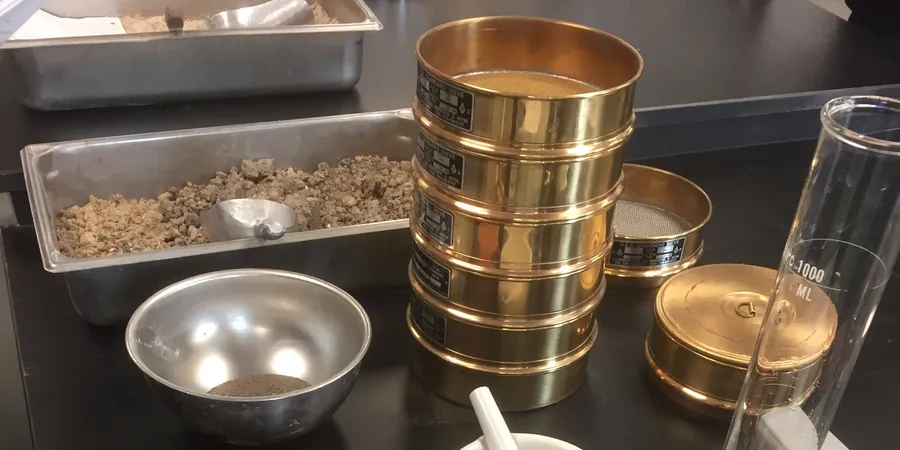
Sieve analysis separates particles larger than 75 µm using a stack of mechanical sieves, while hydrometer analysis measures the settlement rate of particles smaller than 75 µm in a liquid suspension, capturing the silt and clay fractions that sieves cannot differentiate.
How long does a grain size test take in the lab?
A complete sieve and hydrometer analysis usually requires three to five working days, because the hydrometer portion involves timed readings over a 24-hour sedimentation period as specified in ASTM D7928.
Why is grain size analysis important for Albuquerque's arroyo soils?
Arroyo deposits in Albuquerque often contain a mix of coarse sand, gravel, and dispersed silt that can look clean but have enough fines to hold water and reduce friction. Without a full gradation curve, engineers risk misclassifying these soils and underestimating drainage problems or settlement potential.