Albuquerque sits at roughly 5,300 feet elevation, wedged between the Rio Grande and the Sandia Mountains. That geography creates unstable ground conditions across the metro area. The 2021 monsoon season triggered over 15 slope failures along the I-40 corridor and Tramway Boulevard alone. Every cut slope in the Northeast Heights tells a story of erosion, fractured granite, or colluvium sitting on bedrock. A slope stability analysis quantifies that story. It measures the factor of safety against sliding, rotational failure, or debris flow. We run the numbers with SLOPE/W and FLAC to model your specific site conditions. The output determines if retaining walls, soil nails, or drainage controls are needed before construction moves forward. Our team correlates field data from test pits with lab shear strength results to calibrate the model. No assumptions. Just measured parameters and a clear go/no-go recommendation.
A slope that looks stable in January can fail in August after six weeks of monsoon saturation. Factor of safety changes with moisture content.
Process and scope
Area-specific notes
The Santa Fe Group sediments underlying much of Albuquerque contain interbedded silts and clays that lose shear strength when wet. Combine that with a 0.25g design earthquake, and slopes that have stood for decades can liquefy at the toe and fail retrogressively. We have seen this pattern in the foothills south of Montgomery Boulevard. The risk compounds when homeowners cut into natural slopes to build patios or access roads without engineered reinforcement. A single storm can erode the toe and trigger a translational slide that moves several feet overnight. Our analysis identifies these failure surfaces before construction disturbs the equilibrium. We map the critical slip circle with the lowest factor of safety and design the countermeasure, whether that means a gravity wall at the toe, a row of drilled shafts, or a subsurface drain to depress the phreatic surface. In wildfire burn scars on the east side, debris flow potential adds another layer of analysis using the USGS debris-flow likelihood model.
Relevant standards
ASCE 7-22 Minimum Design Loads and Associated Criteria for Buildings and Other Structures, IBC 2021 Chapter 18 Soils and Foundations, ASTM D1586-18 Standard Test Method for Standard Penetration Test (SPT), ASTM D2487-17 Standard Practice for Classification of Soils for Engineering Purposes, FHWA-NHI-05-123 Soil Slope and Embankment Design
Linked services
Limit Equilibrium Analysis & Mitigation Design
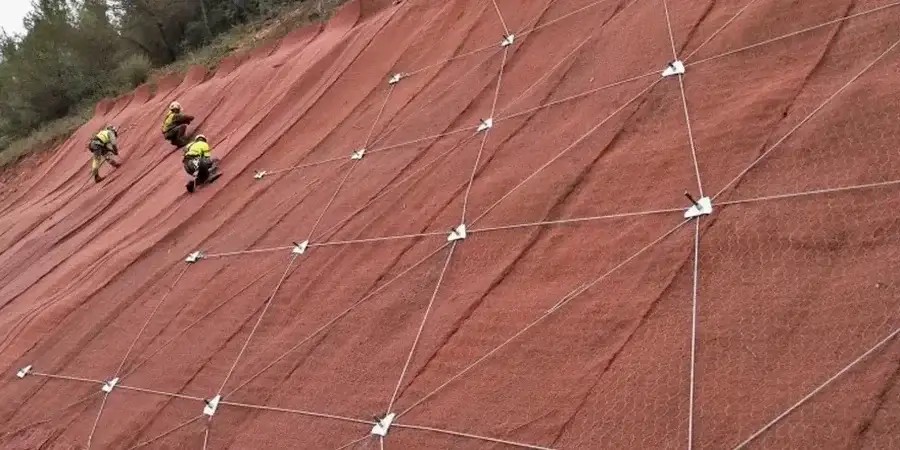
We model your slope in SLOPE/W and FLAC using site-specific shear strength data. The deliverable is a stamped report with critical failure surfaces, factor of safety for static and seismic cases, and a mitigation plan: retaining walls, soil nails, drainage, or regrading. Ready for city permit submittal.
Post-Failure Investigation & Remediation
If your slope has already moved, we map the scarp, install inclinometers to track displacement rate, and sample the failure plane. The analysis back-calculates the shear strength at failure so the repair design targets the right parameters. We stabilize first, then rebuild.
Typical parameters
Common questions
How much does a slope stability analysis typically cost in Albuquerque?
For a standard residential or commercial slope in the Albuquerque area, the analysis and report normally run between US$1,440 and US$4,140. The range depends on slope height, access for drilling equipment, and whether we need rock mechanics testing versus standard soil shear tests.
What triggers a slope stability review under the Albuquerque building code?
IBC Chapter 18 and the city grading ordinance require a stability analysis for any cut or fill slope steeper than 2H:1V and taller than 10 feet, or any slope on a mapped landslide hazard area. The city plan reviewer will flag it during permit intake if the site is in the Hillside Development Zone.
How long does the analysis take from start to finish?
Fieldwork and sampling take one to three days depending on access. Lab shear testing runs two to four weeks. Once we have the strength parameters, the computational modeling and report writing take another two weeks. The full process averages five to seven weeks.
Can you analyze a slope that has already started cracking?
Yes. We treat active failures as urgent. We deploy inclinometers immediately to measure the slip rate and depth. We back-analyze the failure to determine the residual shear strength. That data feeds a stabilization design on an accelerated schedule, often delivering repair drawings within three weeks.